
Employee AI Data Leaking is Accidentally Sharing Your Business Data Through AI Tools
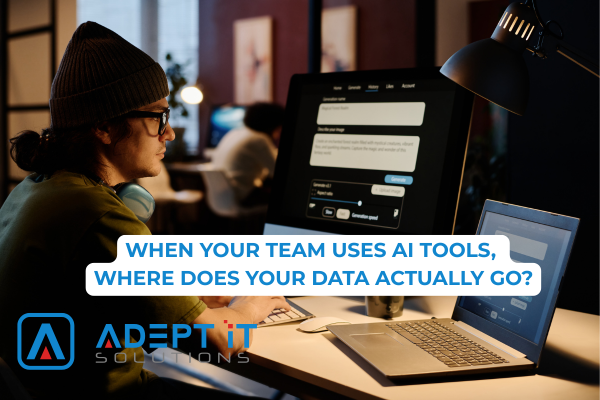
What is shadow AI and why is it a concern for businesses?
Shadow AI is all the rage at the moment. Most business owners are focused on the obvious cybersecurity threats; phishing emails, ransomware, dodgy links. What very few are thinking about is the risk sitting right inside their own team, not from bad intentions, but from good ones.
Your staff are using AI tools to do their jobs faster, and in doing so, they may be handing your most sensitive business information to a third-party server you have no control over.
Shadow AI and data breaches in small business one of the fastest-growing data risks facing small and medium businesses in Australia right now, and the vast majority have no policy, no visibility, and no protection in place.
The problem isn’t your people, it’s the gap in your systems allowing the AI data leakage
When an employee pastes a client proposal into ChatGPT to tighten up the language, or drops a spreadsheet of customer data into an AI tool to build a report faster, they are not being reckless. They are being resourceful. AI tools are genuinely useful, and your team is doing exactly what you’d want them to do, finding smarter ways to work.
The problem causing shadow AI challenges in small business is that most of the AI tools are being accessed through personal accounts, on personal devices, or through free-tier subscriptions that sit entirely outside your business’s security controls. The data goes in, and from that point, you have no idea where it goes or how it is stored, processed, or potentially used.
According to LayerX Security’s Enterprise AI and SaaS Data Security Report 2025, around 18 percent of enterprise employees regularly paste corporate data into AI tools. More than half of those paste events include sensitive company information — client records, internal financials, proprietary processes, or personally identifiable information.
In most cases, the employees involved had no idea they were creating a data exposure risk.
What actually happens to that data
This is where it gets important to understand the mechanics, without getting lost in the technical weeds.
When you or your team use a free or standard consumer version of an AI tool like ChatGPT, the data you enter is processed on OpenAI’s servers.
“Server” is a fancy word for infrastructure that sits outside your business entirely. Depending on the platform’s terms of service and the account type being used, that data may be stored, reviewed, or even used to train future AI models. Enterprise versions of these tools generally offer stronger privacy protections, but most small businesses are not using enterprise versions. They are using whatever their staff signed up for on their own.
In 2023, Samsung discovered this the hard way as per the article from tech radar. In three separate incidents, employees uploaded confidential semiconductor source code and internal meeting notes to ChatGPT while working through technical problems. None of them were acting maliciously. They were solving problems. The result was that proprietary information, the kind of data a company’s entire competitive position can rest on, left the building and landed on a third-party platform. Samsung’s response was an immediate internal ban on AI tools, a blunt solution that created its own set of productivity problems.
Then in 2025, a different kind of exposure made headlines. Nearly 100,000 ChatGPT conversations, including business strategy discussions, internal communications, and sensitive personal content, were discovered indexed in Google search results. The cause was a feature that allowed users to make their conversations publicly discoverable. Most users had no idea they had enabled it meaning that employees caused AI data leakage in small business by mistake. The conversations simply appeared in search results, visible to anyone.
These are not edge cases. They are early indicators of what happens when AI adoption outpaces governance.
The shadow AI problem in your business
The term “shadow AI” describes exactly this situation.
AI tools being used across a business without IT oversight, without policy, and without any visibility from the people responsible for keeping the business secure.
It is the AI equivalent of shadow IT, which organisations have been grappling with for years as employees bring their own devices and use personal cloud storage for work files.
The difference with AI is the volume and sensitivity of what gets shared. A file sitting in someone’s personal Dropbox is a problem. Business strategy, client data, pricing models, and legal documents being processed through an unmanaged AI platform is a much bigger one.
For businesses operating in industries with strict data obligations such as our clients in healthcare, legal, financial services, aged care, the compliance exposure is significant. Australia’s Privacy Act is currently undergoing its most substantial reforms in years, with stronger consent requirements, higher penalties, and increased accountability for how personal data is handled. If your business cannot demonstrate that you have controls over where client and employee data goes, you are exposed.
As we all know, Australian Regulations on employee use of generative AI tools, just like any changing technology landscape, the regulations and laws are struggling to keep up however if you are looking for a resource, www.cyber.gov has some helpful information.
How can small businesses protect customer data when using AI chat tools and How Adept IT Solutions Can Help?
Banning AI tools across your business is tempting as a quick solution, but it does not work. Your team will find workarounds, use personal devices, or simply become less productive while competitors who have figured out how to use AI safely pull ahead. The goal is not to block AI — it is to govern it.
First, your business needs an AI usage policy. This does not need to be a lengthy legal document and it is something that Adept IT Solutions works with their clients on as it is tailored to your business. It needs to clearly define which tools are approved for work use, what categories of information should never be entered into an AI platform, and what the process is for introducing new tools. Without this baseline, you are relying on each individual employee to make the right call every time, which is not a reasonable expectation when the risks are not explained. Employee AI data leakage in small business isn’t usually intentional, it’s a lack of understanding and education in this area.
Second, you need visibility.
A managed IT provider can help you understand which AI tools are actually being accessed across your network, through which accounts, and how frequently. You cannot manage what you cannot see which is what is causing employee AI data leakage and data breaches to be such a growing challenge.
Third, where possible, businesses should move toward approved enterprise or business versions of AI tools. These typically offer data processing agreements, stronger privacy controls, and contractual commitments about how your information is handled. The cost difference is often smaller than people expect, and the protection difference is significant.
Managing shadow AI risks and your next steps
None of this requires overhauling your entire IT environment overnight. Most businesses can make meaningful progress quickly by
– creating a policy document
– a staff conversation or education moment
– a review of which tools are in use across the team.

If you are reviewing your IT infrastructure and wondering where to start, the answer may already be sitting in your Microsoft subscription.
If your business runs Microsoft 365, you have access to an ecosystem specifically built to address the shadow AI problem. Microsoft Copilot for Business keeps AI interactions inside your own Microsoft environment — your data never leaves your tenant or lands on an external server. Microsoft Purview provides data loss prevention controls that can detect when sensitive information is being moved or shared outside approved channels. And Microsoft Intune gives your IT provider visibility over the devices and applications your team are using, so shadow AI stops being invisible.
The difference between a free consumer AI tool and a properly governed Microsoft business environment is not just technical — it is the difference between having no idea what your data is doing and having complete oversight. For businesses already paying for Microsoft 365, upgrading to the right licence tier or activating the right controls is often a much smaller step than people expect.
This is where a conversation with your IT provider is worth having. Adept IT works with businesses across Newcastle and the Hunter to assess what tools you already have, what you are not using, and what needs to be switched on to properly protect your business in an AI-first world.
If you are not sure where to start, it is worth sitting down with Adept IT and asking a simple question:
“Do we know what AI tools our team is using, and do we have any controls around how company data is shared through them?”
If the answer is no, or if you are not sure, contact us on 1300 423 378 or reach out via our contact page, before an incident forces it where it causes more bigger problems with your intellectual property.
AI is not going away, and your business is right to be exploring how to use it.
The businesses that get this right will use AI as a genuine competitive advantage.
The ones that do not will find out the hard way that productivity gains are not worth much if the data fuelling them ends up somewhere it should never have been.

