
The Canvas data breach Australian businesses are now grappling with has sent a sharp warning through the education, corporate, and public sectors alike. Canvas, the widely used learning management platform, stores sensitive personal and organisational data for thousands of Australian users. When a breach of this scale occurs, the consequences ripple well beyond the platform itself. Businesses, universities, and government agencies that rely on Canvas for training, compliance learning, or staff development must act immediately to understand their exposure and meet their legal obligations.
What Is the Canvas Data Breach and Who Is Affected in Australia?

Canvas is a cloud-based learning management system developed by Instructure, used extensively by Australian universities, TAFEs, corporate training departments, and government agencies. The breach involved unauthorised access to user data held within the platform, potentially exposing names, email addresses, login credentials, course enrolment details, and in some cases, organisational role information.
Australian organisations in Newcastle, the Hunter Region, Central Coast, Sydney, and across the country that use Canvas for staff onboarding, compliance training, or continuing education are potentially affected. The breach is particularly concerning for businesses that integrated Canvas with single sign-on (SSO) systems or connected it to broader corporate identity directories, as the exposure may extend beyond the platform itself.
According to the Verizon DBIR 2026, the education sector remains among the top five most breached industries globally, with third-party and supply chain vectors involved in a growing share of confirmed data disclosure incidents. This trend reinforces why no organisation can treat a third-party platform breach as someone else’s problem.
What Data Was Exposed and What Are the Risks for Australian Users?
The categories of data exposed in incidents like this typically include personally identifiable information (PII) such as full names, institutional email addresses, and phone numbers. For corporate users, this may extend to employee ID numbers, department structures, and access permissions tied to training platforms. In some configurations, password hashes or authentication tokens may also be at risk.
The downstream risks are significant. Exposed credentials can be used in credential stuffing attacks against corporate systems. Stolen PII enables targeted phishing campaigns, often crafted with enough detail to appear highly credible. Attackers who understand an employee’s role, training history, and organisational hierarchy can construct convincing spear-phishing messages that bypass standard user awareness.
For more on how sophisticated threats evolve after data exposure, our post on Advanced Persistent Threats covers how attackers use stolen data as a launchpad for long-term intrusions.
Your Legal Obligations Under the Privacy Act After a Third-Party Breach
Privacy Act compliance Australia obligations do not disappear simply because a breach originated with a third-party vendor. Under the Privacy Act 1988 and the Notifiable Data Breaches (NDB) scheme, Australian organisations remain responsible for personal information they collect and hold, even when that information is processed or stored by an external platform.
If your organisation shared employee or customer personal information with Canvas and that data has been compromised, you may have an obligation to notify the Office of the Australian Information Commissioner (OAIC) and the affected individuals. The NDB scheme requires notification when a data breach is likely to result in serious harm to any of the individuals whose information was involved.
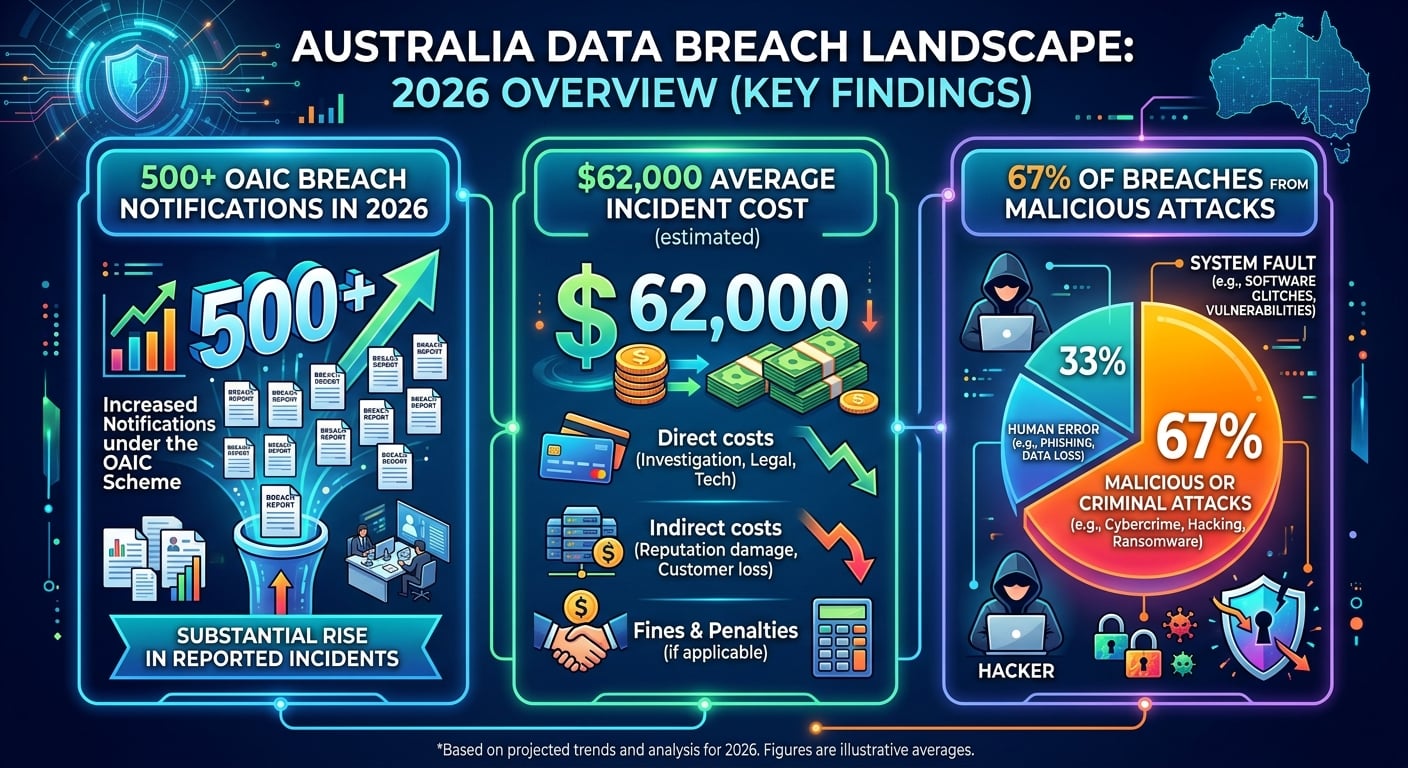
The stakes are real. According to the OAIC 2026, in the first half of the 2025-26 reporting period, the OAIC received over 500 data breach notifications under the NDB scheme, with malicious or criminal attacks accounting for approximately 67% of all reported breaches. Failing to notify when required can result in significant civil penalties under the Privacy Act.
You should also review your data processing agreements with third-party vendors to confirm notification obligations are clearly defined. If those agreements are ambiguous or absent, that is itself a compliance gap requiring urgent attention. The OAIC guidance on data breach response provides a clear framework for assessing whether notification is required.
Canvas Data Breach Australia: 5 Immediate Steps Businesses Must Take
Acting quickly after a third-party breach is critical. The following five steps outline the minimum actions Australian businesses should take right now.
1. Conduct an Immediate Data Inventory
Identify exactly what personal information your organisation shared with Canvas. This includes employee names, email addresses, roles, and any linked authentication credentials. Document who was enrolled, what data fields were populated, and whether any integrations connected Canvas to your internal identity systems or directories.
2. Reset Credentials and Review Access Tokens
Force a password reset for all affected users immediately. If your Canvas environment used SSO or OAuth tokens linked to Microsoft 365, Azure Active Directory, or Google Workspace, revoke and reissue those tokens. Review your identity and access management logs for any anomalous login activity in the weeks following the breach window.
3. Assess Your NDB Notification Obligations
Engage your legal counsel or privacy officer to assess whether the exposure triggers notification obligations under the NDB scheme. Document your assessment and reasoning. If notification is required, the OAIC must be notified as soon as practicable. Affected individuals must also be notified where serious harm is likely.
4. Alert Staff and Issue Phishing Warnings
Notify your team that their details may have been exposed and that targeted phishing attempts using this information are likely. Remind staff not to click unexpected links, verify sender identities before responding to unusual requests, and report suspicious emails immediately. Timely staff communication is a core pillar of effective IT incident management.
5. Engage Your Incident Response Provider
Activate your incident response plan if one is in place. If your organisation does not have a documented incident response plan or a managed security partner, this breach is the catalyst to establish one. The ASD/ACSC 2026 Annual Cyber Threat Report found that cybercrime costs Australian small businesses an average of over $49,000 per incident and medium businesses over $62,000 per incident. Having a managed incident response service dramatically reduces both response time and financial impact.
How to Assess Your Organisation’s Exposure to Third-Party Platform Breaches
Third-party risk is one of the fastest-growing attack surfaces for Australian organisations in 2026. Many businesses in Newcastle, Lake Macquarie, the Central Coast, and Sydney use dozens of cloud platforms without a formal vendor risk register. Each platform that holds personal information represents a potential liability under the Privacy Act, regardless of where the breach originates.
A comprehensive third-party risk assessment should include: a full inventory of all cloud platforms and SaaS tools in use; a review of the personal data shared with each vendor; an assessment of each vendor’s security certifications (such as ISO 27001 or SOC 2); a review of contractual data processing obligations; and a record of each vendor’s breach notification history.
Organisations pursuing alignment with the Australian Cyber Security Centre Essential Eight framework should note that application control, patching, and restricting administrative privileges all apply to third-party platform integrations, not just internal systems. Treating each external platform as a potential attack vector is the foundation of a mature security posture.
If your organisation is unsure where to begin, our guide on Zero Trust in cybersecurity explains how a zero-trust architecture reduces your exposure to exactly this type of supply chain and third-party breach scenario.
“Third-party and supply chain vectors were involved in a growing share of confirmed data disclosure incidents globally in 2026, reinforcing that vendor risk is no longer a secondary concern.” — Verizon DBIR 2026
How Adept IT Solutions Helps Australian Businesses Respond and Stay Protected

Adept IT Solutions provides incident response services for Australian businesses navigating data breaches, whether the breach originates internally or through a third-party platform. Our team works with organisations across Newcastle, the Hunter Region, Central Coast, and Sydney to contain incidents, assess data exposure, and meet notification obligations under the Privacy Act.
Our Cybersecurity Services include managed detection and response, identity protection, third-party risk assessments, and ongoing compliance support aligned to the Essential Eight and ISO 27001 frameworks. We also help businesses implement the technical controls needed to reduce the blast radius of any future third-party breach, including conditional access policies, privileged identity management, and endpoint detection.
For businesses that manage IT internally or rely on lightweight support arrangements, our post on Cybersecurity in 2026 outlines the threat landscape and the minimum controls every Australian business should have in place right now.
Data breach protection for business is no longer optional. The Canvas data breach Australia which organisations are responding to is a clear signal that any cloud platform your business uses is a potential liability. Proactive managed IT support, vendor risk governance, and a tested incident response plan are the difference between a contained incident and a business-critical crisis.
Book a free consultationFrequently Asked Questions
Q: What should Australian businesses do first after the Canvas data breach Australia incident?
A: The first step is to conduct an immediate data inventory to identify exactly what personal information your organisation shared with Canvas. From there, reset all affected credentials, assess your notification obligations under the Notifiable Data Breaches scheme, alert your staff to phishing risks, and engage a managed IT or incident response provider. Acting within the first 72 hours significantly reduces the risk of secondary incidents stemming from exposed credentials.
Q: Does the Privacy Act 1988 apply if the breach happened on a third-party platform like Canvas?
A: Yes. Under Australian Privacy Act compliance requirements, organisations remain responsible for personal information they collect, even when it is held or processed by a third-party vendor. If the exposed data relates to your employees or customers and is likely to result in serious harm, you may be required to notify both the OAIC and the affected individuals under the Notifiable Data Breaches scheme. Seek legal advice if you are unsure whether notification is required in your specific circumstances.
Q: How can managed IT providers help with data breach response?
A: A managed IT provider can assist with the full incident response lifecycle: containing the breach, assessing data exposure, implementing technical controls such as credential resets and access token revocation, and preparing breach notification documentation. Providers with cybersecurity expertise can also help businesses implement ongoing protections including identity management, endpoint detection, and third-party vendor risk assessments to prevent recurrence.
Q: How can businesses reduce their exposure to future third-party platform breaches?
A: Businesses can significantly reduce their exposure by maintaining a complete vendor inventory, reviewing what personal data is shared with each platform, enforcing strong data processing agreements, and implementing a zero-trust access model that limits the blast radius of any single breach. Aligning with the Essential Eight cybersecurity controls and conducting regular third-party risk assessments are both practical and highly effective measures for Australian organisations of any size.
Get in touch with our team of IT experts today! You can contact us via phone at 1300 423 378 or email us at info@adept-it.com.au.

