
Identity security Australia is now front and centre of every serious cybersecurity conversation in 2026. It’s also one of the most important areas Australian businesses cannot afford to ignore. For small and medium-sized businesses (SMBs) across Newcastle, the Hunter Region, the Central Coast, and Sydney, identity-based threats have moved from being a theoretical concern to the leading cause of successful breaches. Attackers no longer need to break down the door when compromised credentials hand them the keys. In this blog we outline the six most critical gaps SMBs are leaving open right now, and what closing them looks like in practice.
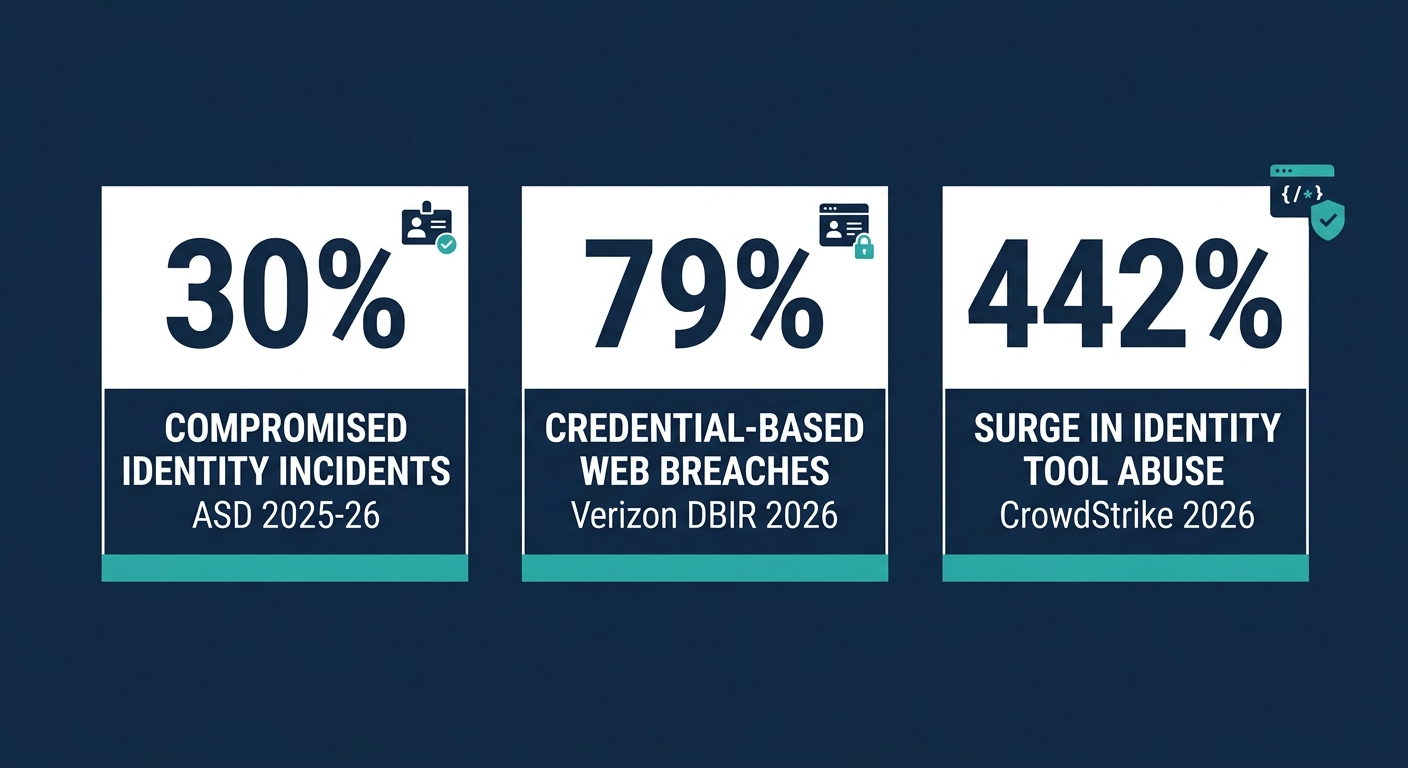
According to the Australian Signals Directorate (ASD), 2026 Annual Cyber Threat Report, over 30% of all cyber incidents reported to the ASD in 2025-26 involved compromised identity or access credentials as the primary attack vector. That figure should be alarming for any business still treating identity management as a secondary concern.
Why Overlooking Identity Security Is the Costliest Mistake in 2026
In the context of Australian businesses, identity security Australia must be a priority to mitigate risks and enhance overall cybersecurity posture.

Many SMBs across Australia still operate under the assumption that sophisticated identity attacks target enterprise organisations rather than smaller businesses. That assumption is dangerously outdated. Identity and access management (IAM) failures are now the single most exploited category in Australian breach reports, with adversaries specifically targeting businesses that lack the governance structures to detect misuse.
The Verizon Data Breach Investigations Report, 2026 confirms that identity-based attacks now account for the majority of initial access techniques observed globally, with adversaries deploying valid credentials in 79% of web application breaches. When attackers use legitimate credentials, traditional perimeter defences offer almost no protection.
Furthermore, CrowdStrike’s 2026 Global Threat Report recorded a 442% surge in attacks using legitimate identity tools and stolen credentials, with breakout times reaching an all-time low median of 48 minutes. That means an attacker who obtains a valid credential has less than an hour before they can move laterally across your environment unchecked.
For a deeper understanding of the broader cybersecurity landscape facing Australian businesses this year, our post on Cybersecurity in 2026: Protecting Your Business from Modern Threats provides essential context.
Gap 1: No Centralised Identity Governance Leaving User Access Ungoverned
Identity governance refers to the policies, processes, and technology that define who has access to what, why, and for how long. Most SMBs in the Hunter Region and beyond simply do not have a centralised system managing this. Access is granted informally when someone joins, roles change organically, and nobody reviews whether that access remains appropriate.
Without centralised identity governance, there is no single source of truth for user access. An employee in accounts payable might still hold administrator rights from a project two years ago. A contractor might retain full system access months after their engagement concluded. These are not edge cases. They represent the everyday reality for businesses operating without a governance framework.
The Australian Cyber Security Centre (ACSC) recommends access control reviews as a foundational element of the Essential Eight maturity model. Businesses that cannot pass a basic access review audit are already operating below the minimum recommended baseline for Essential Eight Maturity Level 1.
Gap 2: Weak or Absent Privileged Access Management Across SMB Environments
Privileged access management (PAM) governs accounts with elevated permissions, including system administrators, finance users with payment authority, and anyone with domain-level control. In most SMB environments across Central Coast and Newcastle, these accounts are poorly controlled. Shared admin passwords, permanent admin rights, and no session recording are all common.
Attackers specifically target privileged accounts because compromising one provides access to far more of the environment than a standard user account. Without PAM controls in place, a single compromised credential can translate directly into a full domain compromise within minutes, as the CrowdStrike breakout time data clearly demonstrates.
Effective PAM includes just-in-time access provisioning, where elevated rights are granted only for specific tasks and automatically revoked. It also includes multi-factor authentication (MFA) on all privileged accounts, session monitoring, and audit logging. These controls are achievable for SMBs using Microsoft Entra ID and Privileged Identity Management features already included in many Microsoft 365 licensing tiers.
Gap 3: Insufficient Conditional Access Policies Beyond Basic MFA Enforcement
Many SMBs have enabled MFA and believe their identity security is handled. MFA is critical, but it is only one layer. Conditional access policies extend beyond MFA by evaluating contextual signals before granting access, including device compliance status, user location, sign-in risk level, and the sensitivity of the resource being accessed.
Without conditional access policies, a user authenticating with MFA from an unmanaged personal device in an overseas location can still access sensitive business systems without triggering any alert. This is a significant gap for businesses with remote workers across the Hunter Region or staff travelling interstate and internationally.
Essential Eight MFA compliance at Maturity Level 2 specifically requires that MFA is applied to all internet-facing services and privileged accounts. Conditional access is the mechanism that operationalises this requirement intelligently, adapting authentication demands based on real-time risk signals rather than applying a uniform rule regardless of context.
If you are reviewing your Microsoft 365 environment and identity controls alongside recent licensing changes, our post on Microsoft 365 price changes in Australia for July 2026 outlines what features are available across each updated tier.
Gap 4: Stale and Orphaned Accounts Creating Silent Entry Points for Attackers
Orphaned accounts are user accounts that remain active in a system after the person they belong to has left the organisation or changed roles. Stale accounts are those that have not been used for an extended period but remain enabled. Both types represent silent entry points that attackers routinely discover and exploit through credential stuffing and brute force techniques.
The Privacy Act 1988 (Cth) and the Office of the Australian Information Commissioner (OAIC) guidance both support the principle of data minimisation, including ensuring that access is only maintained for as long as it is necessary. Retaining active accounts for departed staff is not only a security risk. It may also represent a compliance exposure under the OAIC’s privacy framework if those accounts can access personal information.
Automated offboarding workflows, integrated with your identity provider, are the most reliable defence against orphaned accounts. Businesses using managed IT services through Adept IT Solutions benefit from systematic offboarding processes that disable accounts, revoke licences, and archive mailboxes immediately when a staff member departs, removing the human error element from a high-risk process.
Understanding how identity vulnerabilities connect to broader data breach exposure is important. Our coverage of the Canvas data breach in Australia and critical response steps illustrates what happens when access controls break down at scale.
Gap 5: Absence of Identity Threat Detection and Response
Identity Threat Detection and Response (ITDR) is a security discipline focused specifically on detecting and responding to attacks that target identity infrastructure, including Active Directory, Entra ID, and IAM systems. Most SMBs have no ITDR capability whatsoever, relying instead on general endpoint alerts that were never designed to catch identity-layer attacks.
ITDR solutions monitor for behavioural anomalies such as impossible travel sign-ins, unusual privilege escalation patterns, lateral movement between accounts, and mass credential enumeration attempts. Without this visibility, an attacker operating through a compromised but legitimate account can move through your environment for days or weeks before anyone notices.
For businesses wanting to understand what ITDR means in a practical cybersecurity context, our dedicated explainer on what ITDR is in cybersecurity covers the fundamentals in accessible detail.
Gap 6: Uncontrolled Third-Party and Vendor Access
Third-party vendors, contractors, and technology partners routinely require access to SMB environments. In practice, many businesses grant this access informally through shared accounts or standing permissions that are never reviewed. This creates a significant identity security exposure that sits entirely outside the business’s own workforce.
A zero-trust approach to third-party access means that every vendor connection is treated as untrusted by default, verified explicitly, and granted only the minimum access required for the specific task. Time-limited access tokens, dedicated vendor accounts separate from internal staff accounts, and session monitoring are all components of an effective third-party identity programme.
The zero-trust security model is directly applicable to both Gap 5 and Gap 6. Our post explaining what zero-trust means in cybersecurity provides a strong foundation for businesses beginning to implement these controls.
“Attackers don’t break in — they log in. Every ungoverned identity is an open invitation.”
Identity Security Solutions for Business: Where to Start in 2026
The six gaps outlined above are interconnected. Addressing one in isolation without a broader identity programme will leave your business exposed through the others. The right starting point is a structured identity security assessment that maps your current user population, reviews access entitlements, evaluates your MFA and conditional access configuration, and identifies orphaned and stale accounts.
For SMBs across Sydney, Newcastle, and the broader Hunter Region, identity security solutions for business do not need to be built from scratch. Microsoft 365 Business Premium and Entra ID P2 provide the majority of tools required to address all six gaps, including PAM via Privileged Identity Management, conditional access, ITDR signals through Microsoft Defender for Identity, and automated lifecycle management.
Compliance frameworks such as ISO 27001 and the Essential Eight both require robust identity controls as foundational elements. Addressing these gaps is not only a security improvement. It also positions your business to meet regulatory obligations under the Privacy Act 1988 and any sector-specific requirements that apply to your industry.
Conclusion: Close the Gaps Before Attackers Exploit Them

Identity security is no longer optional for Australian SMBs in 2026. With compromised credentials driving the majority of breaches, breakout times measured in minutes, and regulatory consequences increasing for businesses that fail to protect personal data, the cost of inaction now far exceeds the cost of a structured identity programme. Every gap identified in this post has a practical, scalable solution available today.
Adept IT Solutions works with businesses across Newcastle, the Hunter Region, the Central Coast, and Sydney to assess, design, and implement identity and access management programmes that close these gaps systematically. If your business has not yet reviewed its identity security posture in 2026, now is the right time to act.
Book a free consultationFrequently Asked Questions
Q: What do Australian businesses need to do most urgently in 2026?
A: The most urgent priorities for Australian SMBs are enabling MFA with conditional access policies, implementing privileged access management on all admin accounts, and conducting an immediate audit to identify and disable orphaned or stale user accounts. These three actions address the highest-frequency attack vectors observed in current threat data from the ASD and global sources. Businesses using Microsoft 365 Business Premium already have the tools to implement these controls without additional licensing costs in most cases.
Q: How does identity and access management compliance connect to Essential Eight requirements?
A: Identity and access management is embedded throughout the Essential Eight framework. Maturity Level 1 requires restricting admin privileges and applying MFA to remote access services. Maturity Level 2 extends MFA to all internet-facing services and privileged accounts. Maturity Level 3 adds phishing-resistant MFA and comprehensive access reviews. Businesses working towards any level of Essential Eight compliance will find that addressing the six identity gaps outlined in this post directly supports their maturity uplift across multiple controls simultaneously.
Q: What is ITDR and why do SMBs need it as part of their cybersecurity strategy?
A: Identity Threat Detection and Response (ITDR) is a security capability that specifically monitors identity infrastructure for signs of attack, including unusual login behaviour, privilege escalation, and lateral movement using valid credentials. Traditional endpoint detection tools are not designed to catch these patterns. SMBs need ITDR because attackers using compromised credentials look like legitimate users to conventional security tools. Microsoft Defender for Identity provides ITDR capabilities for businesses already using Microsoft 365, making it accessible without significant additional investment for most SMB environments.
Q: How can a managed IT provider help close compromised credentials SMB vulnerabilities?
A: A managed IT provider with identity security expertise can conduct an access audit to identify ungoverned accounts, configure conditional access and MFA policies, implement automated onboarding and offboarding workflows, and deploy ITDR monitoring across your Microsoft 365 or hybrid environment. For SMBs without an internal IT team, this is the most cost-effective path to closing the six critical identity security gaps. An experienced managed IT partner handles ongoing monitoring and policy tuning, ensuring your identity controls remain effective as your business grows and your threat environment evolves.
Get in touch with our team of IT experts today! You can contact us via phone at 1300 423 378 or email us at info@adept-it.com.au.

