
A cloud security audit has never been more critical than it is right now. In 2026, Australian businesses across Newcastle, the Hunter Region, Central Coast, and Sydney are discovering, often the hard way, that their cloud environments fall well short of regulatory and security expectations. The consequences range from notifiable data breach obligations to significant financial penalties and reputational damage.
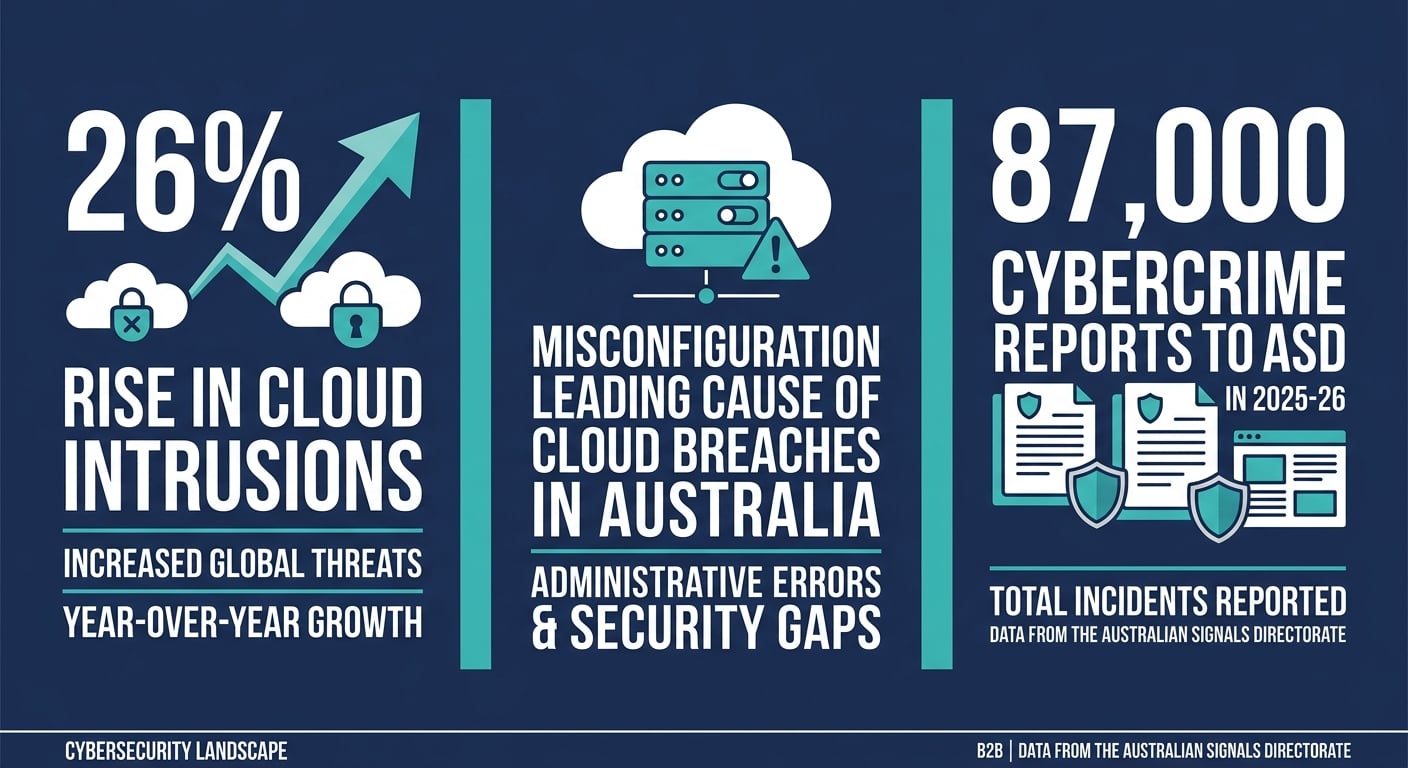
The threat landscape has shifted decisively toward cloud infrastructure. CrowdStrike, 2026 reports that cloud intrusions increased by over 26% year-on-year globally, making cloud environments the most targeted attack surface of the period. For Australian organisations, this is not a distant global statistic — it is an immediate operational risk.
WHAT IS A CLOUD SECURITY AUDIT AND WHY DOES IT MATTER IN 2026?

A cloud security audit is a structured assessment of your organisation’s cloud environment, examining configurations, access controls, data handling practices, and compliance posture. It identifies vulnerabilities before attackers or regulators do. In 2026, with the Privacy Act 1988 amendments increasing obligations around personal data handling, the stakes have escalated considerably.
For businesses operating in regulated industries — including healthcare, finance, legal, and education — the requirement to demonstrate security rigour is no longer optional. Audits are now a baseline expectation from clients, insurers, and government procurement panels. Without a current and documented assessment, organisations expose themselves to contractual and regulatory risk simultaneously.
The ASD/ACSC, 2026 Annual Cyber Threat Report confirms that the Australian Signals Directorate (ASD) received over 87,000 cybercrime reports in 2025-26, with a significant proportion involving exploitation of internet-facing cloud services and remote access tools. That volume underscores just how broadly cloud-targeted attacks are affecting Australian organisations of all sizes.
THE 5 MOST COMMON CLOUD SECURITY FAILURES HITTING AUSTRALIAN BUSINESSES
Understanding why businesses fail a cloud security audit starts with identifying the patterns. The same critical failures appear repeatedly across organisations regardless of size or industry.
1. Misconfigured Cloud Storage and Services
Misconfigured cloud storage remains the single most prevalent vulnerability in Australian cloud environments. Publicly accessible storage buckets, open firewall rules, and default service permissions that were never locked down create immediate exposure. Many organisations migrated to cloud platforms rapidly during 2020 to 2022 and never revisited the foundational security settings that were applied at the time.
2. Weak Identity and Access Management
Inadequate identity controls are the second most reported cause of cloud-related breaches. Overprivileged accounts, absent multi-factor authentication (MFA), and stale user credentials present attackers with minimal resistance. Our blog on identity security gaps for Australian SMBs examines this failure mode in detail and explains why it persists even among technically capable teams.
3. Inadequate Logging and Monitoring
Many businesses assume that cloud platforms provide monitoring by default. In reality, comprehensive logging must be deliberately enabled and actively reviewed. Without it, threat actors can persist inside environments for weeks or months before detection. A cloud security assessment typically exposes significant gaps in audit trail configuration across Microsoft Azure and similar platforms.
4. Absence of a Tested Backup and Recovery Plan
Having data in the cloud does not automatically mean it is protected. Cloud-native backup tools are often left unconfigured or set to default retention periods that fail to meet business continuity requirements. Auditors consistently flag the absence of documented, tested recovery procedures as a material control deficiency, particularly in organisations subject to the Notifiable Data Breaches (NDB) scheme.
5. Unmanaged Third-Party and Shadow IT Connections
Third-party application integrations and unsanctioned cloud tools used by staff create security gaps that sit outside traditional monitoring scope. These connections often bypass organisational security policies entirely. For a deeper look at this risk, our post on third-party vendor security audit failures outlines seven critical gaps that regularly surface during assessments.
HOW MISCONFIGURED CLOUD ENVIRONMENTS LEAD TO NOTIFIABLE DATA BREACHES
The connection between misconfiguration and notifiable breaches is direct and well-documented. The Office of the Australian Information Commissioner (OAIC), 2026 confirms that misconfiguration and inadequate identity controls remained the leading causes of cloud-related data breaches reported under the NDB scheme during 2025-26.
When a misconfigured cloud storage bucket exposes customer records, or when compromised credentials allow unauthorised access to personal information, the NDB scheme requires prompt notification to both the OAIC and affected individuals. The reputational and financial cost of that process, combined with potential regulatory action, far exceeds the cost of a proactive audit.
Beyond the NDB scheme, organisations holding health information face obligations under the My Health Records Act 2012 and sector-specific regulations. A breach in a cloud environment that holds electronic health records carries compounding regulatory exposure that a well-conducted cloud security audit is specifically designed to prevent.
“The shared responsibility model in cloud computing means security obligations do not transfer entirely to the provider. Customers remain accountable for how they configure, access, and protect their cloud-hosted data.”
CLOUD COMPLIANCE FRAMEWORK: WHAT AUSTRALIAN BUSINESSES SHOULD KNOW
Navigating a cloud compliance framework can feel overwhelming, but for most Australian businesses three frameworks form the core of what is expected. Understanding each is essential before undertaking a cloud security audit.
The Essential Eight, developed by the ASD, provides a prioritised set of mitigation strategies specifically calibrated for the Australian threat environment. Organisations seeking to demonstrate security maturity to government clients or cyber insurers increasingly need to evidence alignment with the Essential Eight maturity model.
ISO 27001 cloud alignment provides an internationally recognised framework for information security management. For businesses tendering on enterprise or government contracts, ISO 27001 certification or demonstrated alignment signals a credible and consistent security posture. Audits conducted against this standard examine both technical controls and organisational processes.
The NIST Cybersecurity Framework provides a structured approach to identifying, protecting, detecting, responding to, and recovering from cyber incidents. Many Australian organisations use the NIST framework as the operational backbone of their cloud security programme, supplementing it with ASD-specific guidance for local regulatory alignment.
For organisations using Microsoft 365 and Azure, Microsoft Security’s Secure Score provides a measurable baseline for cloud configuration quality. It is an accessible starting point, but it does not replace a comprehensive audit conducted by an independent security professional.
HOW ADEPT IT SOLUTIONS CONDUCT CLOUD SECURITY AUDITS ACROSS THE HUNTER REGION AND BEYOND
At Adept IT Solutions, our approach to a cloud security audit is structured, thorough, and aligned with the frameworks that matter to Australian regulators and enterprise clients. We serve organisations in Newcastle, Lake Macquarie, the Hunter Region, Central Coast, Sydney, and across Australia, bringing local expertise and national capability to every engagement.
Our audit process begins with a discovery phase, mapping every cloud asset, service connection, and data flow within your environment. We review Microsoft 365 and Azure configurations against ASD Essential Eight requirements, assess identity and access management controls, and evaluate backup and disaster recovery arrangements against documented recovery objectives.
We then produce a findings report that prioritises risks by severity and maps remediation actions to practical business outcomes, not just technical controls. Our clients receive a clear roadmap that addresses immediate critical risks first, followed by systematic improvement across their cloud security posture over time. This approach aligns with our broader cybersecurity strategy for 2026, which we outline in detail for Australian businesses of all sizes.
For organisations exploring zero-trust architecture as part of their remediation, our post on zero-trust in cybersecurity provides a practical introduction to how that model integrates with cloud security controls. Zero-trust principles address many of the identity and access management failures that consistently surface during audits.
Managed IT clients benefit particularly from our on-the-ground presence. We understand the operational constraints facing businesses outside major capital cities, including limited internal IT resources, dependence on hybrid cloud setups, and pressure to reduce technology costs without increasing risk exposure.
NEXT STEPS: BOOK YOUR CLOUD SECURITY ASSESSMENT TODAY

The data is clear: misconfigured cloud environments, weak identity controls, and absent monitoring are driving a rising volume of notifiable breaches across Australia in 2026. A proactive cloud security audit is no longer a luxury reserved for large enterprises. It is a baseline requirement for any organisation operating in the cloud.
Adept IT Solutions works with businesses across Newcastle, the Hunter Region, Central Coast, Sydney, and Australia-wide to assess, remediate, and continuously improve cloud security posture. Whether your organisation is preparing for an ISO 27001 audit, responding to a cyber insurer’s requirements, or simply concerned about the gaps you have not yet identified, we are equipped to help.
Do not wait for a breach notification to trigger your first cloud security assessment. Reach out to the team at Adept IT Solutions today and take a proactive step toward a more secure and compliant cloud environment.
Book a free consultationFrequently Asked Questions
Q: What does a cloud security audit process typically involve?
A: A cloud security audit typically involves a structured review of your cloud environment covering configuration settings, identity and access management controls, logging and monitoring capabilities, backup and recovery arrangements, and compliance alignment against frameworks such as the ASD Essential Eight or ISO 27001. The outcome is a prioritised findings report with clear remediation guidance tailored to your organisation’s risk profile and regulatory obligations.
Q: How does misconfigured cloud storage lead to a notifiable data breach in Australia?
A: Misconfigured cloud storage, such as publicly accessible storage buckets or overly permissive access policies, can expose personal information held by your organisation to unauthorised parties. Under the Notifiable Data Breaches scheme administered by the OAIC, organisations are required to notify both the OAIC and affected individuals when a data breach is likely to result in serious harm. Misconfiguration is one of the most commonly reported causes of such breaches in Australia.
Q: Which cloud compliance framework is most relevant for Australian businesses in 2026?
A: For most Australian businesses, the ASD Essential Eight is the most directly relevant cloud compliance framework, as it is specifically designed for the Australian threat environment and is required for many government contracts and cyber insurance applications. ISO 27001 is the preferred international standard for organisations seeking formal certification. The NIST Cybersecurity Framework is widely used as an operational backbone, and all three can be applied in a complementary manner depending on your organisation’s size and sector.
Q: How often should a business in Newcastle or the Hunter Region conduct a cloud security assessment?
A: A cloud security assessment should be conducted at minimum once per year, and additionally whenever significant changes occur in your cloud environment, such as migrating new workloads, onboarding third-party integrations, or following a security incident. For businesses in the Hunter Region and Newcastle that operate under regulatory obligations, including the Privacy Act 1988 or sector-specific requirements, more frequent assessments are strongly recommended to ensure ongoing compliance and timely identification of new vulnerabilities.
Get in touch with our team of IT experts today! You can contact us via phone at 1300 423 378 or email us at info@adept-it.com.au.

