
AI-powered cyber attacks Australian businesses face in 2026 represent a categorically different threat from anything seen in previous years. Artificial intelligence is no longer solely a defensive tool. Adversaries across every threat category are leveraging it to automate intrusions, craft convincing phishing content, and accelerate breakout times to a degree that overwhelms legacy security tools. For organisations across Newcastle, the Hunter Region, the Central Coast, and Sydney, this shift demands immediate attention and a structured response built on proven defensive controls.
Why AI-Powered Cyber Attacks Are a Game-Changer
The threat environment has shifted fundamentally. AI enables threat actors to operate at machine speed, removing the human bottlenecks that once limited the scale and sophistication of attacks. Campaigns that previously required skilled operators can now be launched by relatively low-capability adversaries using commercially available AI tooling.
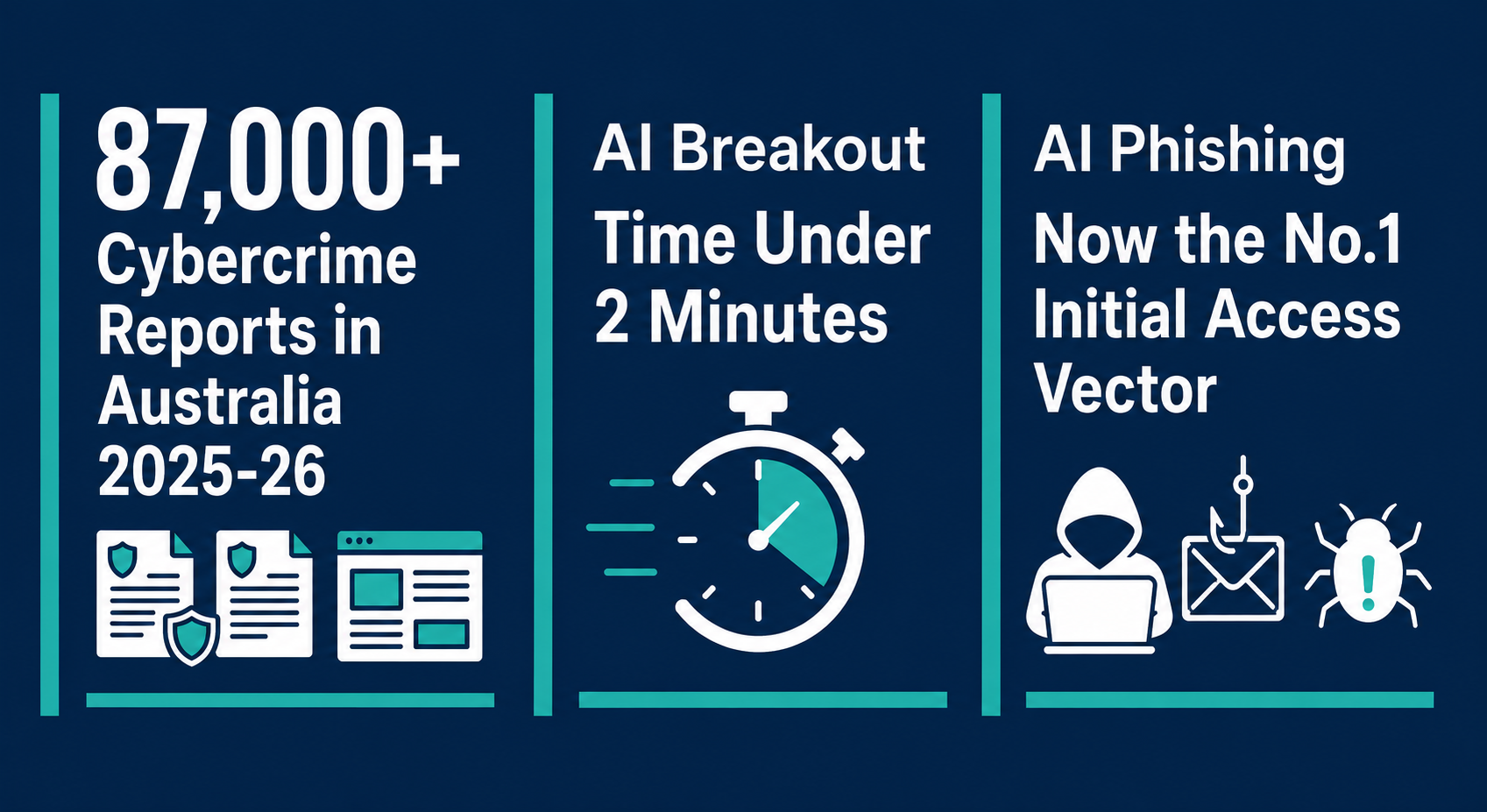
The consequences for Australian businesses are measurable. According to the Australian Signals Directorate, 2026, over 87,000 cybercrime reports were received in Australia in 2024-25, with AI-assisted attacks identified as an accelerating factor across all threat categories. That figure represents a sustained, high-volume assault on Australian industry that is only growing more sophisticated.
Small and medium-sized businesses (SMBs) are disproportionately affected. Many operate with limited internal IT capability, making them attractive targets for automated campaigns that scan for vulnerabilities and exploit them without human intervention. Understanding why these attacks are different is the first step toward building effective defences. Our overview of cybersecurity in 2026 outlines the broader threat environment facing Australian organisations this year.
How Attackers Are Using AI to Outpace Traditional Security Defences
The mechanics of AI-enabled attacks have matured considerably. Threat actors are using large language models to generate highly personalised phishing emails that are grammatically flawless and contextually relevant, bypassing the obvious red flags that once made phishing easy to spot. According to the Verizon, 2026 Data Breach Investigations Report (DBIR), phishing and social engineering attacks leveraging AI-generated content now account for a majority of initial access vectors recorded globally in the 2026 reporting period.
Beyond phishing, AI is being deployed to conduct automated vulnerability scanning, optimise malware payloads in real time, and perform credential stuffing at unprecedented scale. CrowdStrike, 2026 reported that breakout times for some threat actors have dropped to under two minutes in observed 2025-26 campaigns. That is the time between initial access and lateral movement across a network.
Traditional rule-based security tools are simply not equipped to respond at this speed. Static firewall rules and signature-based antivirus solutions were designed for a different era. AI threat detection capabilities are now a baseline requirement, not a premium add-on. Businesses that have not reviewed their security stack in the last 12 months are likely operating with significant blind spots.
The Australian Threat Landscape: ASD Compliance and What the Data Reveals
The Australian Signals Directorate (ASD) continues to provide the most authoritative picture of the domestic threat environment. Its 2025-26 annual report confirms that cybercrime is not only increasing in volume but also in complexity, with AI-enabled techniques appearing across ransomware, business email compromises, and supply chain attacks.
The ASD’s Essential Eight framework remains the foundational compliance baseline for Australian organisations. However, achieving even Maturity Level Two across all eight controls requires consistent effort and technical capability that many SMBs in Newcastle, Lake Macquarie, and the broader Hunter Region struggle to maintain independently. ASD compliance is no longer optional for businesses that handle sensitive data or operate within regulated industries.
The Office of the Australian Information Commissioner (OAIC) has also flagged rising volumes of notifiable data breaches linked to phishing and credential compromise. Businesses operating under the Privacy Act 1988 must treat AI-enabled attack vectors as a primary risk category in their privacy impact assessments. Failure to do so creates both regulatory exposure and reputational damage.
Seven Critical Defences Every Australian SMB Must Have in Place Now

Cyber resilience Australia-wide depends on organisations implementing layered, proactive defences. The following seven controls directly address the tactics used in AI-enabled attacks and align with the ASD Essential Eight framework.
1. Multi-Factor Authentication Across All Systems
Multi-Factor Authentication (MFA) remains the single most effective control against credential-based attacks. AI-powered credential stuffing tools can test millions of username and password combinations per hour. MFA breaks that attack chain at the point of authentication. Every user account, including administrators, must be covered.
2. AI-Augmented Endpoint Detection and Response
Legacy antivirus cannot detect behavioural anomalies at the speed required to stop sub-two-minute breakout events. Endpoint Detection and Response (EDR) platforms with AI threat detection capabilities identify unusual process behaviour, privilege escalation attempts, and lateral movement in real time, enabling automated containment before damage spreads.
3. Phishing-Resistant Email Security
Given that AI-generated phishing now represents the dominant initial access vector, email security must be equally sophisticated. Solutions that incorporate natural language processing to assess the intent and context of inbound messages, not just scan for known malicious links, are now essential. Combine this with regular phishing simulation training for staff.
4. Zero Trust Network Architecture
A zero trust architecture removes the assumption that anything inside the network perimeter is safe. Every access request is verified regardless of origin. This approach limits lateral movement and contains the blast radius of any successful intrusion, which is particularly critical given AI-accelerated breakout timelines.
5. Identity Threat Detection and Response
Identity has become the primary attack surface in AI-enabled campaigns. Understanding what Identity Threat Detection and Response (ITDR) involves is critical for businesses that rely on cloud platforms and remote access. ITDR solutions continuously monitor identity systems for compromise indicators, including impossible travel events and anomalous privilege escalation.
6. Immutable Backup and Tested Disaster Recovery
AI-powered ransomware campaigns identify and target backup infrastructure before triggering encryption. Immutable backups, stored offsite or in air-gapped environments, ensure a clean recovery path exists regardless of what the attacker corrupts. Backups that are never tested are not backups, they are liabilities. Scheduled recovery testing must be part of every business continuity plan.
7. Continuous Security Awareness Training
People remain both the most targeted and most improvable element of any security programme. AI-generated social engineering content is designed to exploit human psychology, not technical vulnerabilities. Regular, scenario-based training that reflects current attack techniques significantly reduces the likelihood of a successful initial compromise. The ASD’s protective security guidance provides a solid foundation for staff awareness programmes.
How Managed IT Security Services Close the AI Threat Detection Gap
Implementing and maintaining the seven controls above requires specialised expertise, tooling, and around-the-clock monitoring. For most SMBs across cyber security services Hunter Region-wide, building that capability in-house is neither practical nor cost-effective. This is where managed IT security services provide measurable value.
A managed security partner provides access to enterprise-grade AI threat detection platforms, experienced security analysts, and continuous monitoring, all without the overhead of building an internal Security Operations Centre (SOC). Managed Detection and Response (MDR) services in particular are designed to bridge the gap between detection and containment at the speed AI-powered attacks demand. For context on what MDR delivers, our explainer on what MDR means in cybersecurity outlines the key components.
Businesses in the managed IT space benefit from working with a provider that understands both the local regulatory environment and the global threat landscape. Local presence means faster on-site response capability, while global threat intelligence ensures defences remain current against emerging AI attack techniques. Third-party and supply chain risks are equally important to address, and our analysis of third-party vendor security audit failures highlights where many Australian businesses remain exposed.
“The adversarial use of AI has fundamentally changed the economics of cybercrime. What once required a skilled team can now be automated and scaled. Defenders must match that capability or accept the consequences of an asymmetric disadvantage.”
Next Steps: Strengthening Your Cyber Resilience

The seven defences outlined above are not aspirational goals. They are minimum standards for any Australian business that holds customer data, processes financial transactions, or operates critical infrastructure. AI-powered cyber attacks that organisations face in 2026 will only intensify as the underlying technology becomes more accessible to threat actors at every capability level.
Cyber resilience requires a commitment to continuous improvement, not a one-time investment. Threats evolve, and so must your defences. Businesses that treat security as a periodic audit exercise rather than an ongoing operational discipline will continue to be outpaced by adversaries who iterate daily.
Adept IT Solutions works with businesses across Newcastle, Lake Macquarie, the Hunter Region, the Central Coast, Sydney, and Australia-wide to design and deliver layered security programmes built around the ASD Essential Eight, zero trust principles, and AI-augmented detection capabilities. If your organisation has not completed a security assessment in the last 12 months, now is the time to act. Reach out to the Adept IT Solutions team through our contact page to begin the conversation about protecting your business against today’s most advanced threats.
Book a free consultationFrequently Asked Questions
Q: What makes AI-powered cyber attacks that Australian businesses face different from traditional cyberattacks?
A: AI-powered attacks differ in speed, scale, and adaptability. Traditional attacks required skilled human operators to execute each stage of an intrusion. AI enables automation across reconnaissance, phishing content generation, vulnerability scanning, and lateral movement, compressing attack timelines to minutes. For Australian businesses, this means legacy security tools that relied on human response speeds are no longer adequate. AI threat detection and around-the-clock monitoring are now baseline requirements for effective cyber resilience Australia-wide.
Q: Which Australian compliance frameworks apply to AI-driven cyber threats in 2026?
A: The ASD Essential Eight is the primary compliance benchmark for Australian organisations. It covers controls such as application control, patching, MFA, and restricted administrative privileges, all of which directly address AI-enabled attack techniques. Businesses subject to the Privacy Act 1988 must also address AI-driven threats within their privacy risk management obligations. For organisations seeking higher assurance, ISO 27001 provides a globally recognised information security management framework that complements ASD compliance requirements.
Q: How can a managed IT security provider help with AI cyber threats?
A: A managed IT security provider delivers the expertise, tooling, and monitoring capability that most SMBs cannot sustain internally. This includes access to AI-augmented endpoint detection, 24/7 threat monitoring, phishing simulation programmes, and incident response planning. Local providers understand the specific risk profile of businesses in the Hunter Region and Central Coast, while leveraging global threat intelligence feeds to ensure defences remain current against emerging AI attack methodologies. This combination is critical for maintaining effective cyber resilience in 2026.
Q: What should an Australian SMB do first if they suspect they have been targeted by AI-powered cyber attacks?
A: The immediate priority is containment. Isolate affected systems from the network to prevent lateral movement, preserve log data for forensic analysis, and notify your IT security provider. Australian businesses are also required to assess whether a notifiable data breach has occurred under the Privacy Act and report to the OAIC if applicable. Once the incident is contained, a root cause analysis should inform remediation and improvements to prevent recurrence. Engaging a managed security partner before an incident occurs is always the preferred position.
Get in touch with our team of IT experts today! You can contact us via phone at 1300 423 378 or email us at info@adept-it.com.au.

