
Business email compromise is no longer a threat reserved for large enterprises with deep pockets and complex supply chains. In 2026, small and medium-sized businesses (SMBs) across Newcastle, the Hunter Region, Central Coast, and Sydney are bearing the heaviest losses from this rapidly escalating form of cybercrime. Attackers are more patient, more convincing, and more technically sophisticated than ever before. If your organisation relies on email to approve payments, communicate with suppliers, or manage payroll, you are already a target.
WHAT IS BUSINESS EMAIL COMPROMISE AND WHY IS IT TARGETING AUSTRALIAN SMB?

Business Email Compromise (BEC) is a form of targeted cybercrime where attackers manipulate email communications to deceive employees, executives, or suppliers into transferring funds or disclosing sensitive information. Unlike malware-driven attacks, BEC relies almost entirely on social engineering and impersonation. There is rarely a malicious attachment involved, which makes it exceptionally difficult for traditional security tools to detect.
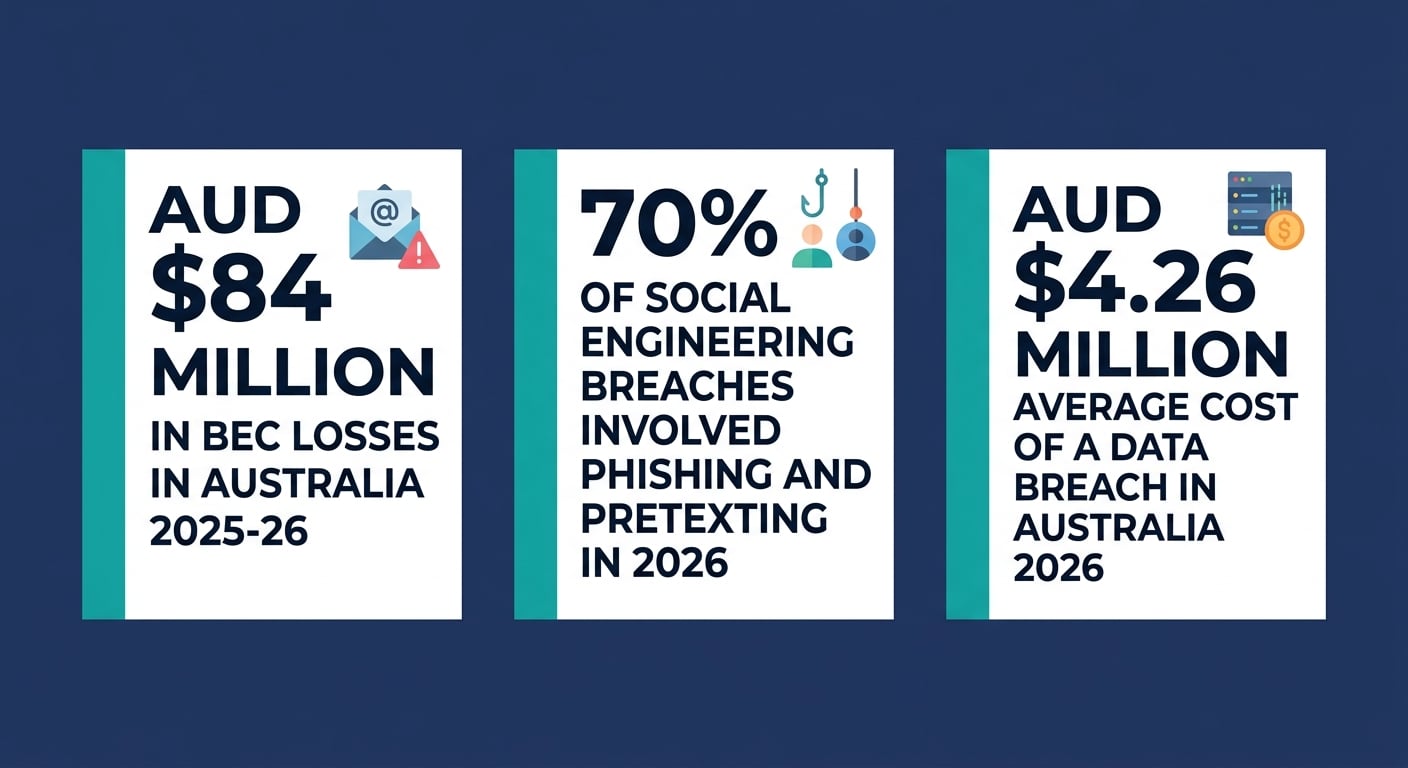
The financial impact on Australian businesses is severe. According to the Australian Signals Directorate / Australian Cyber Security Centre, 2026, business email compromise was the highest-reported cybercrime category causing financial loss in Australia, with self-reported losses exceeding $84 million in the 2025–26 reporting period. Given that most incidents go unreported, actual losses are widely considered to be significantly higher.
SMBs are disproportionately affected because they typically lack the dedicated security teams, layered controls, and incident response capabilities that larger organisations deploy. A single convincing email impersonating a supplier or CEO can result in a six-figure payment disappearing within hours.
THE SEVEN WARNING SIGNS YOUR BUSINESS IS ALREADY UNDER A BEC ATTACK
Recognising a BEC attack in progress is genuinely difficult. Attackers often spend weeks observing email communications before striking. The following seven warning signs should prompt immediate investigation by your IT team or managed IT provider.
1. Unexpected bank account change requests. A supplier or payroll contact sends an email requesting updated payment details. The domain looks legitimate but may have a subtle variation such as an added character or different top-level domain.
2. Urgent payment requests from senior executives. An email appearing to come from your CEO or CFO requests a wire transfer immediately, often citing a confidential transaction or time-sensitive deal.
3. Email rules you did not create. Attackers who gain access to a mailbox often set forwarding rules to silently copy correspondence to an external address. Discovering unfamiliar inbox rules is a serious red flag.
4. Login alerts from unusual locations. Sign-in notifications from countries or cities outside your normal operating footprint suggest credential compromise. For businesses using Microsoft 365, these alerts appear in Entra ID sign-in logs.
5. Responses to emails you never sent. If colleagues or suppliers are replying to conversations you have no record of initiating, an attacker may already be operating from your compromised account.
6. Invoices with mismatched details. Invoice fraud detection failures are common when staff accept documents without verifying BSB and account numbers against known supplier records. Even a single digit difference can redirect funds entirely.
7. Requests to bypass normal approval processes. BEC attackers frequently exploit urgency and authority. Pressure to skip your two-person payment approval or act before management returns is a deliberate manipulation tactic, not a coincidence.
HOW ATTACKERS IMPERSONATE SUPPLIERS, EXECUTIVES AND PAYMENT PORTALS
Modern BEC campaigns are meticulously researched. Attackers mine LinkedIn profiles, company websites, and even social media to understand organisational hierarchies, key supplier relationships, and upcoming projects. This intelligence allows them to craft emails that are contextually accurate and deeply convincing.
The Verizon, 2026 Data Breach Investigations Report found that phishing and pretexting, the two techniques underpinning BEC, were present in over 70% of social engineering breaches recorded globally in the 2026 reporting cycle. Pretexting, where an attacker fabricates a scenario to justify an unusual request, is particularly effective against organisations without robust verification procedures.
Supplier impersonation is the most common variant affecting Australian SMBs. Attackers either register lookalike domains or compromise an actual supplier’s email account to send fraudulent invoices. Because the email appears to originate from a trusted contact, standard spam filters frequently allow it through without flagging it.
For businesses managing vendor relationships, understanding third-party vendor security audit failures is directly relevant to reducing BEC exposure from external supply chain contacts.
FINANCIAL AND LEGAL CONSEQUENCES: PRIVACY ACT COMPLIANCE AFTER A BEC INCIDENT
The immediate financial damage from a BEC attack is obvious. However, many Australian business owners do not realise that a successful BEC incident can also trigger mandatory reporting obligations under the Privacy Act 1988 and the Notifiable Data Breaches (NDB) scheme administered by the Office of the Australian Information Commissioner (OAIC).
If a BEC attacker accesses a mailbox containing personal information about customers, employees, or suppliers, that constitutes a data breach. The Office of the Australian Information Commissioner requires eligible entities to notify affected individuals and the OAIC when a breach is likely to cause serious harm. Failure to comply carries significant penalties.
Remediation costs compound quickly. According to the IBM, 2026 Threat Intelligence Report, the average cost to remediate a data breach in Australia reached AUD $4.26 million in 2026, with email-based intrusions among the leading initial access vectors. For an SMB, a fraction of that figure can be existential.
Beyond financial remediation, businesses face reputational damage, loss of customer trust, and potential civil liability. Privacy Act compliance is not simply a box-ticking exercise — it is a direct component of email security risk management for any Australian business handling personal data.
TECHNICAL CONTROLS THAT STOP BEC: EMAIL SECURITY SOLUTIONS EXPLAINED
Effective email security solutions for BEC protection operate across three distinct layers: authentication, access control, and filtering. Deploying all three in combination dramatically reduces the likelihood of a successful attack reaching your staff.
DMARC, DKIM and SPF: Email Authentication
Domain-based Message Authentication, Reporting and Conformance (DMARC), combined with DomainKeys Identified Mail (DKIM) and Sender Policy Framework (SPF), prevents attackers from spoofing your domain. When correctly configured, these protocols instruct receiving mail servers to reject or quarantine emails that fail authentication checks. Many Australian SMBs have not configured DMARC beyond a monitoring-only policy, leaving their domain open to impersonation.
Multi-Factor Authentication
Multi-Factor Authentication (MFA) is among the most effective single controls against BEC account takeover. Even when credentials are stolen through phishing, MFA prevents an attacker from accessing the mailbox without the second factor. The Australian Cyber Security Centre (ACSC) lists MFA as a core component of the Essential Eight mitigation strategies. Businesses that have not enabled MFA across all email accounts remain at unnecessary and avoidable risk.
Strengthening identity controls is closely linked to BEC prevention. Our detailed guide on identity security gaps for Australian SMBs in 2026 covers the most critical access control failures affecting organisations today.
Advanced Email Filtering and Anti-Impersonation Controls
Modern email security platforms go beyond spam filtering to analyse message intent, sender reputation, lookalike domain detection, and behavioural anomalies. Microsoft Defender for Office 365 and purpose-built gateways provide real-time BEC protection for small business environments running Microsoft 365 or hybrid mail configurations. Staff security awareness training is a complementary layer that reduces the risk of social engineering succeeding even when a suspicious email does reach an inbox.
HOW ADEPT IT SOLUTIONS HELPS BUSINESSES SHUT DOWN BEC RISK
Adept IT Solutions works with businesses across Newcastle, Lake Macquarie, the Hunter Region, Central Coast, and Sydney to deploy layered defences specifically designed to counter BEC and email-based fraud. Our managed IT and cybersecurity services are built around the ACSC’s Essential Eight framework, ensuring your controls meet the standards that Australian regulators and insurers increasingly expect.
Our BEC protection engagements typically begin with an email security assessment covering DMARC configuration, MFA enforcement status, conditional access policies, and mailbox rule auditing. We then implement and manage the technical controls required to close identified gaps. For organisations that have already experienced a suspected compromise, our incident response team can act quickly to contain the threat and support Privacy Act notification obligations.
We also deliver staff awareness training tailored to the specific social engineering scenarios targeting Australian SMBs, including supplier impersonation, CEO fraud, and payment portal phishing. Education remains one of the highest-return investments available for BEC protection for small business environments where technical controls cannot catch every threat.
To understand the broader cybersecurity landscape your business faces in 2026, our guide on cybersecurity threats and protections in 2026 provides practical context alongside our BEC-specific recommendations.
“BEC is not a technology problem that technology alone can solve. It is a people, process, and technology problem — and Australian SMBs need all three layers working in coordination to reduce their exposure to an acceptable level.”
CONCLUSION: TAKING ACTION AGAINST BUSINESS EMAIL COMPROMISE IN AUSTRALIA

Business email compromise continues to extract hundreds of millions of dollars from organisations that believed they were too small to be targeted, too careful to be deceived, or too well-protected to be vulnerable. The 2026 data tells a different story. The threat is larger, more targeted, and more financially damaging than at any point previously recorded by Australian authorities.
The good news is that the right combination of technical controls, staff training, and verified payment processes can reduce your exposure significantly. DMARC enforcement, MFA on all accounts, advanced email filtering, and clear payment verification procedures are not expensive, complex initiatives. They are achievable steps that any Newcastle or Hunter Region business can implement with the right support.
Do not wait for an incident to validate the risk. Speak with the team at Adept IT Solutions today and take a structured, evidence-based approach to protecting your business from one of Australia’s most costly and persistent cyber threats.
Book a free consultationFrequently Asked Questions
Q: How does business email compromise differ from standard phishing attacks?
A: Standard phishing attacks typically cast a wide net using generic lures and malicious links or attachments. Business email compromise is far more targeted. Attackers research specific organisations, relationships, and processes before impersonating known contacts such as executives, suppliers, or payment portals. There is usually no malicious link or attachment involved, which means traditional spam filters are far less effective at detection. The attack relies entirely on trust and urgency to succeed.
Q: What invoice fraud detection steps should Australian SMBs put in place immediately?
A: Effective invoice fraud detection starts with a simple but consistently enforced policy: verify any change to banking details via a separate, independently sourced phone call to the supplier using a number from your own records, never one provided in the suspicious email. Implement a two-person payment approval process for transfers above a defined threshold. Reconcile supplier account details against your approved vendor list before processing payments. These procedural controls cost nothing to implement and are highly effective at stopping fraudulent transfers before they are executed.
Q: Is a BEC attack a notifiable data breach under Australian Privacy Act requirements?
A: It depends on what information the attacker accessed. If the compromised mailbox contained personal information about customers, employees, or business contacts, and that access is likely to result in serious harm, the incident must be reported to the Office of the Australian Information Commissioner under the Notifiable Data Breaches scheme. Privacy Act compliance obligations apply even when the primary motivation of the attack was financial rather than data theft. Businesses should engage a cybersecurity specialist promptly after any suspected BEC incident to assess notification requirements.
Q: What email security solutions does Adept IT Solutions recommend for BEC protection for small business?
A: Adept IT Solutions recommends a layered approach to BEC protection for small business environments. This includes enforcing DMARC, DKIM, and SPF at a reject policy level to prevent domain spoofing; enabling Multi-Factor Authentication across all Microsoft 365 or cloud email accounts; deploying advanced email filtering with anti-impersonation capabilities; auditing mailbox rules regularly for unauthorised forwarding; and conducting ongoing staff awareness training. For businesses in Newcastle, the Hunter Region, and the Central Coast, our managed security service provides continuous monitoring and rapid response to suspicious email activity.
Get in touch with our team of IT experts today! You can contact us via phone at 1300 423 378 or email us at info@adept-it.com.au.

