
Disaster recovery planning is no longer an optional exercise for small and medium businesses in Australia. In 2026, the threat landscape has matured to the point where a single ransomware incident, hardware failure, or natural disaster can halt operations for days. With the average cost of IT downtime reaching approximately $9,000 per minute for Australian businesses, according to the ASD / ACSC, 2026, the financial and reputational stakes have never been higher. This guide outlines seven critical steps every Australian small and medium business (SMB) should follow right now.

WHY DISASTER RECOVERY PLANNING DEMANDS URGENT ATTENTION IN 2026
Many SMBs across Newcastle, the Hunter Region, and the Central Coast still operate without a formally documented recovery plan. They assume their cloud backups are sufficient, or that an incident simply will not happen to them. That assumption is proving costly.
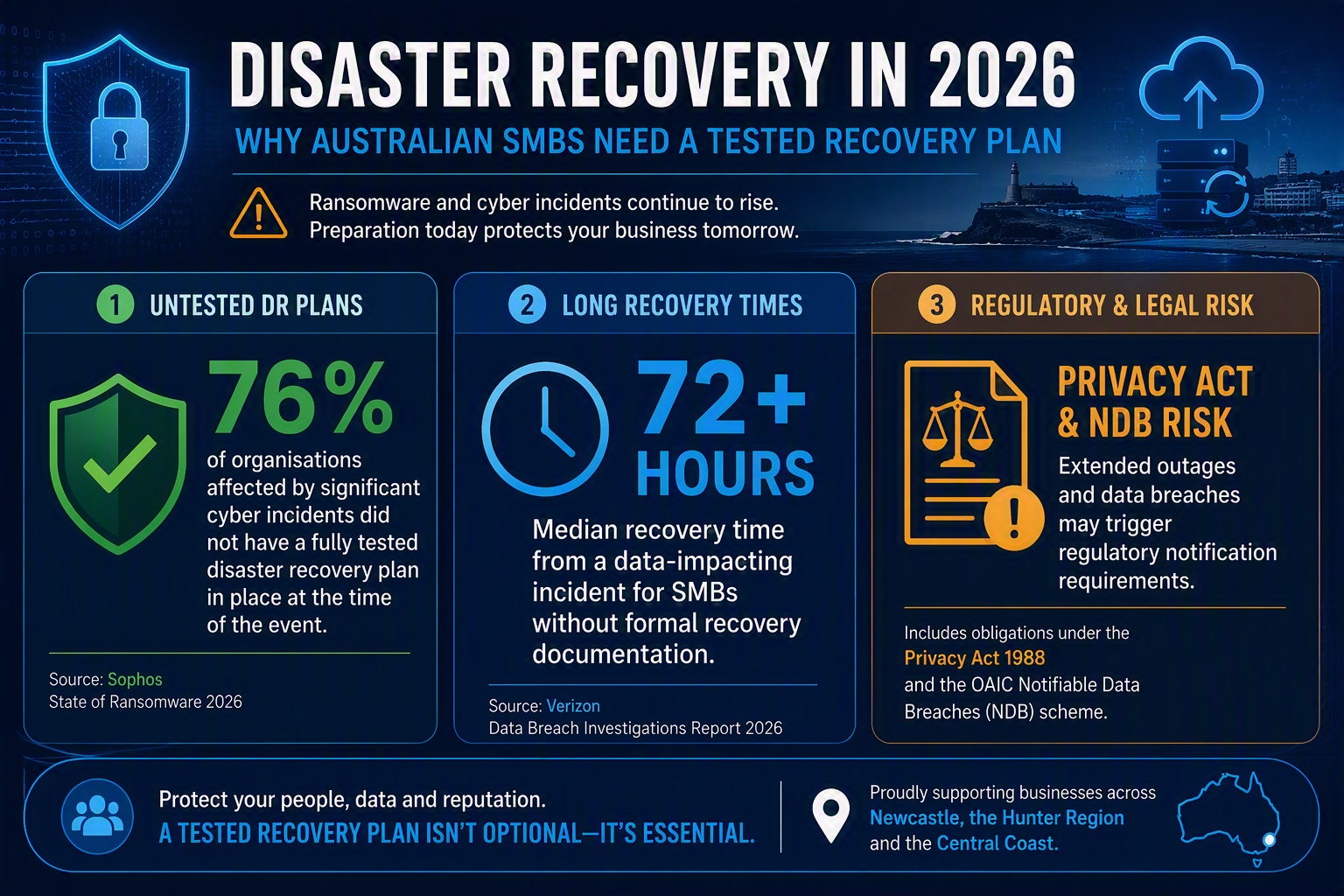
According to the Sophos, 2026 State of Ransomware report, 76% of organisations that experienced a significant cyber incident did not have a fully tested disaster recovery plan in place at the time of the event. That is a staggering gap, particularly when combined with evidence from the Verizon, 2026 Data Breach Investigations Report (DBIR), which found that the median recovery time from a data-impacting incident exceeded 72 hours for SMBs lacking formal recovery documentation.
Business continuity planning and IT disaster recovery are deeply connected disciplines. Businesses that confuse the two, or neglect both, face extended outages, regulatory penalties under the Privacy Act 1988, and potential notification obligations under the Notifiable Data Breaches (NDB) scheme administered by the Office of the Australian Information Commissioner (OAIC).
STEP 1: CONDUCT A BUSINESS IMPACT ANALYSIS BEFORE ANYTHING ELSE
A Business Impact Analysis (BIA) is the foundation of any credible recovery strategy. It identifies which business functions are mission-critical, quantifies the financial and operational harm of their disruption, and prioritises which systems must be restored first.
For a manufacturing business in the Hunter Region, a BIA might reveal that the inventory management system carries far more daily risk than the marketing platform. For a professional services firm in Sydney, the priority may be email and document management. Without this analysis, recovery efforts during a real incident become reactive and disorganised.
STEP 2: DEFINE YOUR RECOVERY TIME OBJECTIVE AND RECOVERY POINT OBJECTIVE
Two metrics define the boundaries of any recovery plan. The Recovery Time Objective (RTO) is the maximum acceptable duration of downtime before the business suffers irreparable harm. The Recovery Point Objective (RPO) is the maximum tolerable period in which data can be lost.
A retail business processing daily transactions may have an RPO of four hours, meaning it cannot afford to lose more than four hours of transaction data. Its RTO might be two hours. These numbers directly inform your backup frequency, redundancy architecture, and overall technology investment. The Recovery time objective guidance from frameworks such as NIST Cybersecurity Framework reinforces that RTO and RPO must be tested, not just documented.
STEP 3: MAP EVERY CRITICAL SYSTEM, APPLICATION AND DATA ASSET
You cannot protect or recover what you have not documented. A thorough asset inventory covers servers, endpoints, cloud workloads, third-party Software as a Service (SaaS) applications, and all data repositories, whether on-premises or in platforms like Microsoft Azure.
This step often surfaces surprises. Many SMBs across Newcastle and the Central Coast discover shadow IT during this process: unauthorised applications storing sensitive data outside formal backup coverage. If you want to understand how shadow technology creeps into businesses, our post on 5 Ways Shadow AI is Creeping Into Your Business outlines the patterns to watch for.
STEP 4: BUILD A TESTED, DOCUMENTED INCIDENT RESPONSE RUNBOOK
An Incident Response Runbook is a step-by-step operational guide that tells your team exactly what to do when something goes wrong. It assigns roles, defines escalation paths, lists contact numbers for vendors and insurers, and documents the precise technical steps to isolate, contain, and restore affected systems.
Many SMBs confuse a vague “we have a plan” with an actual documented and rehearsed runbook. The difference becomes painfully clear at 2am during a ransomware event. The runbook must be version-controlled, stored offline or in a secure out-of-band location, and reviewed every six months at minimum.
Cybersecurity incidents are frequently the trigger for invoking a recovery plan. Our detailed guide on AI Cyber Attacks: Seven Threats Targeting SMBs in 2026 details the attack vectors that are most likely to force your runbook into action this year.
STEPS 5 TO 7: TEST, REVIEW AND PARTNER WITH A TRUSTED AUSTRALIAN MSP FOR DISASTER RECOVERY PLANNING
Steps five, six, and seven form the operational discipline that separates businesses with genuine resilience from those with documentation that has never been challenged.
Step 5: Test your plan with a tabletop exercise. A tabletop exercise walks your leadership and IT teams through a simulated incident scenario without touching live systems. It exposes gaps in decision-making, communication chains, and technical assumptions. Aim to run a full tabletop at least once per year, with smaller technical restore tests quarterly.
Step 6: Review your plan after every significant change. Infrastructure migrations, cloud adoption, new staff, new software, and changes to your supplier network all affect your recovery posture. Every material change to the business environment should trigger a review of the recovery documentation. Disaster recovery compliance under frameworks such as the Australian Signals Directorate’s (ASD) Essential Eight maturity model requires that your backup and recovery controls are regularly validated, not just implemented.
Step 7: Partner with a qualified backup and disaster recovery MSP. For most SMBs, building and maintaining in-house expertise across backup architecture, cloud replication, and incident response is not realistic. A Managed Service Provider (MSP) with proven disaster recovery capabilities provides the technology, testing discipline, and 24/7 monitoring that in-house teams rarely sustain. Businesses in Sydney, Newcastle, and the Hunter Region benefit from working with a provider that understands the local regulatory environment and can respond on the ground when it matters most.
Supply chain vulnerabilities are also a key risk factor in recovery planning. An incident affecting a key vendor can cascade directly into your own operations. Our post on Supply Chain Cyber Attacks Australia: 5 Ways to Stay Safe covers how to harden this exposure as part of a broader resilience strategy.
“A disaster recovery plan that has never been tested is not a plan. It is a hypothesis. Australian SMBs must treat recovery testing as a recurring operational discipline, not a one-time project.”

CONCLUSION: ACT ON YOUR DISASTER RECOVERY PLANNING AUSTRALIA OBLIGATIONS NOW
Effective disaster recovery planning Australia is not a luxury reserved for enterprise organisations with large IT budgets. The seven steps outlined above are achievable for any SMB that is prepared to invest the time and expertise. From conducting a Business Impact Analysis to defining RTO and RPO targets, mapping assets, building a tested runbook, and partnering with a qualified MSP, each step builds measurable resilience into your business. The cost of preparation is a fraction of the cost of recovery without a plan.
Adept IT Solutions works with businesses across Newcastle, Lake Macquarie, the Hunter Region, the Central Coast, and Sydney to build, document, test, and manage disaster recovery frameworks that align with Australian compliance requirements. If your business has not reviewed its recovery posture in the past twelve months, now is the time to act. Contact Adept IT Solutions today to start a no-obligation conversation about protecting your operations.
Frequently Asked Questions
Q: What is disaster recovery planning Australia and why does it matter for SMBs?
A: Disaster recovery planning Australia refers to the documented processes, technologies, and responsibilities that allow a business to restore its IT systems and data following an unplanned disruption. For Australian SMBs, it matters because cyber incidents, hardware failures, and natural disasters can halt operations for extended periods. Without a tested plan, recovery can take days or weeks, causing significant financial loss and potential regulatory penalties under the Privacy Act 1988 and the Notifiable Data Breaches scheme.
Q: What is the difference between a Recovery Time Objective and a Recovery Point Objective?
A: A Recovery Time Objective (RTO) defines the maximum acceptable period of downtime before business operations are critically impaired. A Recovery Point Objective (RPO) defines the maximum amount of data that can be lost, measured in time. For example, an RPO of four hours means your backup and disaster recovery systems must capture data at least every four hours. Both metrics should be defined during a Business Impact Analysis and used to design your backup architecture and replication strategy.
Q: How often should an Australian SMB test its IT disaster recovery plan?
A: IT disaster recovery Newcastle and broader Australian guidance recommends a full tabletop exercise at least annually, combined with quarterly technical restore tests to verify backup integrity and system recovery procedures. Plans should also be reviewed and updated after any significant change to the business environment, including cloud migrations, new software deployments, staff changes, or modifications to supplier and vendor relationships. Untested plans frequently fail during real incidents due to outdated assumptions.
Q: Does business continuity planning cover the same things as disaster recovery?
A: Business continuity planning and disaster recovery are related but distinct disciplines. Business continuity planning covers the broader organisational response to any disruption, including people, processes, communications, and physical operations. Disaster recovery is a subset focused specifically on restoring IT systems, data, and infrastructure. A complete resilience strategy requires both: a business continuity plan that addresses operations at a human and process level, and a disaster recovery plan that addresses the technical restoration of systems and data within defined RTO and RPO targets.
Get in touch with our team of IT experts today! You can contact us via phone at 1300 423 378 or email us at info@adept-it.com.au.

