
Privileged access management has rapidly moved from a best-practice recommendation to an operational necessity. For small and medium businesses (SMBs) across Newcastle, the Hunter Region, Central Coast, and Sydney, unprotected administrator accounts represent one of the most dangerous vulnerabilities in any IT environment. Attackers no longer need to break down the door when they can simply walk in using stolen credentials. The risks are real, escalating, and directly relevant to businesses of every size. Here are seven critical reasons why Australian SMBs cannot afford to delay action.

What Is Privileged Access Management and Why Does It Matter?
Privileged Access Management (PAM) is a cybersecurity discipline that controls, monitors, and audits access to sensitive systems and data by users with elevated permissions. These users include system administrators, IT staff, cloud platform managers, and anyone with the ability to modify configurations, access confidential data, or install software.
For many Australian SMBs, privileged accounts are created during setup and never properly reviewed again. Passwords are shared, accounts are left active after employees leave, and access rights are rarely audited. This creates a sprawling attack surface that sophisticated threat actors actively target. Understanding what PAM is, and why it matters, is the first step toward securing your business.
PAM solutions work by enforcing least-privilege principles, requiring just-in-time access approvals, rotating credentials automatically, and recording privileged sessions for audit purposes. When implemented correctly, PAM dramatically reduces the risk of both external attacks and internal misuse. For businesses wanting to understand the broader identity security landscape, our post on identity security SMB gaps provides essential context.
Why Unprotected Admin Accounts Are Your Highest-Value Target in 2026
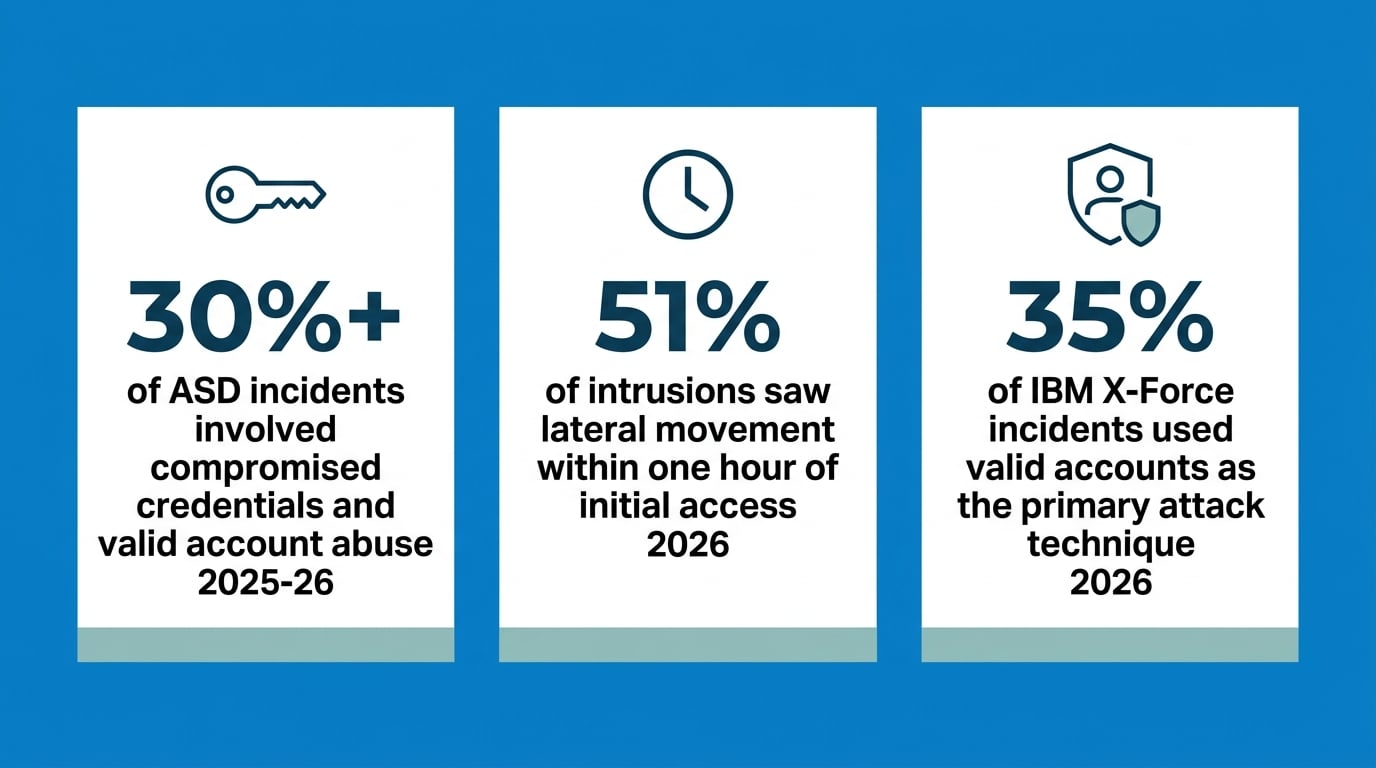
The threat data for 2026 is unambiguous. Australian Signals Directorate, compromised credentials and the abuse of valid accounts were identified as the top initial access method, appearing in over 30% of all incidents responded to. This is not a theoretical risk; it is the documented reality of how Australian businesses are being breached right now.
Once an attacker gains access to a privileged account, the speed of damage is extraordinary. The CrowdStrike, 2026 Global Threat Report found that attackers are moving from initial access to lateral movement in under one hour in 51% of intrusions recorded globally. That gives an unprepared IT team almost no response window.
Compounding this, the IBM X-Force Threat Intelligence Index 2026 recorded valid account abuse as the top action-on-objective technique in 35% of incidents investigated, surpassing malware as the primary threat action. The message is clear: attackers prefer to use legitimate credentials over deploying complex tools, because it is faster, cheaper, and harder to detect.
7 Critical Reasons Australian SMBs Must Implement PAM Without Delay
1. Credential Theft Is the Dominant Attack Vector
The statistics above confirm that stolen credentials are how attackers most commonly enter Australian networks. Without PAM enforcing multi-factor authentication (MFA) and just-in-time access controls on privileged accounts, a single compromised password can grant unrestricted access to your entire infrastructure. PAM removes that single point of failure by layering controls that make credential abuse exponentially harder.
2. Lateral Movement Attacks Exploit Shared Admin Accounts
A lateral movement attack occurs when an attacker uses one compromised account to pivot across systems, escalating privileges and deepening their foothold. Shared administrator accounts are a primary enabler of this technique. PAM enforces unique credentials per user, per session, making lateral movement significantly more difficult to execute undetected. Our article on zero-trust cybersecurity principles explains how this approach complements PAM controls.
3. Insider Threats Are a Real Risk for SMBs
Insider threats are not exclusively a large-enterprise problem. Disgruntled employees, contractors with excessive permissions, and former staff whose accounts were never deprovisioned all represent genuine risks. PAM provides session recording and real-time alerting that creates accountability for every privileged action taken within your environment, regardless of whether the threat is internal or external.
4. Ransomware Deployment Requires Privilege Escalation
Ransomware operators consistently seek privileged access before deploying payloads. Elevated permissions allow them to disable security tools, delete backups, and spread encryption across the entire network rather than a single endpoint. By restricting and monitoring privileged access, PAM creates critical choke points that can interrupt a ransomware attack before it causes catastrophic damage. Businesses should also review their disaster recovery planning strategy as a complementary measure.
5. Supply Chain Compromises Target Third-Party Access
Managed service providers, software vendors, and IT contractors often hold privileged access to client environments. When these third parties are compromised, attackers inherit that access. PAM solutions allow businesses to define, limit, and monitor exactly what third-party accounts can do and when, significantly reducing supply chain exposure. This risk is explored in depth in our guide on supply chain cyber attacks in Australia.
6. Regulatory Compliance Demands Access Controls
The Australian Privacy Act 1988 and its 2024 amendments require organisations to take reasonable steps to protect personal information. Privileged accounts with uncontrolled access to customer data directly undermine this obligation. The Office of the Australian Information Commissioner has consistently highlighted access control failures as contributing factors in notifiable data breaches. PAM provides a documented, auditable control framework that supports compliance obligations.
7. Cyber Insurance Providers Now Scrutinise PAM Controls
The cyber insurance market has hardened considerably. Underwriters are increasingly requiring documented evidence of PAM controls, MFA on privileged accounts, and access reviews as prerequisites for coverage. Businesses without these controls face higher premiums, reduced coverage limits, or outright policy exclusions for credential-based attacks. Implementing PAM is not just a security decision; it is a financial and risk management decision with direct impact on insurance outcomes.
How Attackers Exploit Privileged Accounts to Move Laterally Across Your Network
Understanding attacker methodology helps clarify why PAM is so effective as a defensive control. A typical intrusion targeting an SMB follows a recognisable pattern. First, an attacker obtains initial access through a phishing email, a brute-forced Remote Desktop Protocol (RDP) connection, or a credential purchased from a dark web marketplace. Once inside, the priority shifts to privilege escalation.
With a privileged account compromised, the attacker can disable endpoint detection tools, create new administrator accounts as persistence mechanisms, and map the internal network. From there, lateral movement proceeds rapidly across servers, cloud environments, and connected systems. In environments without PAM, this entire process can occur silently over days or weeks before any alert is triggered.
PAM disrupts this kill chain at multiple points. Session monitoring flags unusual privileged activity in real time. Just-in-time access ensures that privileged accounts do not persistently exist for attackers to discover. Credential vaulting means that even if a user’s standard account is compromised, they cannot self-escalate to administrator level without an approved workflow.
PAM and the Australian Essential Eight: What SMBs Need to Understand
The Australian Government’s Essential Eight framework, developed by the Australian Cyber Security Centre (ACSC), includes restricting administrative privileges as one of its core mitigation strategies. This Essential Eight access control measure directly maps to PAM principles: ensuring that only authorised users hold admin rights, that those rights are reviewed regularly, and that privileged access is time-limited where possible.
For Newcastle and Hunter Region SMBs seeking Essential Eight compliance, PAM implementation is not optional. Achieving Maturity Level 2 or above requires documented access reviews, MFA on all privileged accounts, and controls preventing privileged users from browsing the internet or accessing email from administrative accounts. The Australian Cyber Security Centre provides detailed guidance on meeting these requirements.
Beyond the Essential Eight, organisations pursuing ISO 27001 certification will find that PAM directly supports multiple controls within Annex A, particularly those addressing access control, identity management, and cryptographic key management. A PAM security solution is therefore a dual-purpose investment that simultaneously strengthens security posture and supports formal compliance outcomes.
How Adept IT Solutions Helps Newcastle and Hunter Region Businesses Secure Privileged Access
Adept IT Solutions provides managed IT to Newcastle businesses and organisations across the Hunter Region, Central Coast, and Sydney with end-to-end PAM implementation and ongoing management. Our approach begins with a thorough audit of existing privileged accounts, identifying dormant credentials, shared accounts, and excessive permissions that create unnecessary exposure.
From there, we design and deploy a PAM security solution scaled appropriately for your business size and complexity. We integrate PAM controls with your existing Microsoft 365 and Azure environments, configure just-in-time access policies, deploy credential vaulting, and establish session monitoring with alerting aligned to your incident response procedures.
We also support ongoing compliance reporting, access reviews, and staff awareness training to ensure that PAM controls remain effective as your business grows and your team changes. Our team understands the specific challenges facing Australian SMBs, from limited IT resources to budget constraints, and we design solutions that deliver maximum protection without unnecessary complexity.
“The question is no longer whether attackers will target privileged accounts, but whether your business will have the controls in place to stop them when they do. In 2026, privileged access management is the line between a contained incident and a catastrophic breach.”

Conclusion: The Time to Secure Privileged Access Is Now
The evidence in 2026 is overwhelming. Privileged access management is not a luxury reserved for large enterprises with dedicated security teams. Every SMB operating in Newcastle, the Hunter Region, Central Coast, or Sydney that holds sensitive data, relies on cloud systems, or processes customer information has a privileged access risk that needs to be addressed. The cost of implementing PAM is a fraction of the cost of a breach, a ransom payment, or a regulatory penalty under the Privacy Act.
Adept IT Solutions is ready to help your business take this critical step. From initial audit through to ongoing managed PAM services, our team delivers the expertise and accountability that Australian SMBs need to stay protected in an increasingly hostile threat environment. Contact Adept IT Solutions today to schedule your privileged access review and take control of your security posture before an attacker does it for you.
Frequently Asked Questions
Q: What is privileged access management and why do Australian SMBs need it?
A: Privileged access management (PAM) is a cybersecurity framework that controls and monitors accounts with elevated permissions, such as system administrators and IT staff. For Australian SMBs, PAM is essential because compromised privileged accounts are the leading cause of data breaches in 2026. Without PAM, a single stolen password can give an attacker unrestricted access to your entire network, cloud environment, and sensitive data.
Q: How does PAM relate to the Australian Essential Eight framework?
A: Restricting administrative privileges is one of the eight core mitigation strategies in the Essential Eight access control framework published by the Australian Cyber Security Centre. PAM implementation directly supports this requirement by enforcing least-privilege access, enabling MFA on all privileged accounts, and providing documented access reviews. Achieving Maturity Level 2 or above under the Essential Eight requires PAM-aligned controls as standard practice.
Q: Is privileged access management for small business realistic given budget constraints?
A: Yes. Modern PAM security solutions are designed to scale for small businesses without requiring enterprise-level infrastructure or dedicated security staff. Many PAM platforms are available as cloud-delivered services with predictable monthly costs. When weighed against the average cost of a data breach in Australia, which includes incident response, regulatory penalties, and reputational damage, the investment in a right-sized PAM solution is consistently cost-effective for SMBs.
Q: How quickly can privileged access management Australia be implemented for a Newcastle or Hunter Region business?
A: For most SMBs, an initial PAM deployment covering privileged account discovery, credential vaulting, and MFA enforcement can be completed within two to four weeks. A full implementation including session monitoring, just-in-time access workflows, and integration with Microsoft 365 or Azure typically takes four to eight weeks depending on the complexity of the environment. Adept IT Solutions manages this entire process for businesses across Newcastle, the Hunter Region, and the Central Coast with minimal disruption to daily operations.
Get in touch with our team of IT experts today! You can contact us via phone at 1300 423 378 or email us at info@adept-it.com.au.

