
AI cyber attacks Australian businesses face in 2026 have fundamentally changed the threat landscape. Artificial intelligence (AI) has handed adversaries a powerful force multiplier, enabling them to automate reconnaissance, craft hyper-personalised phishing lures, and compress attack timelines to a fraction of what was previously possible. For small and medium-sized businesses (SMBs) across Newcastle, the Hunter Region, Central Coast, and Sydney, these developments represent a clear and immediate danger. Understanding how these threats work is no longer optional; it is a business survival imperative.
WHAT ARE AI-POWERED CYBER ATTACKS AND WHY AUSTRALIA IS A PRIME TARGET

AI-powered cyber attacks use machine learning algorithms, large language models, and automated tooling to conduct malicious operations at a speed and scale that human operators alone cannot achieve. Adversaries use AI to scan networks for vulnerabilities, generate convincing phishing emails in fluent Australian English, synthesise deepfake audio and video, and adapt malware behaviour in real time to evade detection.
Australia presents a high-value target for several reasons. The country’s open digital economy, high rate of cloud adoption, and concentration of critical industries including mining, healthcare, finance, and professional services make it attractive to both state-sponsored actors and financially motivated criminal groups. SMBs often hold valuable supply chain access or sensitive customer data, yet operate with leaner security resources than large enterprises.
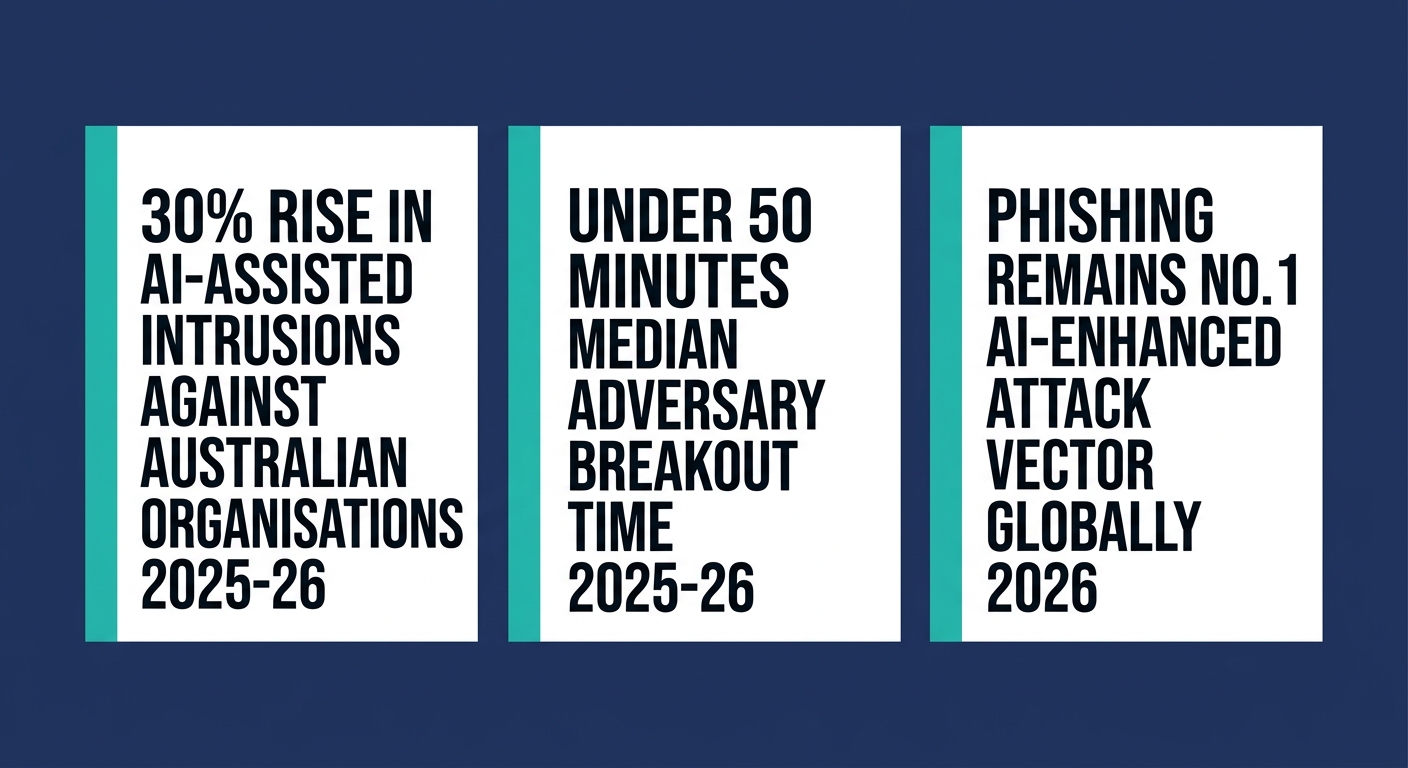
According to the Australian Signals Directorate (ASD) / Australian Cyber Security Centre (ACSC), 2026, AI-generated phishing and deepfake-assisted intrusions contributed to a 30% rise in successful initial access events against Australian organisations in 2025-26. This statistic alone should prompt every business leader to reassess their current security posture.
HOW ADVERSARIES ARE USING AI TO BREACH AUSTRALIAN SMBs: AI-GENERATED PHISHING AND BEYOND
The methods adversaries use have grown significantly more sophisticated in 2026. AI-generated phishing emails are now virtually indistinguishable from legitimate business communications. Attackers feed AI tools with publicly available information gathered from LinkedIn, company websites, and social media to construct contextually accurate, personalised messages that bypass traditional spam filters and fool even cautious employees.
Business email compromise (BEC) has evolved through deepfake voice cloning. Criminals synthesise audio of a known executive and call finance staff with urgent payment instructions. Several Australian businesses have suffered significant financial losses through this attack vector in 2025-26. These attacks require no technical vulnerability; they exploit human trust.
Phishing and social engineering, increasingly AI-enhanced, remained the top initial infection vector globally in 2025-26, appearing in the majority of analysed breaches, according to the Verizon Data Breach Investigations Report (DBIR), 2026. For SMBs in regional areas such as Newcastle and Lake Macquarie, where IT security awareness training may be less mature, this vector poses particular risk.
THE SEVEN AI-DRIVEN THREAT TECHNIQUES SURGING ACROSS AUSTRALIAN NETWORKS IN 2026
The following seven techniques represent the most active AI-driven threats observed across Australian networks in 2026. Each presents unique challenges for organisations relying on conventional defences.
1. AI-Generated Spear Phishing
Attackers use large language models to generate highly targeted phishing emails tailored to individual recipients. These messages reference real projects, colleagues, and business events, making them extraordinarily convincing and difficult to identify without advanced filtering solutions.
2. Deepfake Voice and Video Impersonation
Real-time audio and video synthesis enables criminals to impersonate executives during calls and video conferences. Finance and payroll staff are the most common targets, manipulated into authorising fraudulent transfers or revealing sensitive credentials.
3. Automated Vulnerability Discovery
AI-powered reconnaissance tools scan thousands of IP addresses per second, identifying unpatched systems, exposed remote desktop protocol (RDP) ports, and misconfigured cloud storage buckets. SMBs with limited patch management processes are particularly exposed to this technique.
4. Polymorphic Malware
AI-driven polymorphic malware rewrites its own code on each execution, generating unique signatures that evade signature-based antivirus solutions. Machine learning threat detection is required to identify these threats based on behaviour rather than known signatures.
5. AI-Accelerated Ransomware
Ransomware operators now use AI to identify the most valuable data on a network before encrypting it, maximising leverage for extortion. Attacks that once took days to execute are now compressed into hours, leaving organisations with almost no window to contain the threat.
6. Credential Stuffing at Machine Speed
AI systems automate credential stuffing campaigns, testing billions of username and password combinations across multiple platforms simultaneously. Businesses that have not implemented multi-factor authentication (MFA) and identity security controls are highly vulnerable to this vector.
7. AI-Powered Living-Off-the-Land Attacks
Attackers use AI to orchestrate living-off-the-land (LotL) attacks, leveraging legitimate system tools such as PowerShell and Windows Management Instrumentation (WMI) to conduct malicious activity. These attacks leave minimal forensic footprints and are extremely difficult to detect without behavioural analytics.
WHY TRADITIONAL DEFENCES ARE FAILING AGAINST AI CYBER ATTACKS
Conventional perimeter-based security tools were designed to counter threats that operate on human timescales. Firewalls, signature-based antivirus, and manual security monitoring simply cannot keep pace with machine-speed attacks. The gap between attacker capability and defender capability has widened considerably in 2026.
CrowdStrike’s 2026 Global Threat Report recorded a median intrusion breakout time of under 50 minutes, leaving minimal window for human-led response. In practical terms, this means that by the time an alert is triaged by an internal IT team, an adversary may already have moved laterally across the network and exfiltrated data.
Many Australian SMBs also operate without a formal security operations capability. They rely on endpoint protection tools and reactive support, without the 24/7 monitoring and automated response capabilities that modern threats demand. As detailed in our post on cybersecurity challenges in 2026, the threat environment has shifted faster than many businesses have been able to adapt.
Compliance frameworks such as the Essential Eight and ISO 27001 provide valuable guidance, but compliance alone does not equal security. Organisations that treat compliance as a checkbox exercise rather than a living security programme remain exposed to AI-driven threats that evolve continuously.
“Adversaries are no longer constrained by human speed. They deploy AI to compress every phase of an attack, from reconnaissance to exfiltration, into windows too narrow for reactive defences to close. The only effective answer is to match that speed with AI-augmented detection and response.” — ASD Threat Report 2026 context, Adept IT Solutions analysis.
HOW MANAGED DETECTION AND RESPONSE COUNTERS AI CYBER ATTACKS AUSTRALIAN BUSINESSES FACE IN REAL TIME
Managed Detection and Response (MDR) is the security model best positioned to address machine-speed threats. MDR combines AI-powered telemetry analysis, threat hunting, and human expert oversight operating 24 hours a day, seven days a week. When an anomaly is detected, automated playbooks can isolate affected endpoints within seconds, well ahead of the 50-minute breakout window.
Machine learning threat detection platforms ingest vast volumes of network, endpoint, and identity telemetry. They establish behavioural baselines and flag deviations in real time, identifying threats that signature-based tools would miss entirely. This is particularly valuable for detecting polymorphic malware and LotL attacks. Our overview of MDR in cybersecurity explains the model in detail for organisations evaluating their options.
For SMBs in Newcastle, the Hunter Region, and across managed IT Newcastle client bases, MDR delivered through a trusted managed service provider removes the need to build and staff an internal security operations centre (SOC). This makes enterprise-grade threat detection accessible at a cost point that aligns with SMB budgets.
The IBM X-Force Threat Intelligence Index consistently highlights that organisations with continuous monitoring and rapid response capabilities suffer significantly lower breach costs and shorter dwell times than those relying solely on reactive defences. The business case for MDR is clear and quantifiable.
STEPS AUSTRALIAN BUSINESSES SHOULD TAKE RIGHT NOW TO REDUCE AI THREAT EXPOSURE
Reducing exposure to AI-driven threats requires a layered, proactive security strategy. The following steps represent immediate priorities for Australian SMBs in 2026.
Implement MFA universally across all user accounts, particularly for Microsoft 365, VPN, and cloud platforms. Credential-based attacks account for a significant proportion of initial access events, and MFA remains one of the highest-impact controls available.
Adopt a Zero Trust security architecture. Assume breach and verify every access request, regardless of whether it originates inside or outside the network perimeter. Our detailed guide on Zero Trust in cybersecurity outlines practical implementation steps for SMBs.
Conduct regular phishing simulation training. Employees are the first line of defence against AI-generated phishing. Ongoing, realistic phishing simulations build the muscle memory needed to identify and report suspicious messages before they cause harm.
Maintain rigorous patch management. Automated vulnerability discovery tools target unpatched systems. A structured, prioritised patching programme removes the most commonly exploited footholds before attackers can use them.
Review backup and disaster recovery (DR) processes. Offline, immutable backups are the last line of defence against ransomware. Ensure recovery time objectives (RTOs) and recovery point objectives (RPOs) are tested regularly and align with business continuity requirements.
Organisations seeking a comprehensive defence framework should also review our guide on seven defences against AI-powered cyber attacks, which covers additional controls including network segmentation and supply chain security. The ASD Essential Eight framework also provides a structured baseline that Australian businesses can implement progressively.
CONCLUSION: ACTING ON THE AI CYBER ATTACKS THREAT BEFORE IT ACTS ON YOU

The scale and sophistication of AI cyber attacks Australian organisations face in 2026 demand a fundamentally different security response. Passive, perimeter-based defences are no longer sufficient. Businesses that delay investment in proactive detection, identity security, and continuous monitoring are accepting a risk profile that grows more dangerous with every passing month.
The good news is that enterprise-grade protection is accessible to Australian SMBs through the right managed service partner. Adept IT Solutions delivers cyber security services businesses across Newcastle, the Hunter Region, Central Coast, and Sydney can rely on, with MDR, cloud security, compliance support, and 24/7 managed IT helpdesk all available under a single, scalable engagement. The time to act is now, before an adversary’s AI finds the gap yours has left open.
Book a free consultationFrequently Asked Questions
Q: What makes AI cyber attacks Australian businesses face in 2026 different from traditional cyber threats?
A: Traditional cyber attacks relied heavily on manual effort and known exploit kits. AI cyber attacks Australian organisations now face are automated, adaptive, and operate at machine speed. Adversaries use AI to generate convincing phishing content, discover vulnerabilities in seconds, mutate malware to evade detection, and compress intrusion timelines to under 50 minutes. This speed and adaptability overwhelms defences designed for slower, human-paced threats, making machine learning threat detection and 24/7 managed monitoring essential components of a modern security programme.
Q: How can Australian SMBs protect themselves against AI-generated phishing attacks?
A: Protecting against AI-generated phishing requires a layered approach. Businesses should implement advanced email filtering with AI-assisted anomaly detection, conduct regular phishing simulation training for all staff, enforce MFA on all accounts, and adopt DMARC, DKIM, and SPF email authentication protocols. Because AI-generated phishing is nearly indistinguishable from legitimate email, human awareness training must be ongoing rather than a once-per-year exercise. Partnering with a managed IT provider for continuous monitoring adds an additional layer of detection and response capability.
Q: Is the ASD Essential Eight sufficient to defend against AI-driven cyber threats?
A: The ASD Essential Eight provides an excellent foundational baseline and addresses many of the vectors AI-driven attacks exploit, including patching, application control, and MFA. However, compliance with the Essential Eight at Maturity Level One or Two does not provide complete protection against sophisticated, AI-powered threats. Businesses should pursue higher maturity levels and complement the framework with behavioural threat detection, identity security controls, and continuous monitoring through an MDR or managed security service. The Essential Eight is a starting point, not a complete solution.
Q: How does Adept IT Solutions help businesses in Newcastle and the Hunter Region respond to AI-powered cyber threats?
A: Adept IT Solutions delivers end-to-end cyber security services businesses in Newcastle, Lake Macquarie, the Hunter Region, Central Coast, and Sydney can access without needing an internal security team. Services include managed detection and response, 24/7 helpdesk support, cloud and Microsoft 365 security hardening, backup and disaster recovery, identity security, and compliance advisory across the Essential Eight, ISO 27001, and the Privacy Act. Businesses receive proactive, real-time protection scaled to their size and risk profile, backed by a local team that understands the regional threat landscape.
Get in touch with our team of IT experts today! You can contact us via phone at 1300 423 378 or email us at info@adept-it.com.au.

