
Server misconfiguration risks are no longer a concern reserved for large government agencies, as a major cybersecurity incident at NSW Health made clear in late October 2026. Unauthorised access was discovered on 29 October 2026, when a hacker identifying as ‘ByteToBreach’ claimed to have accessed approximately 70 gigabytes of data through a misconfigured subdomain on the Oral Health Fee For Service Scheme website. ABC News, November 2026 reported that NSW Police and Cyber Security NSW declared the event a major incident, with alleged data samples posted on an underground forum. For small and medium-sized businesses (SMBs) across Newcastle, the Hunter Region, and the Central Coast, this breach is a direct warning.

What the NSW Health Breach Means for Your Business
The NSW Health incident involved an isolated server within a government health website. Despite this isolation, an improperly configured subdomain was sufficient for a threat actor to gain access and exfiltrate a significant volume of data. NSW Health confirmed that police had been notified and the breach met the threshold to be classified as a major incident under the state’s emergency cyber sub-plan.
SMBs often assume that cyberattacks target only large organisations with high-value data. That assumption is dangerous. Threat actors increasingly scan for exposed, misconfigured systems across the internet regardless of the organisation’s size. If your server, subdomain, or cloud environment is improperly configured, it is a target. The question is not whether your systems will be probed, but whether they are hardened when they are.
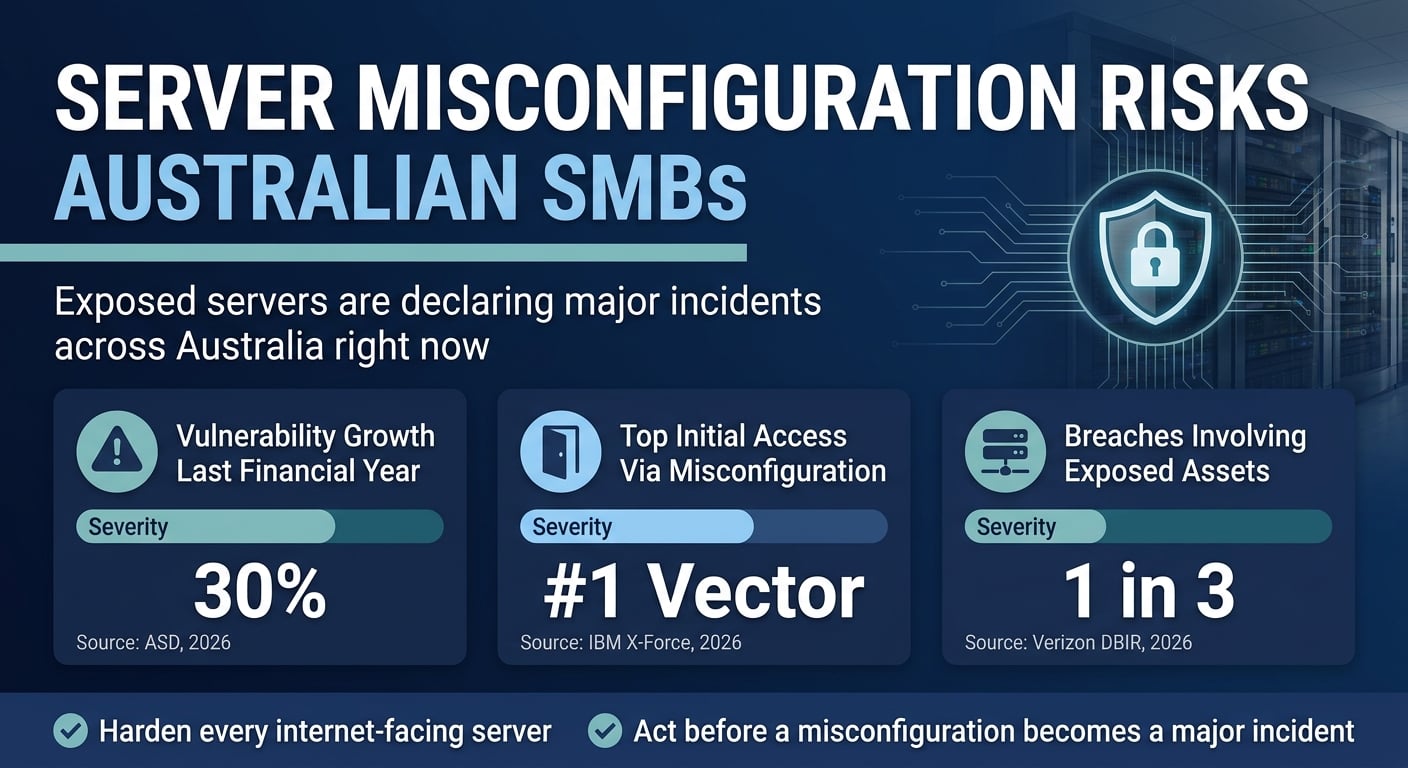
According to the Australian Signals Directorate, 2026, publicly reported software vulnerabilities rose 30 per cent in the 2025-26 financial year, with some exploited within 48 hours of disclosure. That window leaves almost no margin for delay when a vulnerability is announced.
What Is a Server Misconfiguration and Why Is It Dangerous?
A server misconfiguration occurs when a server, application, or network device is set up incorrectly, leaving it exposed to unauthorised access. This can include open ports, default credentials, overly permissive access controls, or publicly accessible administrative interfaces. These errors are frequently introduced during deployment and left undetected for months or years.
Misconfiguration is particularly dangerous because it does not require a sophisticated exploit. An attacker simply finds an open door that was never properly locked. The IBM X-Force Threat Intelligence Index identified misconfiguration and exploitation of public-facing applications as among the top initial access vectors in reported incidents in 2026. This means attackers are actively prioritising these weaknesses as entry points.
For businesses without a dedicated IT security audit process, misconfigurations accumulate silently. A web application deployed for one purpose can expose an entire internal network if its subdomain is not locked down. The NSW Health breach illustrates exactly this risk in a real-world context. Reviewing your exposure is not optional. It is a business continuity requirement.
9 Server Misconfiguration Risks Australian SMBs Must Address Right Now
1. Misconfigured Subdomains and DNS Records
The NSW Health breach originated from a misconfigured subdomain, making this the most topical risk on this list. Subdomains are often created for specific projects, testing environments, or legacy systems and then forgotten. Without proper DNS security for small business, these orphaned subdomains can be exploited or taken over. Conduct a full audit of your DNS records and decommission anything no longer in active, managed use.
2. Default Credentials Left Unchanged
Factory-default usernames and passwords on servers, routers, firewalls, and Internet of Things (IoT) devices remain one of the most common and easily exploited vulnerabilities. Attackers use automated tools to scan for devices still running default credentials. Every device deployed across your Newcastle or Hunter Region office network should have its credentials changed immediately upon installation and managed through a password management policy.
3. Open or Unnecessary Ports
Many servers are deployed with numerous ports open by default, only a fraction of which are required for business operations. Each open port is a potential entry point. A firewall policy that blocks all ports by default and permits only those explicitly required (a deny-all, permit-by-exception model) significantly reduces your attack surface. Regular port scanning should be part of any vulnerability management programme for Australian SMBs.
4. Overly Permissive Access Controls
When users are granted broader access than their role requires, any compromise of that account gives an attacker the same broad access. The principle of least privilege dictates that every user, service account, and application should have the minimum permissions needed to perform its function. Review your access control lists regularly, especially following staff changes or system updates.
5. Unpatched or Outdated Software
The Australian Signals Directorate Annual Cyber Threat Report confirmed that some vulnerabilities were exploited within 48 hours of public disclosure in 2026. Running unpatched software on a public-facing server is equivalent to leaving a known unlocked window in a building. Automated patch management, combined with a tested patching schedule, is a non-negotiable baseline for server hardening in Australia. This is also a core requirement under the Australian Signals Directorate (ASD) Essential Eight framework.
6. Publicly Exposed Administrative Interfaces
Administrative control panels, database management interfaces, and remote desktop services should never be exposed directly to the public internet. When these interfaces are internet-accessible, attackers can attempt brute-force login attacks continuously without any friction. Administrative access should be restricted to internal networks or secured via a secure remote access solution, such as a virtual private network (VPN) with multi-factor authentication (MFA).
7. Cloud Storage Buckets and Containers Left Open
Cloud misconfiguration is a growing issue as more Australian SMBs migrate workloads to platforms such as Microsoft Azure and Microsoft 365. Publicly accessible storage containers, misconfigured sharing permissions, and open application programming interfaces (APIs) can expose sensitive business and customer data to anyone with the right URL. The Verizon Data Breach Investigations Report found that over one in three data breaches globally involved misconfigured or internet-exposed assets as a contributing factor in 2026.
8. Inadequate Logging and Monitoring
In the NSW Health incident, unauthorised access was discovered on 29 October 2026, but it is not yet clear when access first occurred. Without comprehensive logging and real-time monitoring, breaches can persist for extended periods before detection. Every server should maintain detailed access logs, and those logs should be reviewed regularly through automated alerting. If your business lacks a centralised Security Information and Event Management (SIEM) capability, you are likely missing active intrusion indicators. For more on how zero-day exploits affect small business, the risks of delayed detection are significant.
9. Missing or Misconfigured Backup Systems
Even when a misconfiguration is exploited, the ability to recover quickly depends on the integrity of your backup environment. Backups stored on the same server or network segment that was compromised are equally at risk. Segregated, encrypted, and regularly tested backups are essential. Review our guidance on cloud backup compliance mistakes that Australian SMBs commonly make to ensure your recovery capability is not compromised before you need it most.
How a Misconfigured Subdomain Became a 70 GB Data Disaster
The mechanics of the NSW Health breach are instructive. A subdomain of the Oral Health Fee For Service Scheme website was allegedly accessible in a way that allowed the attacker, using the alias ‘ByteToBreach’, to traverse to backend server resources. From there, approximately 70 gigabytes of data was reportedly accessed and samples were posted to an underground forum as proof.
What makes this particularly relevant for Sydney and Central Coast businesses is the simplicity of the attack vector. No sophisticated zero-day exploit appears to have been required. The misconfiguration itself provided sufficient access. This pattern is consistent with broader global trends, as the IBM X-Force report noted that exploitation of public-facing applications through misconfiguration is a leading initial access method.
For businesses managing web applications, customer portals, or any internet-facing service, this breach is a blueprint of what can go wrong when configuration hygiene is neglected. Even a single improperly locked subdomain can serve as an open gateway to your entire server environment.
Understanding Server Misconfiguration Risks Under Australian Privacy Law
Australian businesses handling personal information are subject to obligations under the Privacy Act 1988 and the Notifiable Data Breaches (NDB) scheme. If a server misconfiguration leads to unauthorised access to personal information, the business responsible may be required to notify both the Office of the Australian Information Commissioner (OAIC) and affected individuals. The OAIC has the authority to investigate and impose significant penalties for non-compliance.
The NSW Health breach was declared a major incident under the state’s emergency cyber sub-plan, triggering mandatory reporting and coordination with law enforcement. While government agencies operate under different frameworks, private sector businesses are not exempt from comparable obligations. Privacy Act compliance requires organisations to take reasonable steps to protect personal information, and a preventable misconfiguration is difficult to characterise as a reasonable security posture.
Beyond the Privacy Act, businesses seeking alignment with frameworks such as ISO 27001 or the ASD Essential Eight will find that server hardening and configuration management are foundational controls. If your organisation has not yet assessed its exposure against these frameworks, the ASD Essentials framework changes are worth reviewing. Our post on the ASD Essentials Framework for SMBs outlines what has changed and what your business needs to address.
The reputational damage from a publicly disclosed breach also carries long-term consequences. Customers, partners, and stakeholders in Newcastle, the Hunter Region, and Sydney increasingly expect businesses to demonstrate due diligence in their cybersecurity practices. A breach attributed to a preventable misconfiguration can erode that trust rapidly and permanently.
How Adept IT Solutions Helps Hunter Region Businesses Harden Their Systems
Adept IT Solutions works with businesses across Newcastle, Lake Macquarie, the Hunter Region, the Central Coast, and Sydney to identify and remediate server misconfiguration risks before they become incidents. Our approach combines regular IT security audits, continuous monitoring, and structured remediation planning aligned to the ASD Essential Eight and ISO 27001 frameworks.
Our managed IT services include configuration baseline management, patch management, privileged access reviews, and cloud security assessments. For businesses running Microsoft 365 or Azure environments, we conduct environment-specific hardening reviews. Our team can also assist with subdomain and DNS audits for any organisation concerned about exposure similar to the NSW Health incident.
We also recognise that many SMBs are managing cyber fatigue warning signs alongside day-to-day operations. Our role as a managed service provider is to take the complexity of server hardening off your team’s plate so that your business can focus on growth, not remediation.
The CrowdStrike Global Threat Report consistently highlights that organisations with mature configuration management practices suffer fewer successful intrusions. Investing in proper IT security hygiene today is substantially less costly than the incident response, legal exposure, and reputational damage that follows a breach.
“A misconfigured server does not announce itself. It waits silently until someone finds the unlocked door. For Australian SMBs, the question is whether that someone is your IT provider conducting an audit, or a threat actor posting your data on a forum.”

Act Before Your Business Becomes the Next Headline
The NSW Health breach demonstrates that server misconfiguration risks are real, present, and capable of triggering major incident declarations even at well-resourced government organisations. For SMBs across Newcastle, the Hunter Region, the Central Coast, and Sydney, the lesson is unambiguous: configuration hygiene is not a luxury feature of enterprise IT. It is a baseline requirement for any business operating internet-facing systems.
Address the nine risks outlined above. Commission an IT security audit. Review your DNS records, patch your servers, restrict your administrative interfaces, and confirm your backup environment is fully segregated. If you have experienced warning signs such as unusual account activity or unexpected outbound traffic, do not wait. Act now before a misconfiguration becomes a 70-gigabyte crisis of your own.
Adept IT Solutions is ready to help your business assess and address these risks today. Contact Adept IT Solutions to book a no-obligation consultation and take the first step toward a properly hardened environment.
Frequently Asked Questions
Q: What are the most common server misconfiguration risks for Australian SMBs?
A: The most common server misconfiguration risks include misconfigured subdomains, unchanged default credentials, unnecessary open ports, overly permissive access controls, unpatched software, publicly exposed administrative interfaces, unsecured cloud storage, inadequate logging, and poorly segregated backup environments. Each of these can be exploited without sophisticated tools, as the NSW Health breach in October 2026 demonstrated. Regular IT security audits are the most effective way to identify and remediate these gaps before they are exploited.
Q: Does a misconfigured server trigger Privacy Act compliance obligations in Australia?
A: Yes. Under the Privacy Act 1988 and the Notifiable Data Breaches scheme, Australian businesses that experience unauthorised access to personal information resulting from a server misconfiguration may be required to notify the Office of the Australian Information Commissioner and affected individuals. The OAIC considers whether a business took reasonable steps to protect personal data, and a preventable misconfiguration is unlikely to satisfy that standard. Businesses should treat server hardening as both a security and a Privacy Act compliance requirement.
Q: How often should a business in Newcastle or the Hunter Region conduct a server hardening review?
A: At a minimum, a server hardening review should be conducted annually, with additional reviews triggered by significant changes such as new server deployments, cloud migrations, software updates, or staff turnover in IT roles. For businesses managing customer data or operating in regulated industries, quarterly configuration reviews are strongly recommended. An IT security audit from a managed service provider such as Adept IT Solutions can benchmark your current configuration against frameworks like the ASD Essential Eight and ISO 27001 to identify gaps specific to your environment.
Q: Can a small business realistically address all these server misconfiguration risks without a dedicated IT team?
A: Yes, with the right managed IT support partner. Many SMBs across Sydney, the Central Coast, and the Hunter Region operate without internal IT security specialists, which is precisely why managed IT services exist. A qualified managed service provider can implement automated patch management, conduct regular security audits, enforce access control policies, and monitor your environment continuously. Outsourcing these functions to a specialist is often more cost-effective than the alternative of discovering a misconfiguration after a breach has already occurred.
Get in touch with our team of IT experts today! You can contact us via phone at 1300 423 378 or email us at info@adept-it.com.au.

