
Zero-day exploits for small business are no longer a theoretical risk buried in enterprise threat reports. They are an active, immediate danger that Australian small and medium-sized businesses (SMBs) face every single day. A zero-day exploit targets a software vulnerability that the vendor has not yet discovered or patched, giving attackers a window of opportunity that defenders cannot close in time. For SMBs across Newcastle, the Hunter Region, the Central Coast, and Sydney, this is a problem that size or obscurity cannot protect against. Understanding zero-day exploits for small business is critical for defending your assets.

What Is a Zero-Day Exploit and Why Should SMBs Worry Right Now
With the rise of zero-day exploits for small business, it is essential for owners to recognize the threats and take proactive measures to mitigate risks.
Zero-day exploits for small business can disrupt operations and lead to significant financial losses, making awareness crucial.
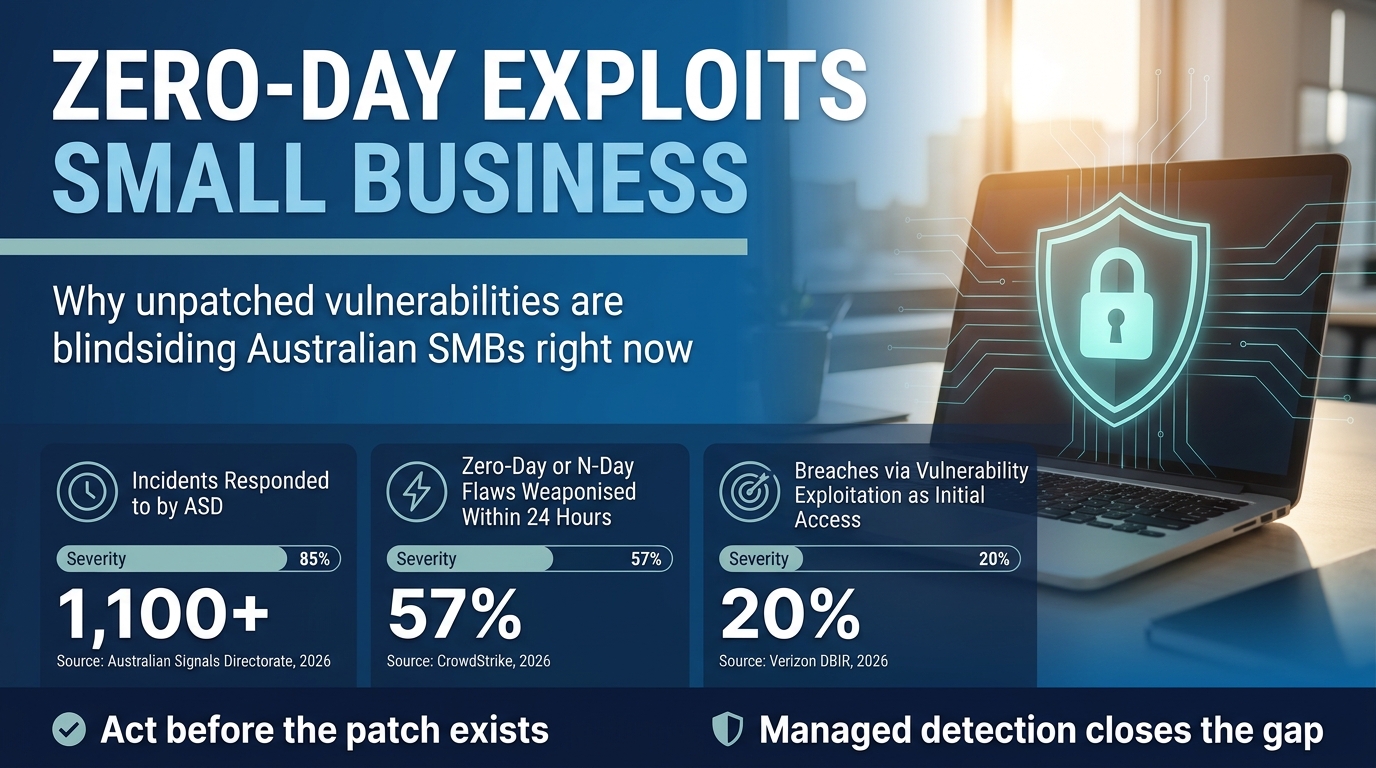
A zero-day vulnerability is a software flaw unknown to the developer. When cybercriminals discover and weaponise that flaw before a patch exists, it becomes a zero-day exploit. The term “zero-day” refers to the number of days a vendor has had to fix the problem: zero. For Australian SMBs, the danger is compounding rapidly. According to the CrowdStrike Global Threat Report 2026, 57% of vulnerability exploits observed in 2025 involved zero-day or n-day flaws weaponised within 24 hours of public disclosure.
That 24-hour window is not long enough for most SMBs to even identify the problem, let alone respond to it. Without a dedicated security team or a vulnerability management programme, most small businesses are exposed for days, weeks, or longer before action is taken.
By understanding zero-day exploits for small business, you can better prepare your defences against potential attacks.
Zero-day exploits for small business often go unnoticed until damage has been done, emphasizing the need for vigilance.
Why Zero-Day Exploits Target Small Businesses More Than You Think
Awareness of zero-day exploits for small business will help owners understand their risk landscape.
The reality is that zero-day exploits for small business can strike at any moment, and preparedness is vital.
Every small business owner should be informed about zero-day exploits for small business to effectively manage their security risks.
There is a persistent myth that cybercriminals only target large organisations. The reality is the opposite. SMBs are attractive precisely because they typically lack the endpoint protection for SMBs, the threat intelligence service capability, and the patch discipline that larger enterprises maintain. Attackers automate their scanning tools to find vulnerable systems at scale, and unpatched software vulnerabilities across SMB networks are discovered in bulk.
The Verizon Data Breach Investigations Report 2026 found that exploitation of vulnerabilities as an initial access vector rose to 20% of all breaches analysed, overtaking phishing as the second most common entry method. That is a significant shift and a direct warning for Australian SMBs that have historically focused their defences on email-based threats.
The 9 Ways Zero-Day Exploits for Small Business Catch Owners Off Guard
1. Relying Solely on Antivirus Software
Zero-day exploits for small business are becoming more common, highlighting the importance of cybersecurity.
Traditional antivirus tools rely on known threat signatures. A zero-day exploit, by definition, has no signature yet. Many SMBs assume their antivirus is a complete solution when it only addresses previously catalogued threats. Behavioural detection and next-generation endpoint protection for SMBs are required to identify anomalous activity before damage occurs.
Protecting against zero-day exploits for small business requires a proactive approach to IT security.
2. Delayed or Inconsistent Patch Management
Investing in tools to combat zero-day exploits for small business is increasingly vital in today’s digital landscape.
When a zero-day becomes public and a patch is released, the race begins. Businesses that patch within hours dramatically reduce their risk. Those that take days or weeks do not. Poor patch management practices are among the most common reasons SMBs suffer avoidable breaches, particularly after a vulnerability becomes publicly known and exploit code is shared on criminal forums.
The threat landscape includes zero-day exploits for small business, which can be unpredictable and highly damaging.
3. No Network Segmentation
When every device on a network can communicate freely with every other device, a single compromised endpoint can expose an entire business. Network segmentation limits lateral movement. Without it, attackers who exploit a vulnerability in one system can pivot quickly across the entire environment, escalating privileges and accessing sensitive data with minimal friction.
The impact of zero-day exploits for small business can be severe, necessitating a robust incident response plan.
4. Unmonitored Internet-Facing Applications
Zero-day exploits for small business should be on every owner’s radar to ensure continued safety and security.
The Australian Signals Directorate Annual Cyber Threat Report 2026 identified exploitation of public-facing applications among the top reported incident categories for Australian businesses. Web portals, remote desktop services, and business applications exposed to the internet without monitoring are prime targets. Many SMBs have no visibility into what is exposed or whether it has been probed.
Zero-day exploits for small business often result from inadequate security measures, which can lead to devastating effects.
5. Overlooking Third-Party Software and Plugins
Zero-day exploits frequently target third-party software components: browser plugins, content management system extensions, PDF readers, or productivity add-ins. SMBs often focus patching attention on operating systems while ignoring the broader software ecosystem. Attackers exploit this blind spot aggressively, using plugins and integrations as entry points into otherwise defended systems.
6. No Threat Intelligence Service in Place
A threat intelligence service aggregates information about emerging vulnerabilities and active exploit campaigns in near real time. Without it, SMBs are reacting to threats they read about in the news rather than preparing for threats identified hours earlier. Managed IT Newcastle providers that offer threat intelligence integration give clients a critical early-warning advantage that in-house teams rarely replicate.
To navigate challenges posed by zero-day exploits for small business, engaging with IT experts is advisable.
7. Inadequate Backup and Recovery Capability
Taking action against zero-day exploits for small business helps create a safer digital environment.
Remaining aware of zero-day exploits for small business can save organisations from potential ruin.
Addressing zero-day exploits for small business can significantly lower the risk of cyber incidents.
Zero-day exploits for small business are not just a concern for large corporations; they affect the entire business landscape.
Zero-day exploits for small business necessitate constant updates to security measures and protocols.
Even when a zero-day exploit succeeds, robust backups limit the damage. SMBs without tested, immutable backups have no clean recovery path after ransomware or data destruction. Backup gaps mean that even a recoverable incident becomes a catastrophic one. Reviewing your cloud backup compliance posture is an essential step in zero-day resilience.
Zero-day exploits for small business remind us that cyber threats are ever-evolving, requiring constant vigilance and adaptation.
8. Insufficient Employee Security Awareness
Understanding the nature of zero-day exploits for small business is essential to safeguarding your organisation.
A comprehensive security posture against zero-day exploits for small business includes both technology and training.
Proactive measures against zero-day exploits for small business can significantly mitigate risks and improve resilience.
Educating employees about zero-day exploits for small business is a critical component of an effective security strategy.
Zero-day exploits are increasingly delivered through social engineering. A malicious attachment or a crafted link can trigger a vulnerability in a document viewer or browser before any patch exists. Employees who lack security awareness training are more likely to execute the payload unknowingly. Human behaviour remains a critical factor in zero-day exploit chains.
9. No Incident Response Plan
When a zero-day exploit hits, the first 60 minutes determine whether containment is possible or whether the business faces full compromise. SMBs without a documented incident response plan waste those critical minutes in confusion. Clear escalation procedures, defined roles, and pre-approved isolation steps can mean the difference between a contained incident and a business-threatening breach.
How Fast Do Attackers Move After a Zero-Day Is Disclosed
The speed of exploitation after public disclosure has accelerated dramatically. The 24-hour weaponisation window identified in the 2026 CrowdStrike data means that by the time a vendor publishes an advisory, automated exploit scanners may already be probing internet-facing systems. The Sophos Annual Threat Report has consistently highlighted the narrowing gap between vulnerability disclosure and mass exploitation across SMB-targeted campaigns.
For businesses without automated monitoring, that speed is impossible to match manually. Human-driven patch processes that depend on IT staff reading advisories, testing updates, and scheduling maintenance windows simply cannot keep pace. This is precisely why proactive, managed security services have become a practical necessity rather than a premium option for Australian SMBs.
What Managed IT Services Can Do to Reduce Your Zero-Day Exposure
A managed IT provider combines continuous monitoring, rapid patch deployment, and threat intelligence feeds to dramatically reduce the window between disclosure and protection. For SMBs in Newcastle, Lake Macquarie, and the Hunter Region, access to managed IT Newcastle services means having enterprise-grade security operations without the enterprise cost. This includes 24/7 monitoring, automated patch management, and incident response capability that most SMBs cannot build internally.
Aligning your security posture to the ASD Essentials Framework provides a structured baseline that directly addresses the conditions zero-day exploits rely on. Controls such as application control, macro restrictions, and privileged access management all limit what an attacker can do even when an unpatched vulnerability exists. These controls do not stop every zero-day, but they contain the blast radius significantly.
The Australian Cyber Security Centre recommends a layered security approach precisely because no single control eliminates zero-day risk. Network monitoring, endpoint detection, identity controls, and backup resilience must work together to protect Australian SMBs from exploitation they cannot predict or prevent at the perimeter alone.
Steps to Take Today If You Suspect a Zero-Day Attack on Your Business
If unusual system behaviour, unexplained outbound traffic, or unexpected authentication alerts appear, treat it as a potential zero-day incident until proven otherwise. Isolate affected systems from the network immediately. Do not attempt to clean or restore systems while they are still connected, as this can allow the attacker to persist or escalate. Preserve logs before shutting anything down, as forensic evidence is critical.
Engage your managed IT provider or incident response team immediately. If your business holds personal information, obligations under the Privacy Act 1988 and the Notifiable Data Breaches scheme may require timely reporting to the Office of the Australian Information Commissioner (OAIC). Review your Privacy Act compliance obligations now, before an incident occurs, not during one.
“In 2026, the question for Australian SMBs is not whether a zero-day vulnerability will appear in software you use. It is whether your business will be positioned to survive the 24 hours before a patch arrives.”, Adept IT Solutions

Protecting Your Business Starts Before the Next Zero-Day Hits
Zero-day exploits for small business represent one of the most difficult cybersecurity challenges of 2026 precisely because they cannot be fully anticipated. However, the nine blindspots outlined above are entirely addressable with the right combination of controls, monitoring, and managed services. SMBs that invest in layered defences, rapid patch processes, and trained staff will consistently suffer fewer consequences from zero-day events than those that do not.
Adept IT Solutions works with businesses across Newcastle, the Hunter Region, the Central Coast, Sydney, and Australia-wide to build security postures that hold up under real-world attack conditions. If your business has not yet assessed its exposure, the time to act is now. Contact Adept IT Solutions today to speak with a specialist about reducing your zero-day risk before the next vulnerability disclosure puts your business in the crosshairs.
Frequently Asked Questions
Q: What makes zero-day exploits for small business particularly dangerous compared to known vulnerabilities?
A: Zero-day exploits target vulnerabilities that have no existing patch or public fix. This means that even businesses with disciplined patch management and up-to-date endpoint protection for SMBs can be compromised before any defensive action is possible. The danger is compounded by the speed of modern exploitation: attackers can weaponise a newly disclosed flaw within hours, leaving little time for businesses without automated monitoring to respond.
Q: Does my business need a threat intelligence service to defend against zero-day exploits?
A: A threat intelligence service significantly improves your ability to identify and respond to emerging vulnerabilities before they are actively exploited against your systems. While it is not the only control required, it provides early warning that manual monitoring cannot replicate. For SMBs without dedicated security staff, accessing threat intelligence through a managed IT provider is a practical and cost-effective alternative to building this capability in-house.
Q: How does the ASD Essentials Framework help protect against unpatched software vulnerabilities?
A: The ASD Essentials Framework includes controls such as application control, restricting macro execution, and patching applications and operating systems promptly. These measures reduce the conditions that zero-day and unpatched software vulnerability exploitation rely on. Even when a patch does not yet exist, application control and privilege restrictions can prevent an attacker from executing arbitrary code or moving laterally through a network after initial access.
Q: If zero-day exploits are unavoidable, what is the most important thing an Australian SMB can do right now?
A: The most impactful step is to ensure your business has continuous monitoring, tested backups, and a documented incident response plan. Zero-day exploits for small business cannot always be prevented at the point of entry, but their consequences can be dramatically limited through rapid detection and containment. Engaging a managed IT provider that offers 24/7 monitoring and threat intelligence integration gives your business the best available protection in the absence of a known patch.
Get in touch with our team of IT experts today! You can contact us via phone at 1300 423 378 or email us at info@adept-it.com.au.

