
The Privacy Act reforms Australia businesses must now navigate represent the most significant overhaul of the country’s data protection framework in decades. For small and medium-sized businesses (SMBs) across Newcastle, the Hunter Region, Central Coast, and Sydney, these changes carry real legal weight. The expanded obligations are not theoretical. They affect how you collect, store, share, and dispose of personal information right now. Waiting for perfect clarity is no longer a strategy.

What the Privacy Act Reforms Mean for Australian SMBs in 2026
The Privacy Act reforms Australia has introduced through the Privacy and Other Legislation Amendment Act 2024 bring sweeping changes to how personal information must be handled. The former exemption that shielded businesses with annual turnover below $3 million is being phased out. Once fully enacted, many SMBs that were previously outside the regulatory scope will become fully covered entities.
The reforms introduce a statutory tort for serious invasions of privacy, new children’s data protections, and tighter rules around automated decision-making. For business owners in regional areas like Newcastle and Lake Macquarie, this means privacy compliance is no longer just a concern for large corporations. The obligations are now local, practical, and enforceable.
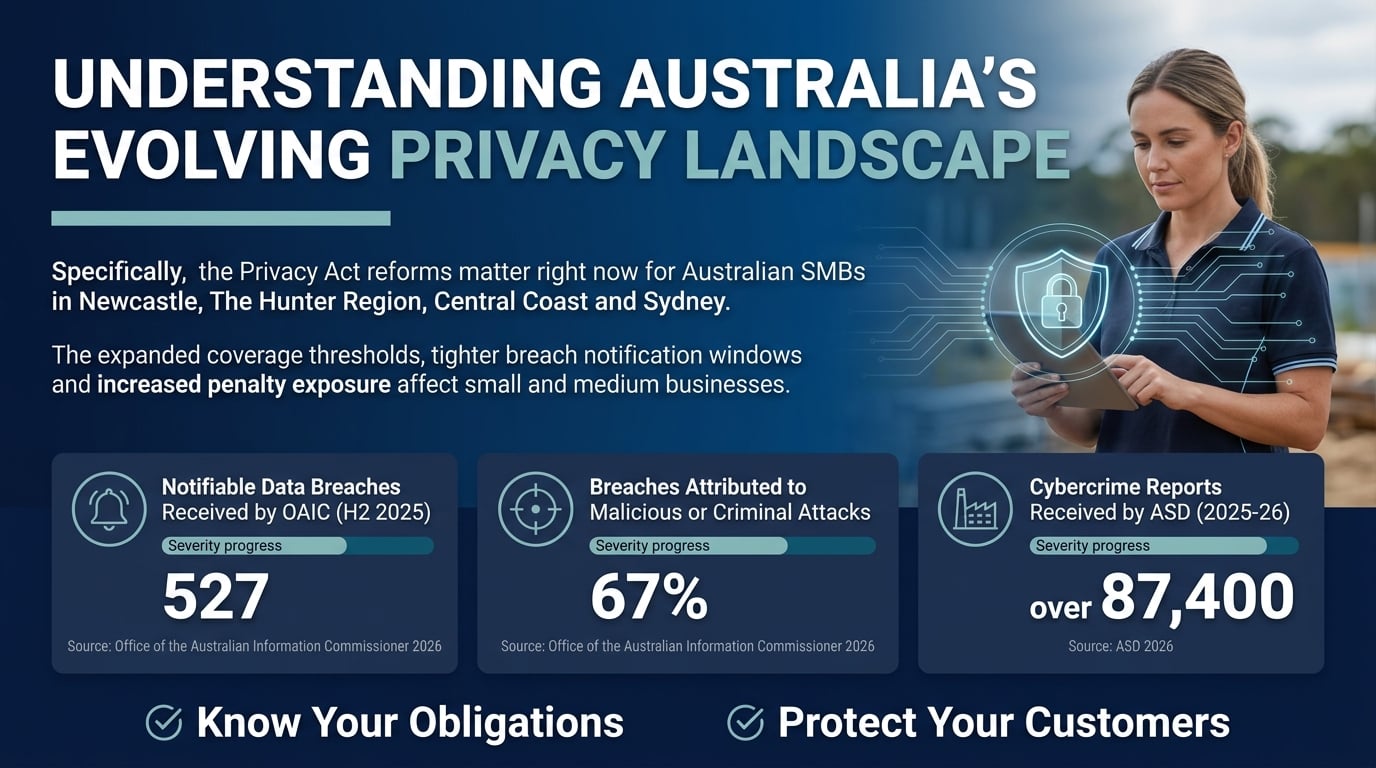
The latest data underscores the urgency. According to the Office of the Australian Information Commissioner, 2026, in the second half of 2025 alone, the Office of the Australian Information Commissioner (OAIC) received 527 notifiable data breach notifications, with malicious or criminal attacks accounting for 67% of all reported breaches. These are not isolated incidents. They are a signal of what Australian businesses are facing right now.
Which Businesses Are Now Covered Under the Updated Privacy Act
Coverage under the revised framework is broader than many SMB owners realise. The removal of the small business exemption means that if your business handles personal information as part of its operations, you are likely subject to the Australian Privacy Principles (APPs). This applies regardless of industry or revenue, once the threshold changes are fully in effect.
Sectors already heavily scrutinised include health, finance, and legal services. According to the Office of the Australian Information Commissioner, 2026, in the 2025-26 reporting period, the health sector remained the top industry for notifiable data breaches in Australia, followed by finance and legal services.
Beyond those sectors, any SMB that trades in personal data, runs customer databases, or uses cloud-based platforms storing individual records must now treat Australian Privacy Principles compliance as a baseline operational requirement, not an optional extra. For businesses across the Central Coast and Hunter Region, this shift requires immediate attention. For guidance on how your existing cloud environment intersects with these obligations, our cloud security audit guide is a useful starting point.
The 7 Critical Compliance Steps Every SMB Must Take Right Now
Step 1: Conduct a Personal Information Audit
You cannot protect what you cannot see. Start by mapping every data flow in your business: what personal information you collect, where it is stored, who can access it, and how long you retain it. This audit forms the foundation of your entire compliance programme and should be documented formally.
Step 2: Update Your Privacy Policy
Your privacy policy must reflect the updated obligations under the APP framework. It should clearly state what data you collect, why you collect it, how it is used, who it may be shared with, and how individuals can access or correct their records. Generic templates no longer meet the standard. Policies must be specific, current, and accessible.
Step 3: Implement a Data Breach Response Plan
The Notifiable Data Breaches (NDB) scheme requires eligible data breaches to be reported to the OAIC and affected individuals. Without a documented response plan, your business is likely to miss the 30-day notification window. Your plan must include breach identification, containment, assessment, and notification steps. Our guide to ransomware recovery for Australian SMBs outlines complementary response procedures that align well with breach obligations.
Step 4: Strengthen Access Controls and Identity Management
APP 11 requires entities to take reasonable steps to protect personal information from misuse, interference, loss, and unauthorised access. Role-based access controls, multi-factor authentication, and privileged access management are all directly relevant here. Limiting who can see sensitive data reduces your exposure significantly. For a deeper look at access risks, review our post on privileged access management for SMBs.
Step 5: Review Third-Party Vendor Contracts
Many SMBs share personal information with suppliers, cloud providers, and contractors. Under the reformed Act, you remain accountable for how third parties handle data on your behalf. Every vendor contract that involves personal information must include privacy clauses aligned to APP requirements. A systematic approach to third-party vendor security audits will help identify gaps before they become liabilities.
Step 6: Train Your Staff on Privacy Obligations
Human error remains the leading cause of data breaches in Australian organisations. Staff must understand what constitutes personal information, how to handle it appropriately, and what to do if they suspect a breach. Training must be role-specific, documented, and repeated at least annually. Awareness of insider threat warning signs is a natural extension of any privacy training programme.
Step 7: Adopt a Privacy by Design Approach
Privacy by design means building data protection into your systems, processes, and culture from the outset rather than retrofitting it later. This includes conducting Privacy Impact Assessments (PIAs) for new projects, minimising data collection to what is strictly necessary, and building in automatic retention and deletion workflows. The NIST Privacy Framework provides a solid structural reference for embedding these practices across your operations.
How to Handle a Notifiable Data Breach Under the New Obligations
When a data breach occurs, the clock starts immediately. Under the NDB scheme, you have 30 days from when a breach is assessed as eligible to notify both the OAIC and affected individuals. The assessment itself must begin as soon as you become aware of a suspected breach, and you have 30 days to complete that assessment as well.
According to the Australian Signals Directorate, 2026, the Australian Signals Directorate (ASD) received over 87,400 cybercrime reports in 2025-26, with small businesses among the most frequently targeted sectors. This volume makes a documented, rehearsed response plan non-negotiable. Verbal agreements and improvised responses will not satisfy regulators.
Your response plan should assign clear ownership roles, define internal escalation thresholds, and include pre-approved communication templates for notifying customers. Integrating this with your broader disaster recovery planning ensures both IT and compliance teams are working from the same playbook when an incident strikes.
The Real Cost of Non-Compliance: Fines, Reputation, and Legal Risk
The financial consequences of non-compliance have escalated sharply. The Privacy and Other Legislation Amendment Act 2024 raised maximum civil penalties to the greater of $50 million, three times the value of benefit obtained, or 30% of adjusted turnover during the breach period. For an SMB, even a fraction of these penalties could be catastrophic.
Beyond fines, reputational damage compounds the cost. Customers who lose trust in how their data is handled rarely return. For Newcastle and Hunter Region businesses competing in tight local markets, a publicised data breach can be permanently damaging. The ISACA Privacy Resources highlight that regulatory scrutiny of SMBs is intensifying globally, a trend mirrored closely in the Australian context.
Legal risk is a third dimension. The new statutory tort for serious invasions of privacy allows individuals to pursue civil claims in court without the OAIC acting as an intermediary. This represents a genuinely new exposure that no SMB with customer data can afford to ignore.
How Managed IT Services Strengthen Your Privacy Act Compliance
Navigating data privacy compliance in Newcastle and across Australia requires both technical capability and process rigour. A managed IT service provider brings both to the table. From configuring endpoint protection and identity management to implementing backup and disaster recovery systems aligned with regulatory timeframes, a managed services partner operationalises compliance in practical terms.
Privacy compliance managed IT services include continuous monitoring for breach indicators, automated patching to close known vulnerabilities, and policy enforcement across all user devices. These are not one-off projects. They are ongoing programmes that require dedicated expertise most SMBs do not have in-house.
For businesses handling sensitive personal information in health, legal, or finance sectors, aligning your IT environment with frameworks such as the Essential Eight provides a measurable baseline for both cybersecurity and privacy obligations. Our post on cybersecurity for Australian businesses explores how these frameworks intersect in practice.
“The question for Australian SMBs is no longer whether they need to comply with updated privacy obligations. It is whether they have the systems, documentation, and expertise to demonstrate compliance when it matters most.”

Take Action Before the Cost Compounds
The Privacy Act reforms Australia continues to implement are not a future concern. They carry legal force today, and enforcement appetite at the OAIC has increased considerably. For SMBs across Newcastle, the Hunter Region, Central Coast, and Sydney, the seven steps outlined above provide a structured path to compliance that is both achievable and defensible.
Every week without a documented privacy programme is a week of unmanaged exposure. The combination of rising breach notifications, expanded penalties, and new individual rights means the risk profile for non-compliant businesses is significantly higher than it was even 12 months ago. The good news is that the steps required are clear, and help is available.
Adept IT Solutions specialises in helping Australian SMBs build robust, practical compliance frameworks that protect personal information, satisfy regulatory obligations, and reduce operational risk. To discuss your current posture and what needs to change, contact our team today for a confidential, no-obligation conversation.
Frequently Asked Questions
Q: Do the Privacy Act reforms Australia introduced actually apply to small businesses with fewer than 20 employees?
A: Yes. As the small business exemption is phased out under the Privacy and Other Legislation Amendment Act 2024, the size of your business will no longer determine whether you are covered. If your business collects, stores, or uses personal information about individuals, you will be subject to the Australian Privacy Principles. SMBs across Newcastle, the Hunter Region, and beyond should treat compliance as a current obligation, not a future consideration.
Q: What is the penalty for failing to comply with notifiable data breach obligations in Australia?
A: Under the updated framework, the maximum civil penalty for serious or repeated breaches is the greater of $50 million, three times the value of any benefit obtained, or 30% of adjusted turnover during the relevant period. Even smaller infringements can attract significant penalties. Beyond financial consequences, reputational damage and the new statutory tort for privacy invasion create additional legal exposure for non-compliant businesses.
Q: How long does a business have to report an eligible data breach to the OAIC?
A: Under the Notifiable Data Breaches scheme, once a business becomes aware of a suspected eligible data breach, it has 30 days to complete an assessment confirming whether the breach meets the threshold. Once assessed as eligible, you must notify the OAIC and all affected individuals as quickly as possible. Having a documented response plan in place before an incident occurs is essential to meeting these timeframes reliably.
Q: How can a managed IT provider help with personal information handling for SMBs in Australia?
A: A qualified managed IT provider helps SMBs implement the technical controls required to meet Australian Privacy Principles compliance, including access management, encryption, secure backup, continuous monitoring, and incident response. They also assist with documentation, policy development, and staff training, covering both the technical and procedural dimensions of compliance. For regional businesses in Newcastle, the Hunter Region, and Central Coast, partnering with a local managed IT provider means faster response and contextually relevant advice.
Get in touch with our team of IT experts today! You can contact us via phone at 1300 423 378 or email us at info@adept-it.com.au.

