
Insider threats Australia businesses face are more complex, more costly, and more common than most small business owners realise. While media coverage tends to focus on external hackers and ransomware gangs, the risk sitting within your own organisation, from current staff, contractors, and former employees, remains dangerously underestimated. Whether malicious or accidental, insider incidents can cause significant financial damage, reputational harm, and regulatory exposure. For small and medium-sized businesses (SMBs) across Newcastle, the Hunter Region, the Central Coast, and Sydney, understanding the warning signs before an incident occurs is the difference between a close call and a crisis.

What Is an Insider Threat and Why Should Australian SMBs Care?
An insider threat is any risk to your organisation that originates from people who have authorised access to your systems, data, or premises. This includes employees, former staff, contractors, and suppliers. Insider threats are categorised as either malicious (deliberate theft or sabotage) or negligent (accidental exposure or policy violations). Both categories cause real harm.
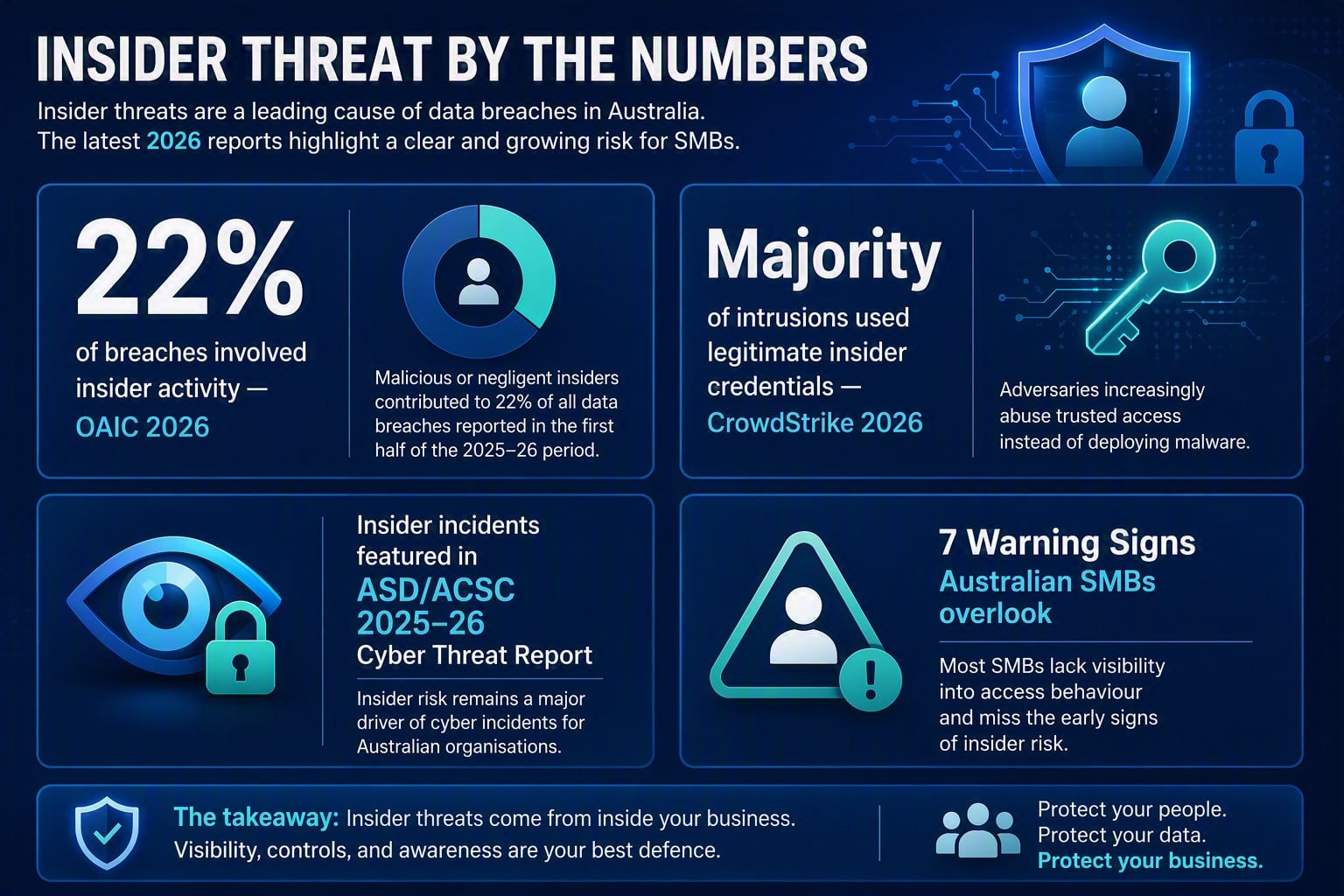
The data is sobering. According to the OAIC, 2026, malicious or negligent insiders were a contributing factor in 22% of all data breaches reported to the Office of the Australian Information Commissioner (OAIC) in the first half of the 2025-26 reporting period. For SMBs that lack the layered defences of large enterprises, this exposure is particularly dangerous.
Many SMB owners assume their tight-knit team culture eliminates the risk. It does not. Negligent insiders, staff who click phishing links, misconfigure cloud storage, or mishandle customer data, are often just as damaging as deliberate bad actors. Understanding the indicators early is critical to building a defensible business.
7 Warning Signs Your Business Is Vulnerable to Insider Threats
Most SMBs miss these indicators because they lack visibility into day-to-day access behaviour. Here are the seven signs that should prompt immediate investigation.
1. Unusual Access Outside Business Hours
Staff accessing sensitive files at 2am on a Sunday is not normal behaviour. Privileged access misuse often follows an irregular access pattern before escalating. If your systems do not log or alert on after-hours access, you are flying blind. Reviewing access logs is one of the simplest insider risk management controls available.
2. Large or Unusual Data Downloads
Employee data theft frequently begins with bulk downloads of customer lists, financial records, or intellectual property. A staff member downloading thousands of files shortly before resignation should trigger an immediate response. Without data loss prevention Australia controls in place, these transfers often go unnoticed until the damage is done.
3. Accessing Systems or Files Outside Job Scope
An accounts payable officer who starts querying HR salary records, or a sales rep browsing engineering documentation, warrants scrutiny. Least-privilege access controls, where users only access what their role requires, are foundational. Our post on identity security SMB gaps covers why this remains one of the most common failures in Australian businesses.
4. Disgruntled or Departing Employees
Employees who have been passed over for promotion, are facing disciplinary action, or have tendered their resignation represent elevated risk. This is not about distrust. It is about recognising behavioural risk factors and ensuring offboarding processes immediately revoke access. Many breaches in the OAIC’s dataset were linked to inadequate offboarding procedures.
5. Use of Personal Devices or Unauthorised Cloud Storage
Shadow IT, including personal email accounts, unapproved USB drives, or consumer cloud storage like personal Google Drive accounts, creates unmonitored data pathways. If staff can route sensitive data outside your managed environment, you have lost visibility and control. This problem connects closely to the shadow AI risks many Hunter Region businesses are only beginning to recognise.
6. Sharing Credentials or Bypassing Authentication Controls
Password sharing, disabling multi-factor authentication (MFA), or using shared administrator accounts eliminates your audit trail. When everyone uses the same login, no one can be held accountable. The CrowdStrike, 2026 global threat report found identity-based attacks featuring abuse of legitimate insider credentials were prominent across the 2026 reporting cycle, with adversaries increasingly living off trusted access rather than deploying malware.
7. No Audit Logging or Security Monitoring
If you cannot answer “who accessed what, when, and from where,” you cannot detect or investigate insider incidents. Many SMBs operate Microsoft 365 environments with audit logging disabled or retention periods set too short. Insider threat detection Newcastle businesses need relies entirely on having adequate logs to review when something looks wrong.
Why Insider Threats Are Harder to Detect Than External Attacks
External attackers must break through defences to gain access. Insiders already have it. This fundamental asymmetry makes insider incidents far more difficult to detect using traditional security tools. Firewalls and antivirus solutions are built to stop inbound threats. They offer little protection when the threat is already authenticated inside your network.
The ASD/ACSC, 2026 annual report noted that insider-enabled incidents, including accidental data exposure and deliberate exfiltration, continued to feature prominently in cyber incident reports from Australian organisations across the 2025-26 period. The report highlighted that many of these incidents went undetected for extended periods precisely because normal security tooling does not flag authorised user behaviour.
This challenge is compounded in SMBs where IT administration is informal, access controls are inconsistently applied, and security awareness training is sporadic. Read our guide on zero-trust cybersecurity to understand the framework that directly addresses this detection gap.
The Real Cost of an Insider Incident for Australian Small Businesses
The financial consequences extend well beyond immediate remediation costs. Organisations facing an insider-related breach must also contend with regulatory notification obligations under the Privacy Act 1988, potential penalties under the Notifiable Data Breaches (NDB) scheme, legal costs, lost customer trust, and productivity disruption.
For businesses in Newcastle, Lake Macquarie, and the broader Hunter Region, a breach that triggers an OAIC notification also requires you to notify affected individuals. This process is time-consuming, reputationally damaging, and often leads to the loss of key client relationships. The ISACA Industry Research consistently identifies insider incidents as among the most expensive breach types when factoring in investigation, remediation, and reputational recovery.
Businesses that have already experienced a major data breach understand these costs acutely. Prevention is always less expensive than response.
How to Build an Insider Threat Detection and Response Programme
Building a structured insider risk management programme does not require an enterprise-scale budget. SMBs can take meaningful steps using existing Microsoft 365 tooling and managed services. The following controls form the foundation of a defensible programme.
Enable and review audit logging. Microsoft 365 Purview includes audit logging capabilities that many SMBs leave disabled. Turn them on, set appropriate retention periods, and schedule regular reviews.
Implement least-privilege access. Every user account should have access only to the systems and data required for their specific role. Review and revise permissions at least quarterly. Our post on Identity Threat Detection and Response (ITDR) explains how to extend this principle into proactive threat detection.
Enforce MFA across all accounts. Multi-factor authentication (MFA) is a foundational control under the Australian Signals Directorate (ASD) Essential Eight framework. It limits the damage from credential theft, including credentials shared or stolen by insiders.
Formalise offboarding procedures. Every departure, voluntary or otherwise, should trigger an immediate access revocation checklist. This includes email, cloud storage, line-of-business applications, and any physical access credentials.
Deploy Managed Detection and Response (MDR). An MDR in cybersecurity solution monitors your environment 24/7 and surfaces anomalous behaviour that correlates with insider threat indicators. For SMBs without internal security teams, this is one of the most practical investments available.
Combining these technical controls with a clear acceptable use policy and regular security awareness training creates a measurable reduction in insider risk exposure. Our broader cybersecurity guide for 2026 provides a comprehensive overview of the layered approach SMBs should take.

How Adept IT Solutions Helps Newcastle and Hunter Region Businesses Stay Protected from Insider Threats
Adept IT Solutions works with businesses across Newcastle, Lake Macquarie, the Hunter Region, the Central Coast, and Sydney to identify and close insider risk gaps before they become reportable incidents. Our managed security services include access control reviews, Microsoft 365 audit log configuration, MDR deployment, and staff security awareness training.
We also assist businesses preparing for compliance frameworks including the ASD Essential Eight, ISO 27001, and obligations under the Privacy Act 1988. Whether you are concerned about a specific access control gap or want a full security posture review, our team provides practical guidance without the enterprise price tag.
“The most dangerous threats are the ones your security tools are configured to trust. Insider risk management requires visibility, policy, and process working together.”
Insider threats Australia organisations face will not diminish as workforce complexity grows. Remote work, contractor reliance, and cloud adoption have expanded the potential insider risk surface significantly. The seven warning signs outlined in this post represent your early detection framework. Ignoring them leaves your business exposed to breaches that are entirely preventable with the right controls in place. If you are ready to take action, contact Adept IT Solutions today to discuss a tailored insider risk assessment for your business.
Further reading: CrowdStrike.
Frequently Asked Questions
Q: What are the most common types of insider threats Australia businesses face?
A: The two most common categories are malicious insiders (employees or contractors who deliberately steal data or sabotage systems) and negligent insiders (staff who accidentally expose data through poor security habits, misconfigured systems, or falling victim to phishing attacks). The OAIC’s 2025-26 data shows that both categories contribute significantly to Australia’s notifiable data breach statistics. SMBs across Newcastle, Sydney, and the Hunter Region are affected by both types.
Q: How can a small business detect privileged access misuse without enterprise-level tools?
A: Microsoft 365 includes built-in audit logging and Microsoft Purview Insider Risk Management tools that are accessible to businesses on Business Premium and above. Enabling these features, setting alert thresholds for bulk downloads and after-hours access, and reviewing logs regularly provides a practical baseline for insider threat detection without requiring a dedicated security operations team. A managed IT provider can configure and monitor these tools on your behalf.
Q: Does data loss prevention Australia compliance require specific tools or software?
A: Data loss prevention (DLP) controls are recommended under the ASD Essential Eight and align with obligations under the Privacy Act 1988. Microsoft 365 Purview provides DLP policy capabilities that can restrict or monitor the transfer of sensitive data such as customer records, financial information, and personal identifiers. These policies can be configured to block transmission to personal email accounts, USB devices, or unsanctioned cloud storage services. A properly configured DLP solution significantly reduces the risk of accidental or deliberate data exfiltration.
Q: What should an SMB do immediately after identifying a potential insider threat incident?
A: Act quickly but carefully. First, preserve evidence by securing audit logs before they are overwritten. Second, isolate the affected account or device without tipping off the individual under investigation. Third, engage your IT provider or managed security partner to conduct a forensic review. Fourth, assess whether the incident meets the threshold for notification under the OAIC’s Notifiable Data Breaches scheme. Finally, document the incident in full as part of your incident response process. Having a tested incident response plan in place before an event occurs is the most effective preparation any SMB can make.
Get in touch with our team of IT experts today! You can contact us via phone at 1300 423 378 or email us at info@adept-it.com.au.

