
Endpoint security Australia has never faced a more demanding threat environment than it does heading into 2026. Small and medium-sized businesses (SMBs) across Newcastle, the Hunter Region, Central Coast, and Sydney are under relentless pressure from attackers who are faster, more sophisticated, and better resourced than ever before. Yet despite the escalating risk, many businesses are still running with critical gaps in their endpoint defences. This post identifies seven of the most dangerous gaps and explains what Australian SMBs can do to close them.

What Is Endpoint Security and Why Does It Matter for Australian SMBs?
Endpoint security refers to the practice of protecting devices that connect to a business network, including laptops, desktops, smartphones, tablets, and servers. Every one of those devices is a potential entry point for an attacker. For SMBs operating across multiple sites or with remote workers, the number of endpoints has grown significantly in recent years, and so has the attack surface.
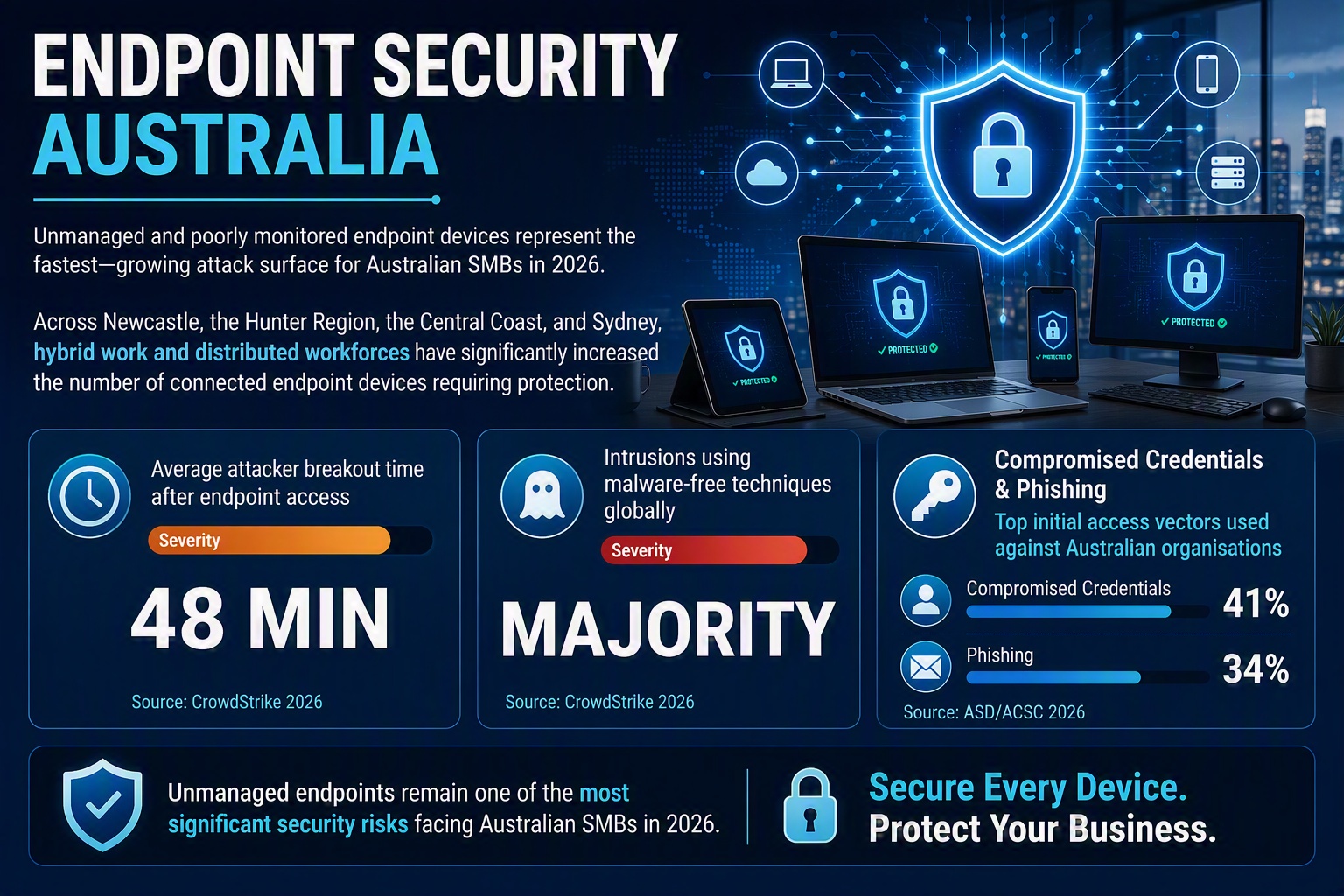
The stakes are well documented. According to the ASD/ACSC Annual Cyber Threat Report 2026, compromised credentials and phishing remain the top two initial access vectors used against Australian organisations, with endpoints the primary entry point in both cases. This is not a theoretical concern. Businesses that lack mature endpoint controls are handing attackers an open door.
For SMBs without a dedicated security team, the challenge is compounded by limited visibility and resources. Understanding where the critical gaps lie is the first step toward addressing them effectively. Our broader post on cybersecurity in 2026 provides useful context on the wider threat environment Australian businesses are navigating this year.
Gap 1: Unmanaged and Personal Devices Connecting to Business Networks
One of the most pervasive risks in any SMB environment is the use of unmanaged or personally owned devices on corporate networks. When employees connect personal smartphones, tablets, or home laptops to business systems, IT teams have limited visibility and control over what software is installed, whether the device is patched, or whether it has been previously compromised.
This unmanaged devices business risk is amplified in hybrid and remote working arrangements, which are now standard across businesses in Newcastle and the wider Hunter Region. Without a formal device management policy and Mobile Device Management (MDM) or Unified Endpoint Management (UEM) tooling in place, each personal device that connects to business applications represents an uncontrolled variable in your security posture.
Businesses that have not addressed this gap should also review their approach to identity security for SMBs, since compromised personal devices frequently serve as the launchpad for credential theft attacks.
Gap 2: Over-Reliance on Legacy Antivirus Instead of Modern EDR
Traditional antivirus software relies on signature databases to identify known threats. The problem is that the modern threat landscape has evolved far beyond what signatures can detect. According to the CrowdStrike Global Threat Report 2026, malware-free attacks now account for the majority of intrusions recorded globally, meaning traditional signature-based endpoint tools miss the bulk of modern threats.
Attackers are increasingly using living-off-the-land techniques, exploiting legitimate system tools like PowerShell and WMI to move through networks without ever deploying a traditional malicious file. Legacy antivirus simply cannot detect this behaviour. Endpoint Detection and Response (EDR) platforms address this gap by monitoring behavioural patterns in real time, correlating telemetry across endpoints, and enabling rapid containment when anomalies are detected.
For SMBs that lack in-house analysts, pairing EDR with a Managed Detection and Response (MDR) service is increasingly the standard approach. Our explainer on what MDR means in cybersecurity is a good starting point for businesses evaluating this option.
Gap 3: No Visibility Across Remote and Hybrid Worker Endpoints
Visibility is the foundation of effective endpoint protection managed IT programs. Without knowing what is happening on every device at any given moment, security teams cannot respond to incidents before they escalate. Many SMBs have no centralised endpoint monitoring in place, leaving remote workers effectively invisible to IT.
This is especially relevant for businesses across the Central Coast and Hunter Region where teams are distributed across multiple sites and home offices. An attacker who compromises a remote endpoint may have hours or days to move laterally through a network before anyone notices. The CrowdStrike Global Threat Report 2026 found that adversaries are deploying malicious tools within 48 minutes of initial access on average, leaving almost no time for manual endpoint response.
Centralised endpoint management platforms integrated with a Security Information and Event Management (SIEM) system close this gap by aggregating telemetry and flagging anomalies automatically. Businesses exploring this capability should also review the risks associated with shadow AI in the workplace, which frequently introduces new, unmonitored endpoint activity.
Gap 4: Delayed Patching Leaving Known Vulnerabilities Open for Attackers
Unpatched systems remain one of the most exploited attack vectors in the world. The Essential Eight framework, developed by the Australian Signals Directorate (ASD), places patching of operating systems and applications among its top mitigation strategies for a reason. Despite this, many SMBs continue to run systems that are weeks or months behind on critical security updates.
Essential Eight patching requirements specify that internet-facing services should have critical patches applied within 48 hours of release, and other systems within two weeks. Very few SMBs without a managed IT provider are achieving these timelines consistently. The result is that known, publicly documented vulnerabilities remain open long after patches are available, and attackers exploit them systematically.
Automated patch management, delivered through a managed IT service, removes the human bottleneck from this process. For a detailed breakdown of related compliance obligations, our post on privileged access management for SMBs covers how access controls and patch hygiene work together to reduce exposure.
Gap 5: Weak or Absent Zero-Trust Policies at the Endpoint Level
The traditional perimeter-based security model assumed that anything inside the network could be trusted. That assumption no longer holds. With cloud applications, remote access, and third-party integrations now standard across most SMBs, the network perimeter has effectively dissolved. Zero-Trust architecture addresses this by requiring continuous verification of every user and device before granting access to any resource.
At the endpoint level, zero-trust means that device health checks are performed before access is granted, regardless of whether the device is on-premises or remote. Many SMBs have never implemented endpoint compliance policies within their identity platform. This leaves them exposed to scenarios where a compromised or non-compliant device can still authenticate and access sensitive business data.
Implementing zero-trust principles at the endpoint is increasingly achievable for SMBs through Microsoft Entra ID and Intune. For a foundational overview, our post on zero-trust in cybersecurity explains the core principles and how they apply in practice.
Gap 6: Inadequate Backup and Recovery Processes Tied to Endpoint Compromise
When an endpoint is compromised, the ability to recover quickly depends on having reliable, recent backups that have not themselves been encrypted or corrupted by ransomware. Many SMBs have backup processes in place, but they are not designed with endpoint compromise in mind. Backups stored on the same network or accessible from the compromised device are frequently destroyed alongside the primary data.
Immutable, offsite, and cloud-based backups with regular recovery testing are essential components of any endpoint security strategy. The Sophos State of Ransomware Report consistently identifies backup destruction as a tactic attackers use to maximise leverage during ransomware incidents. SMBs that have not tested their recovery processes recently should treat this as a priority.
For practical guidance on building resilient recovery processes, our detailed post on disaster recovery planning for SMBs covers the critical steps businesses should be taking in 2026.
Gap 7: No Formal Endpoint Security Policy or Staff Awareness Training
Technology alone cannot close every endpoint gap. Human behaviour remains a significant variable in any security program. Employees who click phishing links, use weak passwords, or connect to public Wi-Fi without a Virtual Private Network (VPN) are creating endpoint risk regardless of the tools in place. Without a formal endpoint security policy and ongoing staff awareness training, even well-configured systems can be undermined.
A formal policy should define acceptable device use, remote access requirements, approved software lists, and reporting procedures for suspected incidents. The ISACA State of Cybersecurity 2026 report highlights that organisations with regular security awareness programs experience significantly fewer successful phishing-based endpoint compromises than those relying on technology controls alone.
Businesses that have experienced endpoint-related incidents should also review their exposure to business email compromise warning signs, since phishing-driven endpoint access is a common precursor to Business Email Compromise (BEC) fraud.
How Adept IT Solutions Strengthens Endpoint Security for Hunter Region Businesses
Adept IT Solutions works with SMBs across Newcastle, the Hunter Region, Central Coast, and Sydney to implement layered endpoint protection programs that address each of the gaps outlined above. Our approach begins with a thorough assessment of your current endpoint environment, identifying unmanaged devices, legacy tools, patching deficiencies, and visibility gaps.
From there, we deploy and manage modern EDR and MDR capabilities, enforce zero-trust device compliance policies through Microsoft Entra ID and Intune, and implement automated patch management aligned with Essential Eight requirements. All of this is monitored 24 hours a day through our managed security operations, so your business has continuous coverage without needing to hire specialist staff in-house.
Endpoint security in Newcastle and across the Hunter Region requires a provider who understands the local business environment and the specific constraints SMBs face. We also support businesses with supply chain risk management, recognising that third-party software on endpoints is itself a common attack vector. Our post on supply chain cyber attacks in Australia covers this dimension in detail.
“Adversaries are deploying malicious tools within 48 minutes of initial access on average. For SMBs without automated endpoint detection, that window is far too short for any manual response to succeed.” — CrowdStrike Global Threat Report 2026

Closing the Gaps Before Attackers Exploit Them
The seven gaps outlined in this post represent the most common and most consequential weaknesses in SMB endpoint defences as of 2026. Each one is exploitable, and each one has a practical solution available to businesses of any size. The challenge is not whether to act, but how quickly action can be prioritised. Endpoint security Australia wide is maturing rapidly, driven by regulatory pressure, increasing attack frequency, and the availability of enterprise-grade tools at SMB price points.
Businesses across Newcastle, the Hunter Region, Central Coast, and Sydney that want to understand their current exposure and build a prioritised remediation roadmap should reach out to the team at Adept IT Solutions for a no-obligation consultation. The cost of identifying a gap before it is exploited is always lower than managing an incident after the fact.
Further reading: CrowdStrike.
Frequently Asked Questions
Q: What makes endpoint security Australia such a priority for SMBs in 2026?
A: Australian SMBs are being targeted at record rates in 2026, with the ASD/ACSC identifying phishing and credential compromise as the leading attack vectors, both of which target endpoints directly. The shift to hybrid work has dramatically expanded the number of devices connecting to business networks, increasing the attack surface. Attackers now move within 48 minutes of initial access, meaning businesses without automated endpoint detection have almost no time to respond manually. Investing in modern endpoint protection is no longer optional for any business that holds customer data or relies on digital systems.
Q: What is the difference between traditional antivirus and endpoint detection and response?
A: Traditional antivirus works by matching files against a database of known malicious signatures. It is effective against known threats but blind to novel attack techniques and living-off-the-land methods that do not use traditional malware files. Endpoint Detection and Response (EDR) monitors device behaviour continuously, looking for anomalies such as unusual process activity, unexpected network connections, and lateral movement patterns. EDR can detect and contain threats that legacy antivirus would miss entirely, which is why it is now the minimum standard recommended for SMBs handling sensitive data.
Q: How does the Essential Eight framework apply to endpoint patching for Australian businesses?
A: The Essential Eight framework, developed by the Australian Signals Directorate, includes patching of operating systems and applications as two of its eight core mitigation strategies. The framework specifies that internet-facing services should have critical patches applied within 48 hours of release, and other endpoints within two weeks. Businesses that achieve Maturity Level Two or higher compliance with these requirements significantly reduce their exposure to exploitation of known vulnerabilities. A managed IT provider can automate and report on patch compliance to ensure businesses consistently meet these timelines.
Q: How can a managed IT provider improve endpoint security for a small business in Newcastle or the Hunter Region?
A: A managed IT provider delivers continuous monitoring, automated patching, EDR deployment, and policy enforcement across all endpoints, including remote and personally owned devices. For businesses in Newcastle and the Hunter Region without dedicated IT security staff, this provides enterprise-grade endpoint protection at a predictable monthly cost. Providers like Adept IT Solutions also align endpoint controls with the Essential Eight and broader compliance obligations, ensuring businesses are not only protected but also audit-ready. The result is a consistent, documented security posture across every device in the organisation.

