
Ransomware recovery Australia is no longer a concern reserved for large enterprises. Small and medium businesses (SMBs) across Newcastle, the Hunter Region, Central Coast, and Sydney are increasingly in the crosshairs of sophisticated ransomware groups that have industrialised their attack methods. The threat has never been more acute, and the cost of an unstructured response has never been higher. This guide outlines seven critical steps every Australian SMB must take when ransomware strikes, and what to do before it ever does.
What Is Ransomware Recovery and Why Does It Matter for Australian SMBs?
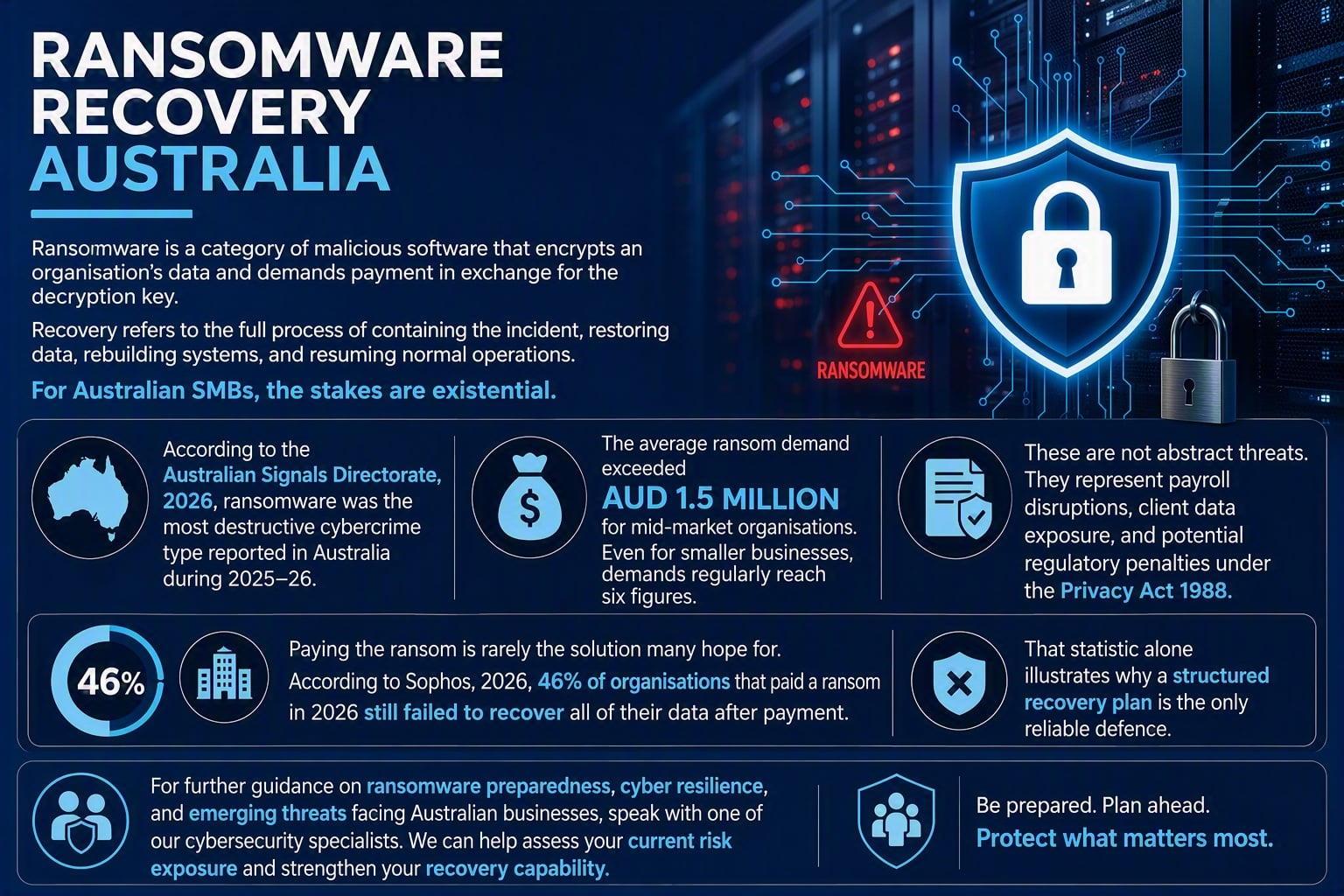
Ransomware is a category of malicious software that encrypts an organisation’s data and demands payment in exchange for the decryption key. Recovery refers to the full process of containing the incident, restoring data, rebuilding systems, and resuming normal operations. For Australian SMBs, the stakes are existential.
According to the Australian Signals Directorate, 2026, ransomware was the most destructive cybercrime type reported in Australia during 2025-26, with the average ransom demand exceeding AUD 1.5 million for mid-market organisations. Even for smaller businesses, demands regularly reach six figures. These are not abstract threats. They represent payroll disruptions, client data exposure, and potential regulatory penalties under the Privacy Act 1988.
Paying the ransom is rarely the solution many hope for. According to Sophos, 2026, 46% of organisations that paid a ransom in 2026 still failed to recover all of their data after payment. That statistic alone illustrates why a structured recovery plan is the only reliable defence. For further context on broader cyber risks affecting Australian businesses, see our overview of cybersecurity threats in 2026.
Step 1: Isolate Infected Systems Immediately to Stop Lateral Spread
The first action when ransomware is detected is network isolation. Every second of delay allows the malware to propagate across shared drives, connected servers, and cloud-synced directories. Disconnect affected devices from the network immediately, including both wired and wireless connections.
Do not simply power off systems unless instructed by a forensic specialist. Forced shutdowns can destroy volatile memory artefacts that are critical for identifying the ransomware variant and its entry vector. The goal at this stage is containment, not remediation. Segment your network to protect unaffected infrastructure, and disable remote desktop protocol (RDP) access points if they are not already restricted. Uncontrolled lateral movement is the primary reason ransomware incidents escalate from minor to catastrophic.
Step 2: Activate Your Incident Response Plan and Notify Key Stakeholders
Every SMB should maintain a documented incident response plan (IRP). If yours does not exist yet, this is the most urgent project on your technology roadmap. Upon detecting ransomware, activate your IRP immediately. Notify your IT team or managed service provider, your leadership team, legal counsel, and your cyber insurance carrier.
Internal communications should move to a separate, unaffected channel. If your primary email server is compromised, use personal mobile phones or a secondary communication platform. Panic-driven decisions made without clear authority chains cost businesses enormous amounts in recovery time. Define roles in advance: who declares the incident, who contacts regulators, and who speaks to clients. For SMBs looking to build this capability, our guide on disaster recovery planning for SMBs is a practical starting point.
Step 3: Assess the Scope of Encryption and Identify the Ransomware Variant
Before attempting any restoration, you must understand what has been encrypted and which ransomware family is responsible. Identification tools such as those referenced in the NIST Cybersecurity Framework guidance help map affected systems and log entry points. Some ransomware variants have freely available decryption keys, which makes correct identification extremely valuable.
Document everything throughout this phase. Screenshot ransom notes, capture file extension changes, and log which systems were first affected. This evidence is required for law enforcement reporting, insurance claims, and forensic analysis. Rushing past this step to begin restoration is one of the most common mistakes that leads to reinfection. Attackers often maintain persistence mechanisms that survive a basic rebuild.
Ransomware frequently enters through compromised credentials or unpatched vulnerabilities. Our post on privileged access management risks explains how credential exposure creates the conditions for exactly these kinds of attacks.
Step 4: Restore from Verified, Offline Backups — Not Shadow Copies
Modern ransomware variants are specifically engineered to delete Volume Shadow Copies (VSS) and target cloud-synced backup folders. Relying on these for recovery will frequently lead to disappointment. The only reliable restoration path is from verified, offline, or air-gapped backups that were disconnected from the network prior to the attack.
Before restoring, verify that your backup copies are not themselves corrupted or partially encrypted. Restore to a clean environment rather than directly to affected hardware. Apply all outstanding patches and security configurations before reconnecting restored systems to the broader network. This is where the discipline of your backup strategy either pays dividends or compounds the disaster. The IBM Threat Intelligence Report, 2026 found the average time to fully recover from a ransomware attack reached 24 days in 2026, a figure that rises sharply when backup integrity is poor.
Businesses across the Hunter Region and Central Coast that have invested in immutable cloud backup solutions or dedicated managed IT Newcastle infrastructure consistently achieve faster recovery timelines. If your current backup strategy has not been tested through a simulated restore exercise in the past six months, it should be treated as an unknown quantity.
Steps 5 Through 7: Reporting, Hardening, and Preventing Reinfection After Ransomware Recovery
Step 5: Meet Your Reporting Obligations. Australian businesses subject to the Notifiable Data Breaches (NDB) scheme must notify the Office of the Australian Information Commissioner (OAIC) if the attack resulted in unauthorised access to personal information. The reporting window is 30 days from becoming aware of an eligible breach. Beyond the NDB scheme, the Australian Cyber Security Centre operates a voluntary reporting portal that contributes to national threat intelligence. Reporting helps the broader Australian business community, and in many cases, investigators can use your incident data to attribute attacks and prevent further harm.
Step 6: Harden the Environment Before Reconnecting. Once clean systems are ready, do not reconnect them to production until a full security hardening pass has been completed. This includes implementing or validating multi-factor authentication (MFA) on all accounts, reviewing firewall rules, patching all known vulnerabilities, and enforcing application whitelisting. Reference the Australian Signals Directorate (ASD) Essential Eight framework for a structured hardening checklist. Businesses that skip this step frequently experience reinfection within weeks, as the original attack vector remains open. See our related post on insider threat warning signs for additional context on post-incident access reviews.
Step 7: Conduct a Post-Incident Review and Update Your Defences. A ransomware attack is a painful but instructive event. Within 30 days of recovery, conduct a formal post-incident review (PIR) with all relevant stakeholders. Document what went wrong, what the response got right, and what must change. This feeds directly into updated business continuity planning and improved security architecture. Consider engaging a managed detection and response (MDR) service to provide ongoing monitoring. Our introduction to MDR in cybersecurity explains how continuous monitoring reduces dwell time for future threats.
“The time to prepare for a ransomware attack is before it happens. Every day without a tested recovery plan is a day spent hoping the odds stay in your favour. In 2026, those odds are no longer favourable.”

Building Long-Term Ransomware Recovery Capability in Australia
Surviving one ransomware incident without a structured approach is luck. Surviving the next one requires investment. Australian SMBs that treat ransomware recovery Australia as an ongoing operational discipline, rather than a reactive emergency measure, demonstrate consistently better outcomes across recovery time, data loss, and regulatory exposure.
Practical long-term measures include adopting a zero-trust security architecture, implementing endpoint detection across all devices, and scheduling quarterly tabletop exercises that simulate ransomware scenarios. For SMBs exploring zero-trust as a foundation for their security posture, our explainer on zero-trust in cybersecurity is a strong starting reference.
Cyber incident compliance obligations are also tightening in Australia. The Privacy Act amendments and evolving Essential Eight maturity requirements mean that SMBs in regulated industries face growing legal exposure alongside operational risk. Businesses that align their ransomware recovery services with compliance frameworks will be better positioned when both regulators and clients ask hard questions after an incident.
Ransomware recovery Australia demands more than good intentions. It requires tested plans, verified backups, trained people, and partners who understand the Australian regulatory and threat landscape. Adept IT Solutions works with businesses across Newcastle, Lake Macquarie, the Hunter Region, Central Coast, and Sydney to build exactly this capability. Contact Adept IT Solutions today to start building your ransomware resilience before the next attack arrives.
Frequently Asked Questions
Q: How long does ransomware recovery in Australia typically take for an SMB?
A: Ransomware recovery Australia timelines vary significantly depending on backup quality, the scope of encryption, and how quickly the incident is contained. The IBM Threat Intelligence Report 2026 found the average recovery time reached 24 days across all organisation sizes. SMBs with tested, offline backups and a documented incident response plan consistently achieve faster recovery, often under 10 days. Those without structured plans frequently face weeks of disruption and higher total costs.
Q: Should Australian SMBs pay the ransom to recover their data?
A: Paying the ransom is strongly discouraged by Australian authorities and cybersecurity experts. The Sophos State of Ransomware 2026 report found that 46% of organisations that paid still failed to recover all of their data. Payment also funds criminal operations, may expose your organisation to sanctions risk depending on the threat actor, and does not guarantee that attackers have removed persistent access from your environment. Investing in verified backup solutions is a far more reliable recovery path.
Q: What are the ransomware attack response reporting obligations for Australian businesses?
A: Australian businesses covered by the Privacy Act 1988 must report eligible data breaches to the OAIC within 30 days of becoming aware of the incident under the Notifiable Data Breaches scheme. This applies where a ransomware attack results in unauthorised access to personal information that is likely to cause serious harm. Additionally, voluntary reporting to the Australian Cyber Security Centre is encouraged to support national threat intelligence and may assist law enforcement investigations.
Q: What ransomware recovery services should Australian SMBs look for in a managed IT provider?
A: When evaluating ransomware recovery services, Australian SMBs should look for providers that offer immutable and offsite backup management, documented incident response planning, 24/7 monitoring through managed detection and response capabilities, and compliance support aligned to the ASD Essential Eight framework. Providers with experience across the Australian regulatory environment and a local presence in regions such as Newcastle, the Hunter Region, Central Coast, and Sydney are better positioned to respond quickly when an incident occurs.
Get in touch with our team of IT experts today! You can contact us via phone at 1300 423 378 or email us at info@adept-it.com.au.

