
Network segmentation Australia is no longer an optional layer of defence reserved for enterprise organisations. In 2026, small and medium businesses (SMBs) across Newcastle, the Hunter Region, Central Coast, and Sydney are increasingly targeted by sophisticated threat actors who exploit poorly designed internal networks to move laterally, escalate privileges, and exfiltrate sensitive data. If your business runs a flat or loosely structured network, you are providing attackers with an open corridor from one compromised endpoint to your most critical systems.
What Is Network Segmentation and Why Does It Matter for Australian SMBs?
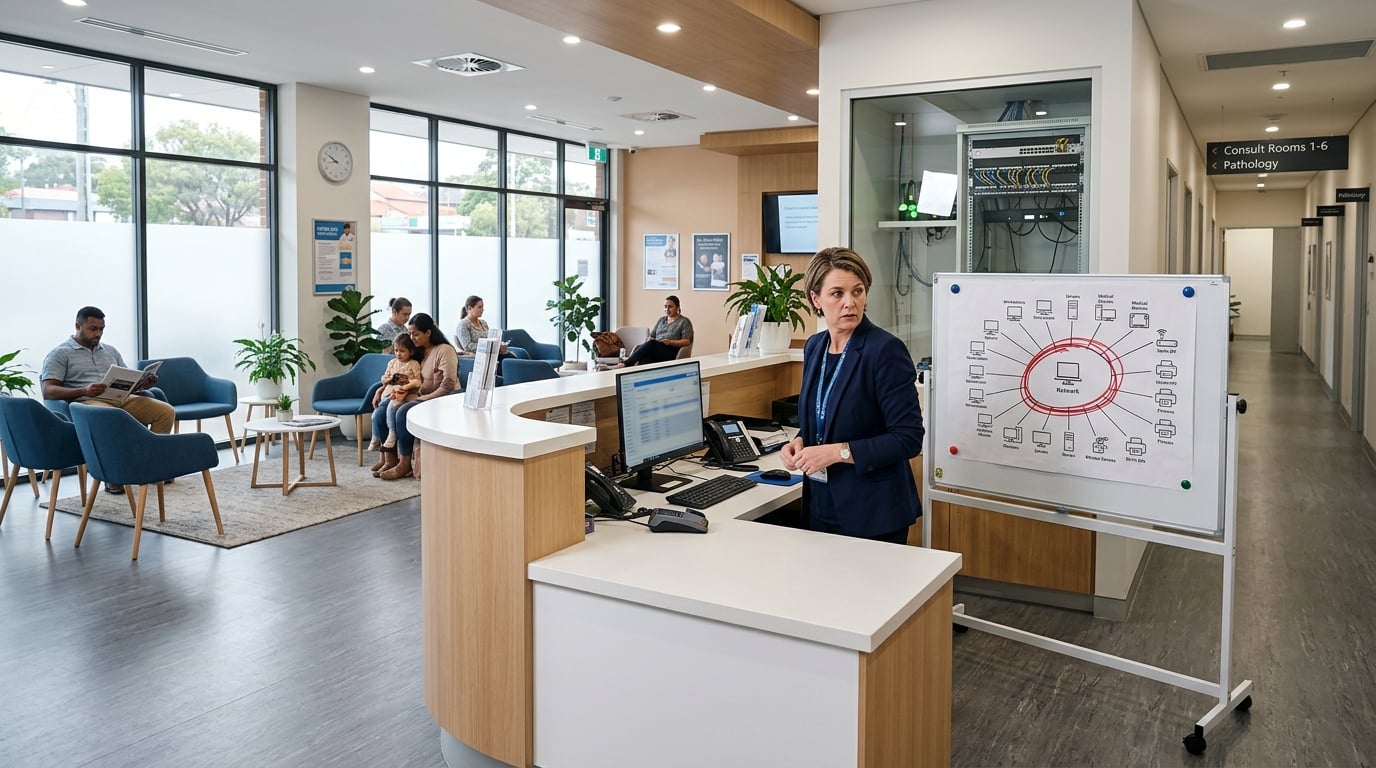
Network segmentation is the practice of dividing a computer network into distinct sub-networks, or segments, so that traffic between them is controlled and restricted. Instead of allowing every device to communicate freely with every other device, segmentation enforces boundaries. A compromised laptop on your sales floor cannot directly reach your finance server or cloud backup environment.
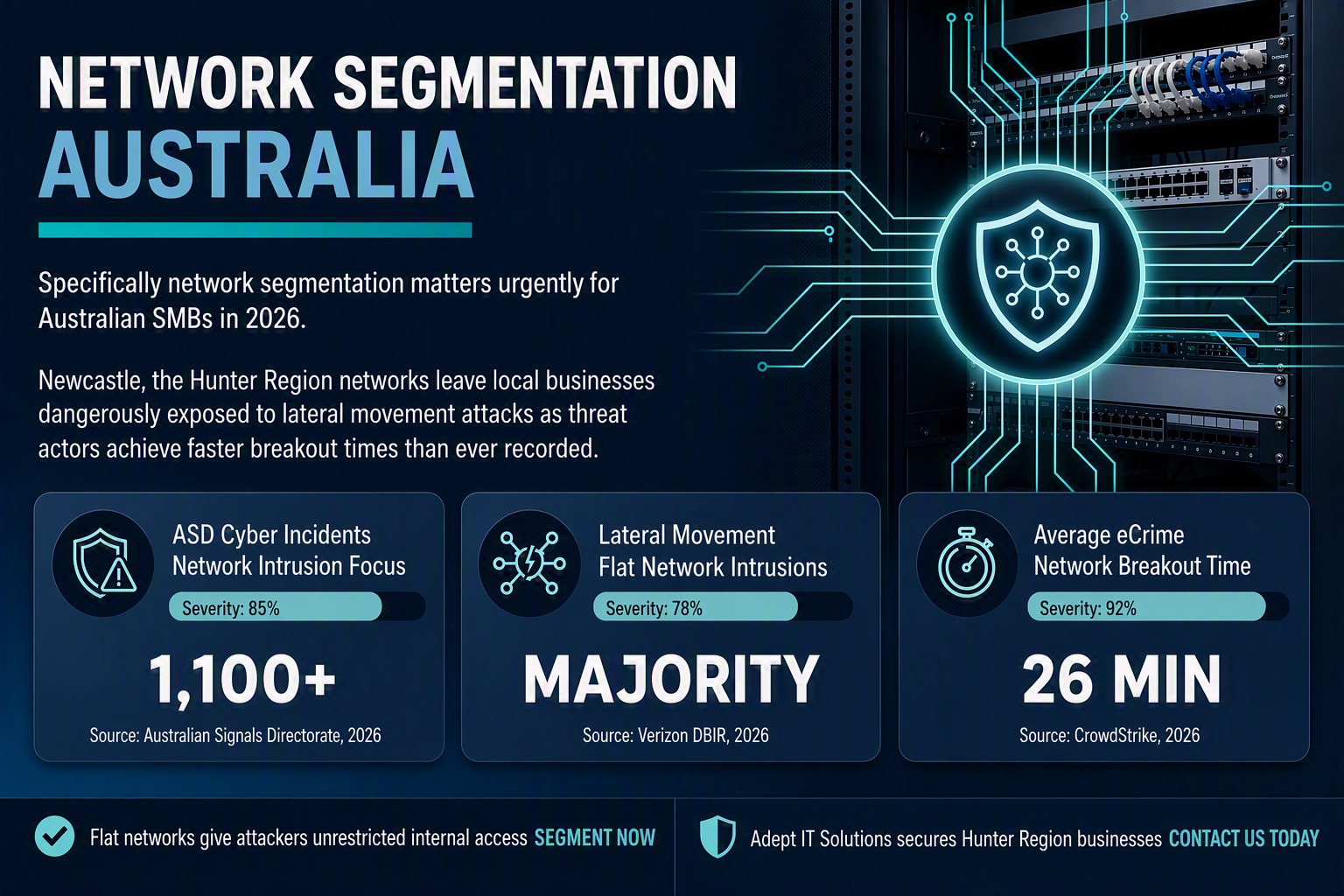
According to the Australian Signals Directorate, 2026, the Australian Signals Directorate (ASD) responded to over 1,100 cyber incidents in 2025-26, with network intrusion and lateral movement identified as primary attack pathways in the majority of significant incidents affecting Australian organisations. These are not theoretical risks. They are happening to businesses of all sizes, right now.
The Verizon, 2026 Data Breach Investigations Report (DBIR) confirms that lateral movement within flat, unsegmented networks was a contributing factor in the majority of successful intrusions globally, with attackers leveraging unrestricted internal access to escalate privileges and exfiltrate data. For SMBs without dedicated security staff, the consequences of a flat network can be catastrophic.
Understanding the most common mistakes is the first step toward meaningful improvement. Below are the seven critical errors SMBs make, and what to do instead.
Mistake 1: Running a Flat Network With No Internal Boundaries
The most prevalent flat network vulnerability in Australian SMBs is the absence of any internal boundary at all. Every device sits on one network, and once an attacker gains a foothold through a phishing email or compromised credential, they can traverse the entire environment without restriction.
The CrowdStrike, 2026 Global Threat Report recorded an average breakout time of just 26 minutes for eCrime adversaries. That means attackers can traverse an unsegmented network and reach critical systems in under half an hour once initial access is achieved. A flat network offers nothing to slow them down.
The remedy is to implement virtual local area networks (VLANs) to logically separate groups of users and systems. Finance, operations, human resources, and IT management should each occupy separate network segments with controlled inter-segment routing. This is foundational, and there is no justification for deferring it in 2026.
Mistake 2: Placing Operational Devices and Corporate Systems on the Same Network
Many SMBs connect printers, physical access controllers, building management systems, and Internet of Things (IoT) sensors directly alongside their corporate workstations and servers. Operational technology (OT) and IoT devices typically run outdated firmware, lack patch support, and have weak authentication. Placing them on the same network as corporate systems creates a significant attack surface.
An attacker who compromises a smart thermostat or an unmanaged printer can pivot directly into your corporate environment if no boundary exists. This risk is explored in detail in our post on operational technology security Australia. Dedicated OT and IoT segments, with strict firewall rules governing what communication is permitted, are essential controls for any business operating physical devices alongside digital infrastructure.
Mistake 3: Ignoring Guest Wi-Fi Isolation and BYOD Separation
Offering guest Wi-Fi without isolating it from your corporate network is a mistake that persists across businesses of every size. When a guest or contractor connects to a shared wireless network, their device, which may be infected with malware, gains proximity to your internal systems. The same risk applies to bring your own device (BYOD) programmes where personal phones and tablets connect to corporate Wi-Fi without separation.
Guest and BYOD traffic must be isolated to their own VLAN with internet-only access. Corporate resources should be entirely unreachable from those segments. Access to internal systems for legitimate BYOD users should be mediated through a virtual private network (VPN) or zero-trust network access (ZTNA) solution. Our guide on zero-trust cybersecurity explains how to implement these controls effectively for Australian SMBs.
Mistake 4: Failing to Segment Cloud Workloads and On-Premises Infrastructure
As Australian SMBs migrate workloads to Microsoft Azure and Microsoft 365, many assume that cloud security is handled automatically by the provider. This is a dangerous misconception. Cloud environments require the same segmentation discipline as on-premises infrastructure, implemented through virtual networks (VNets), network security groups (NSGs), and clearly defined access rules between cloud and on-premises resources.
When cloud workloads and on-premises systems share flat, unrestricted connectivity, an attacker who compromises a cloud resource can move directly into your local environment and vice versa. Proper hybrid network segmentation closes this gap. If your business has concerns about cloud security posture, our cloud security audit Australia resource outlines the key areas that commonly fail review.
Mistake 5: Neglecting Privileged Access and Internal Firewall Rules
Segmentation without enforcement is cosmetic. Many SMBs create VLANs but fail to implement robust internal firewall rules governing what traffic can pass between segments. Others allow administrators to connect from any segment using privileged credentials, eroding the protective value of the architecture entirely.
Privileged access management (PAM) must accompany network segmentation. Administrator accounts should only be usable from dedicated, hardened management segments. Lateral movement by compromised admin credentials is one of the most damaging attack patterns seen in 2026 incidents. Our detailed coverage of privileged access management Australia provides actionable guidance for SMBs looking to close this gap.
Mistake 6: Overlooking the Essential Eight Network Hardening Requirements
Essential Eight network hardening is a compliance baseline that many SMBs are aware of but do not fully implement. The ASD’s Essential Eight Maturity Model includes controls that directly support segmentation, including restricting administrative privileges, patching applications, and configuring Microsoft Office macro settings. These controls are interconnected, and segmentation amplifies their effectiveness.
Businesses that achieve Maturity Level 2 across the Essential Eight framework significantly reduce the risk of successful lateral movement. The ASD Essential Eight Framework provides authoritative guidance on each control and its implementation at each maturity level. Aligning your segmentation strategy with these requirements positions your business for both improved security outcomes and regulatory readiness under the Privacy Act 1988.
Mistake 7: No Monitoring or Alerting Across Segment Boundaries
Even well-designed segmentation provides limited value if no one is watching inter-segment traffic. Many SMBs create network boundaries but deploy no monitoring to detect when those boundaries are being tested or crossed. Without visibility, an attacker can probe segment boundaries for days before triggering a human response.
Effective segmentation requires pairing architectural controls with a security information and event management (SIEM) solution or a managed detection and response (MDR) service. Traffic anomalies between segments, such as a workstation attempting to contact a database server directly, should generate an immediate alert. Businesses that have experienced incidents know the cost of delayed detection. Our post on ransomware recovery Australia details how quickly an undetected intrusion can escalate. The NIST Cybersecurity Framework also emphasises continuous monitoring as a core function of mature cyber defence programmes.
How Adept IT Solutions Strengthens Network Segmentation for Australian SMBs
Adept IT Solutions works with SMBs across Newcastle, Lake Macquarie, the Hunter Region, Central Coast, and Sydney to design, implement, and monitor properly segmented networks. Our approach begins with a thorough network assessment to identify flat segments, unprotected IoT devices, misconfigured cloud connectivity, and gaps in internal firewall rules.
We design segmentation architectures that reflect your business structure and risk profile, implementing VLANs, managed switches, next-generation firewalls, and cloud network security groups. Our managed IT Newcastle and regional teams then provide ongoing monitoring to ensure boundaries remain intact and alerts are actioned in real time.
We also align every segmentation engagement with the ASD Essential Eight and ISO 27001 frameworks, ensuring your investment supports both security outcomes and compliance obligations. Businesses working toward formal certification will find that a well-segmented network forms the structural foundation of a defensible security posture. Our broader cybersecurity in 2026 guide provides additional context on how segmentation fits within a comprehensive security programme.
For businesses that have also identified gaps in endpoint protection alongside network architecture, our post on endpoint security Australia addresses the complementary controls that close the remaining gaps.
“CrowdStrike’s 2026 Global Threat Report recorded a 26-minute average breakout time for eCrime adversaries, meaning attackers can traverse an unsegmented network and reach critical systems in under half an hour once initial access is achieved. Network architecture is not a set-and-forget decision. It is an active defence.”

Building a Resilient Approach to Network Segmentation in Australia
The seven mistakes outlined above are not theoretical. They are patterns observed repeatedly in real SMB environments across Australia in 2026. A flat network, uncontrolled BYOD access, unmonitored segment boundaries, and misaligned cloud connectivity each represent a distinct pathway that attackers are actively exploiting right now.
Effective network segmentation Australia-wide requires a combination of sound architecture, enforced access controls, continuous monitoring, and alignment with established frameworks like the ASD Essential Eight. It is not a one-time project. It is an ongoing discipline that must evolve as your business and the threat landscape change.
If your business has not reviewed its internal network architecture recently, or if you are unsure whether the boundaries you have in place are actually enforced, now is the time to act. Contact Adept IT Solutions to speak with a specialist about a network segmentation review tailored to your business size, industry, and risk profile.
Frequently Asked Questions
Q: What is network segmentation and why do Australian SMBs need it in 2026?
A: Network segmentation is the practice of dividing a business network into separate zones with controlled access between them. For Australian SMBs, it is a critical security control because it limits the ability of an attacker to move laterally after gaining initial access. Without segmentation, a single compromised device can give an attacker access to your entire environment, including financial systems, customer data, and cloud workloads. Network segmentation Australia strategies should align with the ASD Essential Eight framework for maximum effectiveness.
Q: How does micro-segmentation for SMBs differ from standard VLAN-based segmentation?
A: Micro-segmentation for SMBs takes network boundary controls down to the individual workload or application level, rather than applying broad VLAN-based divisions between departments. It is typically implemented using software-defined networking tools or cloud-native controls like Azure Network Security Groups. While standard VLANs are a strong foundation, micro-segmentation provides finer-grained controls that are especially valuable for businesses handling sensitive data or operating in regulated industries. Both approaches can coexist and complement each other in a mature network security architecture.
Q: Does network segmentation help with Essential Eight compliance?
A: Yes. Network segmentation directly supports several Essential Eight controls, particularly those related to restricting administrative privileges, limiting lateral movement, and reducing the impact of malicious code execution. When a properly segmented network is combined with patching, application control, and multi-factor authentication, businesses can achieve a significantly higher Essential Eight maturity level. The ASD recommends network segmentation as a key component of a layered defence strategy for Australian organisations of all sizes.
Q: How can a managed IT provider in Newcastle or the Hunter Region help with network segmentation?
A: A local managed IT provider with network security expertise can conduct a full assessment of your existing architecture, identify flat network risks, and design a segmentation strategy suited to your business. For SMBs in Newcastle, Lake Macquarie, and the broader Hunter Region, working with a provider like Adept IT Solutions means access to on-site support for hardware configuration, combined with remote monitoring and alerting to maintain segment integrity over time. A network security upgrade of this nature is one of the highest-value investments an SMB can make in 2026.
Get in touch with our team of IT experts today! You can contact us via phone at 1300 423 378 or email us at info@adept-it.com.au.

