
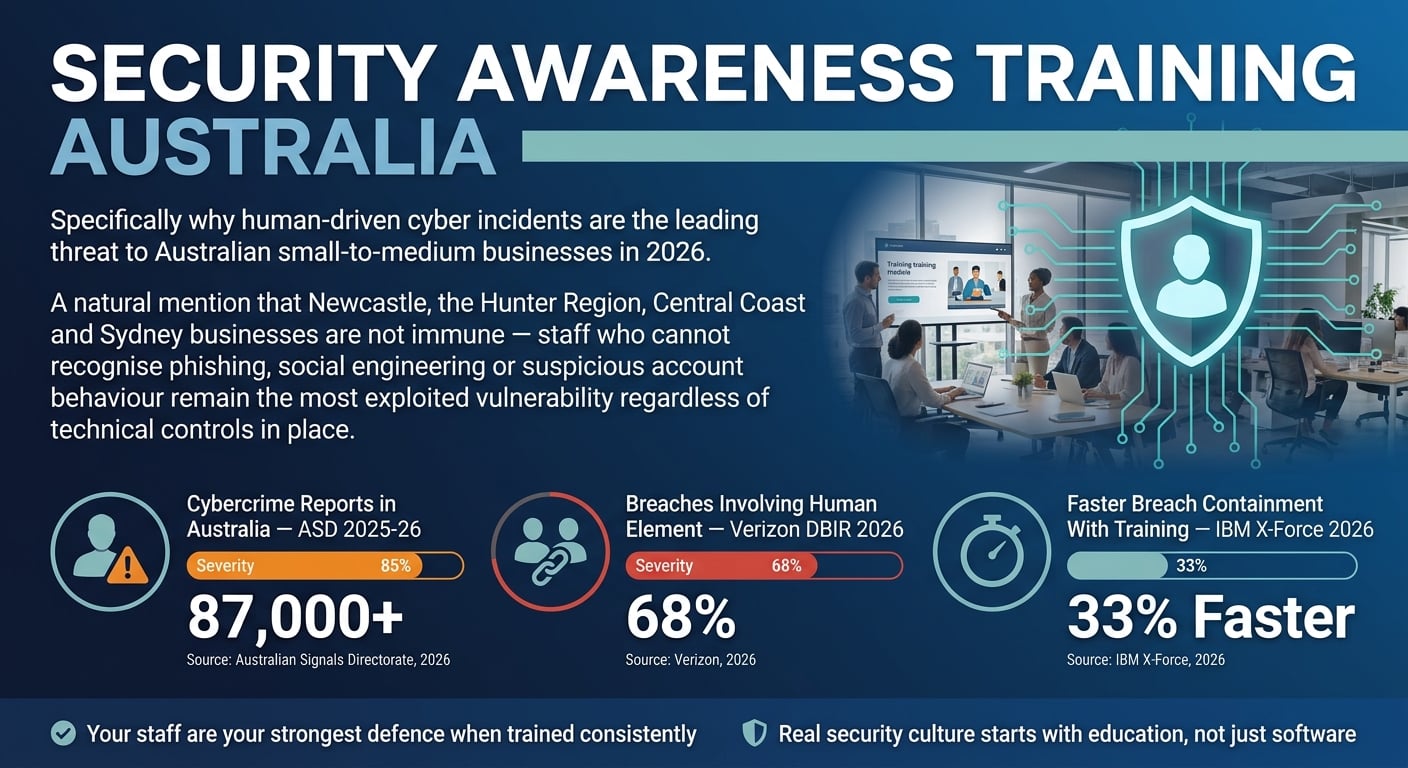
Security awareness training Australia has never been more critical, yet most small and medium businesses (SMBs) are making avoidable mistakes that leave their people, data, and operations dangerously exposed. The Australian Signals Directorate, 2026 received over 87,000 cybercrime reports in the 2025-26 period, with phishing and social engineering driven by human error remaining the leading attack vectors. No firewall or endpoint solution can fully compensate for an untrained workforce. This post identifies the ten critical mistakes Australian SMBs make with security awareness training and explains exactly what to do instead.

Why One-Off Training Sessions Are Leaving Your Business Exposed
Many Hunter Region and Central Coast businesses still treat cyber education as a one-time event: a 30-minute session during onboarding, a compliance video watched once a year, and nothing more. This approach is fundamentally broken. Threat actors do not pause their campaigns while your team forgets last year’s phishing module.
The Verizon, 2026 Data Breach Investigations Report (DBIR) found that 68% of breaches involved a human element, including social engineering, errors, and misuse. Technical controls alone cannot replace a security-educated workforce. Continuous, structured training is the only model that works.
Mistake 1: Treating Security Awareness as a Compliance Checkbox
The most damaging mistake SMBs make is running training purely to satisfy an audit or insurance requirement. When training is designed to tick a box rather than change behaviour, it delivers no real risk reduction. Staff disengage quickly, retention is minimal, and the business remains just as vulnerable after the session as before it.
Effective human risk management requires training that is outcome-focused. The goal is measurable behaviour change: fewer clicked phishing links, faster incident reporting, and stronger password discipline. Compliance is a by-product of good training, not the purpose of it. SMBs that conflate the two pay twice: once for the training and again for the breach.
Mistake 2: Using Generic, Off-the-Shelf Content That Misses the Mark
Generic training modules built for a global audience rarely reflect the threat landscape facing Australian SMBs. References to overseas regulatory frameworks, unfamiliar terminology, or irrelevant scenarios cause staff to disengage. Localised content that references Australian regulations such as the Privacy Act 1988 and real-world attack patterns observed in Newcastle, Sydney, and the broader Hunter Region is far more effective.
Mistake 3: Running No Phishing Simulations
IT security training Newcastle businesses receive often skips phishing simulations entirely, relying instead on passive video content. Simulated phishing exercises are among the most effective tools available. They reveal exactly which staff members are susceptible, provide a measurable baseline, and create a teachable moment at the precise instant of vulnerability. Without simulations, training is theoretical. With them, it becomes practical and actionable.
For more on how attackers exploit human behaviour in email environments, see our guide on Business Email Compromise warning signs.
Mistake 4: Ignoring Role-Based Risk Differences
Not every employee carries the same level of cyber risk. A finance officer processing invoices faces vastly different threats to a warehouse supervisor or a customer service representative. Delivering identical training to all roles wastes time and misses the highest-risk individuals. Role-based training tailors content to the actual threats each job function encounters, dramatically improving relevance and retention.
Privileged users, such as system administrators and executives, require specialised content covering threats like credential theft and targeted spear-phishing. Our blog on Privileged Access Management risks outlines why elevated access demands elevated awareness.
Mistake 5: Measuring Nothing and Improving Nothing
If you cannot measure the impact of your cyber education programme, you cannot improve it. Many SMBs track completion rates as their sole metric, which says nothing about whether behaviour has actually changed. Meaningful metrics include phishing simulation click rates over time, incident reporting frequency, and knowledge assessment scores before and after training cycles.
The IBM X-Force, 2026 Threat Intelligence Index found that organisations with mature security awareness programmes identified and contained breaches 33% faster than those relying on technology controls alone. Measurement is the mechanism that drives that maturity.
Mistake 6: Skipping Leadership Buy-In
Security culture starts at the top. When business owners and senior managers are exempt from training or visibly disengaged, staff follow that lead. Leadership buy-in signals to the entire organisation that cybersecurity is a genuine priority, not an IT department concern. Executives should participate in phishing simulations, attend training sessions alongside their teams, and visibly champion the programme.
Leaders also present a high-value target for attackers. Targeted spear-phishing and business email compromise campaigns frequently impersonate or target senior staff. Our analysis of insider threat warning signs explores the overlap between privileged access and human risk.
Mistake 7: Forgetting Contractors and Third-Party Users
Contractors, labour hire workers, and third-party vendors who access your systems or data are just as capable of introducing a breach as a permanent employee. Most SMBs never extend their training programmes to these groups, creating a significant gap in their human risk management posture. Any individual with access to business systems or sensitive information should complete relevant security awareness training before that access is granted.
Supply chain risk is a growing concern in Australia. Our post on supply chain cyber attack prevention outlines why third-party access control is inseparable from staff awareness.
Mistake 8: Training Too Infrequently to Build Lasting Habits
Annual training is one of the most persistent failures in SMB cybersecurity. Research consistently shows that knowledge and vigilance decay rapidly without reinforcement. A single training session per year means staff spend 364 days operating on diminishing awareness. Best-practice programmes deliver short, targeted modules monthly or quarterly, supplemented by regular phishing simulations and real-time learning moments triggered by actual near-misses.
Mistake 9: Providing No Localised Australian Threat Context
Training that lacks localised threat context fails to resonate. Australian SMBs face specific threat actors targeting Australian industries, Australian tax and government impersonation scams, and regulatory obligations under Australian law. Training content should reference the Australian Cyber Security Centre (ACSC), the Office of the Australian Information Commissioner (OAIC), and real incidents reported in the Australian market.
The OAIC Notifiable Data Breaches scheme provides quarterly reports that offer real, local breach examples ideal for training content. Using these cases makes the threat feel immediate and relevant to your team. Businesses with obligations under the Privacy Act 1988 should also review our guide to Privacy Act reforms for SMBs.
Mistake 10: Failing to Build a Reinforcement Culture Beyond the Classroom
Training modules alone do not create a security-conscious culture. Reinforcement must extend into daily operations through clear reporting pathways, positive recognition for staff who report suspicious activity, and visible security reminders embedded in workflows. Without this ongoing reinforcement, even excellent training fades quickly under the pressure of everyday business demands.
A reinforcement culture also means connecting training to real consequences. When staff understand how a compromised credential can trigger a ransomware event affecting the entire business, the motivation to stay vigilant increases. See our post on ransomware recovery steps for SMBs to understand what is at stake.
How Adept IT Solutions Builds a Human Firewall for Hunter Region SMBs
Adept IT Solutions delivers structured security awareness training Australia-wide, with deep expertise serving Newcastle, Lake Macquarie, the Hunter Region, Central Coast, and Sydney. Our programmes are built on the Essential Eight framework published by the Australian Signals Directorate (ASD), ensuring alignment with Australian government guidance rather than generic international templates.
We combine phishing simulations, role-based learning modules, leadership engagement sessions, and quarterly reporting against measurable behavioural metrics. Our approach integrates with your broader cybersecurity posture, including endpoint protection, secure remote access, and vulnerability management. For context on how training connects to your technical defences, review our post on vulnerability management blind spots.
The ACSC Essential Eight guidance explicitly identifies user education as a foundational control. We translate that guidance into practical, engaging programmes that Hunter Region SMBs can sustain without a large internal IT team.
“68% of breaches involve a human element. Technology closes the technical gaps; training closes the human ones. Both are non-negotiable.”, Verizon Data Breach Investigations Report, 2026

Stop Making These Mistakes and Start Building Real Cyber Resilience
The ten mistakes outlined above are not theoretical risks; they are active vulnerabilities affecting SMBs across Newcastle, the Hunter Region, and the Central Coast right now. Effective security awareness training Australia-wide requires continuous delivery, localised content, measurable outcomes, and genuine cultural commitment from leadership through to contractors.
Every week without a structured programme is a week your people are operating as an untested point of entry for attackers. The cost of training is a fraction of the cost of a breach. Adept IT Solutions works with Australian SMBs to design programmes that build lasting human firewalls rather than annual compliance theatre. Contact Adept IT Solutions today to find out how we can strengthen your organisation’s human risk posture before it is tested by an attacker.
Frequently Asked Questions
Q: How often should SMBs run security awareness training in Australia?
A: Best-practice security awareness training Australia programmes operate on a continuous cycle rather than an annual event. Short, focused modules delivered monthly or quarterly, combined with regular phishing simulations and real-time reinforcement, are significantly more effective at sustaining behavioural change than a single annual session. The ACSC recommends ongoing user education as part of the Essential Eight framework.
Q: What is a phishing simulation SMB programme and why does it matter?
A: A phishing simulation SMB programme sends controlled, fake phishing emails to staff to test whether they click malicious links or provide credentials. When a staff member interacts with a simulated phishing email, they receive immediate, contextual training. This approach identifies high-risk individuals, creates measurable baselines, and drives far greater vigilance than passive training content alone. It is one of the most cost-effective investments in human risk management available to Australian SMBs.
Q: Do contractors need to complete employee cyber training?
A: Yes. Any individual who accesses your systems, data, or premises poses a human risk regardless of their employment status. Contractors, labour hire staff, and third-party vendors should complete relevant employee cyber training before access is granted and at regular intervals thereafter. Failing to include these groups is one of the most common gaps identified during security assessments of Australian SMBs.
Q: How does security awareness training connect to compliance with Australian regulations?
A: Security awareness training Australia programmes that are well-designed support compliance with the Privacy Act 1988, the Notifiable Data Breaches (NDB) scheme administered by the OAIC, and the ASD Essential Eight framework. While compliance should not be the sole objective of training, demonstrating a structured, documented programme with measurable outcomes significantly strengthens your position during audits, insurance assessments, and in the event of a regulatory investigation following a breach.
Get in touch with our team of IT experts today! You can contact us via phone at 1300 423 378 or email us at info@adept-it.com.au.

