
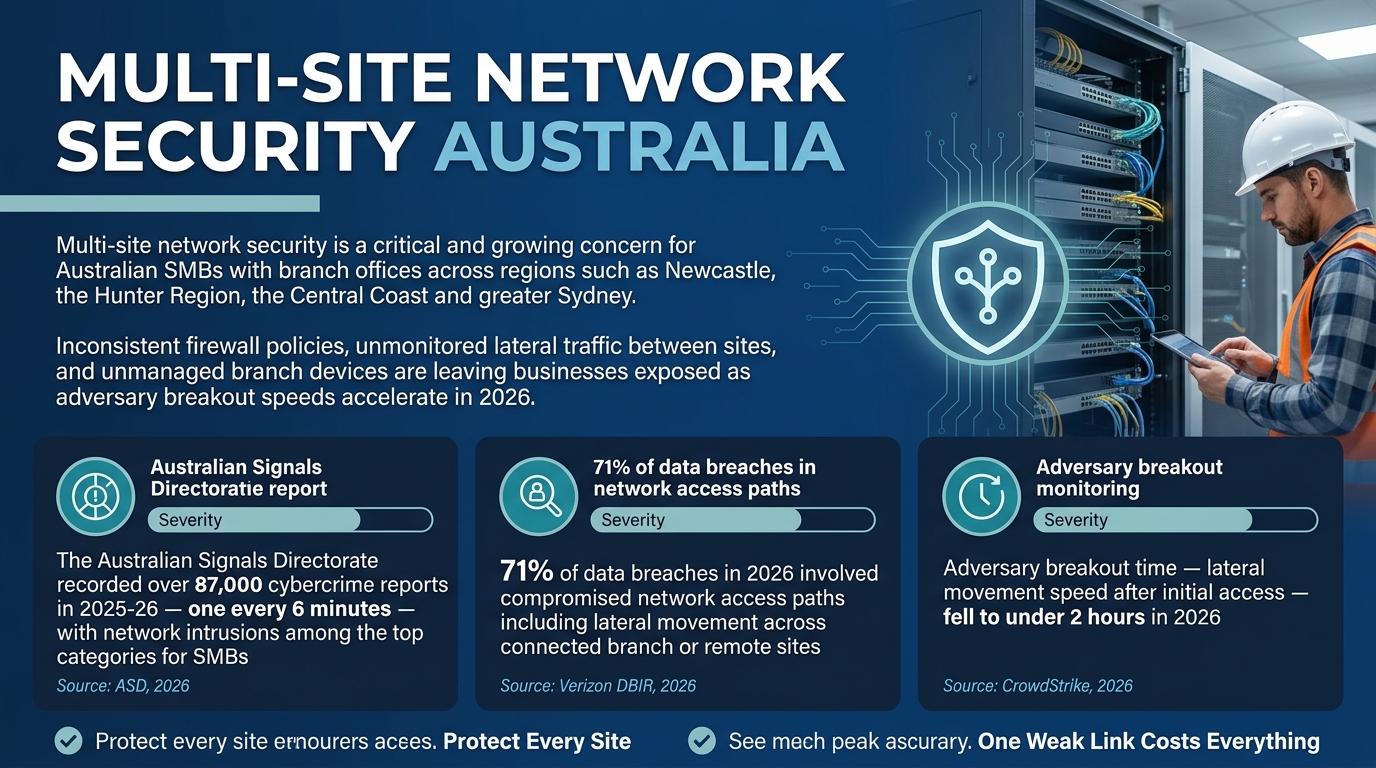
Multi-site network security Australia is one of the most underestimated challenges facing small and medium businesses (SMBs) in 2026. As Australian businesses expand across multiple offices, warehouses, and retail locations in regions like Newcastle, the Hunter Region, the Central Coast, and Sydney, the complexity of keeping every site secure grows exponentially. A single unsecured branch can become the entry point for an attack that cascades across your entire business. According to the Australian Signals Directorate, 2026, over 87,000 cybercrime reports were received in 2025-26, equating to one report every six minutes, with network-level intrusions among the top categories for SMBs.
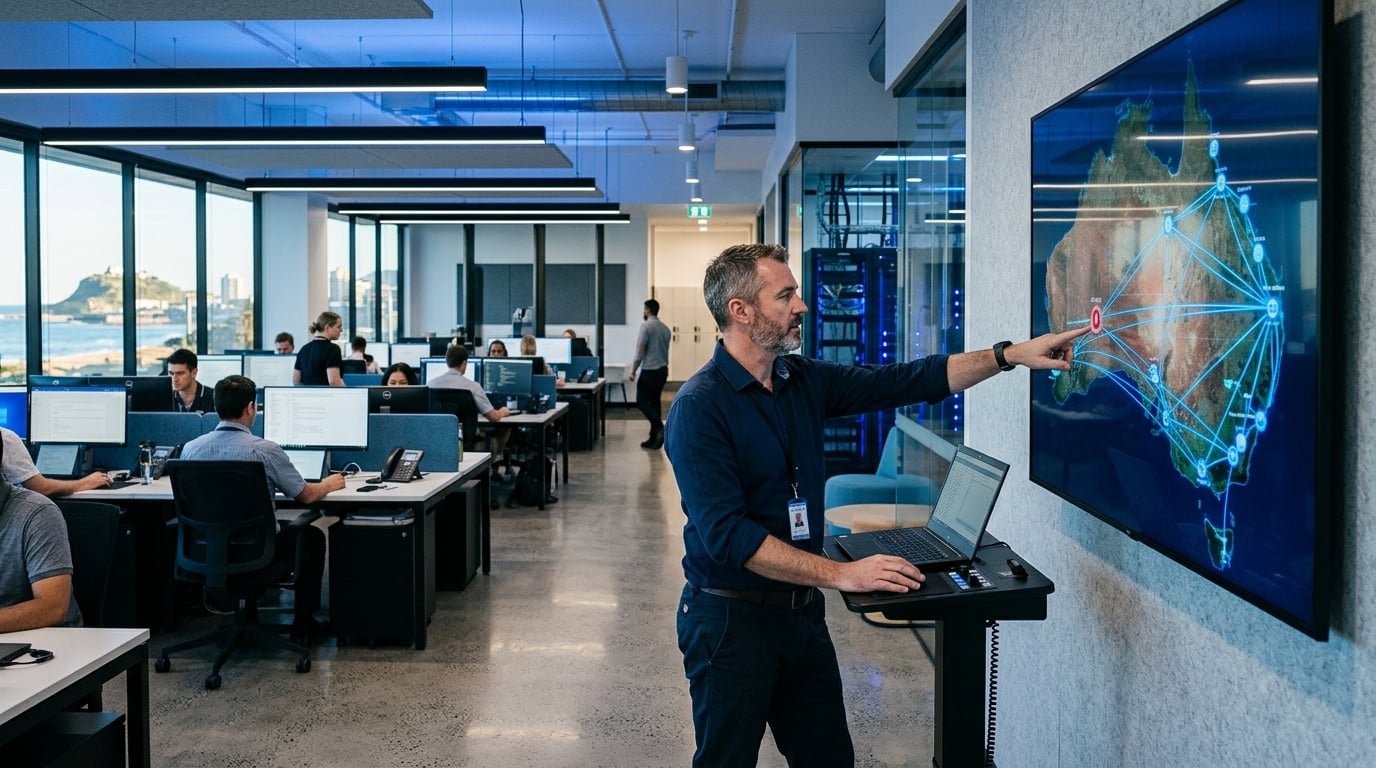
Why a Single Unsecured Branch Office Can Sink Your Entire Business
Most SMBs invest reasonably well in their primary office but treat branch locations as afterthoughts. A regional office in the Hunter Region or a warehouse on the Central Coast may share the same network environment as your head office without receiving the same level of protection. Attackers know this. They actively probe for the weakest link in your connected infrastructure.
The Verizon, 2026 Data Breach Investigations Report found that 71% of data breaches involved compromised network access paths, including lateral movement across connected branch or remote sites, with SMBs disproportionately affected due to inconsistent perimeter controls. Once inside one location, a threat actor can traverse your environment rapidly.
The CrowdStrike, 2026 Global Threat Report revealed that adversary breakout time fell to under two hours in 2026. That is the window between initial access and full lateral movement across your connected sites. For businesses without centralised monitoring, two hours is not enough time to detect and respond manually.
Risks 1 to 3: Inconsistent Firewall Policies Across Your Sites
Risk 1: No Standardised Firewall Ruleset
Many SMBs configure firewall rules differently at each site, often because each location was set up at a different time by a different person. This creates an inconsistent firewall policy environment where what is blocked at your Newcastle head office may be permitted at your Sydney branch. Attackers exploit these gaps deliberately. A standardised ruleset, centrally managed and consistently enforced, is the baseline requirement for any multi-site environment.
Risk 2: Outdated Firmware on Branch Firewalls
Firewall firmware at remote sites is frequently neglected. Without a structured patch management process, branch office firewalls can run versions with known critical vulnerabilities for months. The Australian Cyber Security Centre (ACSC) consistently flags unpatched network devices as one of the most exploited entry vectors across Australian businesses. Updating firmware is not optional; it is a fundamental control.
Risk 3: No Firewall Log Review Process
Even businesses with firewalls installed at every site often fail to review logs consistently. Firewall logs contain critical signals: repeated failed authentications, unusual outbound traffic, and port scans. Without a centralised log review process, these warning signs go unnoticed until an incident is already underway. This is a core gap in vulnerability management for Australian SMBs.
Risks 4 to 6: Flat Networks, Unmonitored Traffic and Weak Remote Access
Risk 4: Flat Network Architecture
A flat network is one where all devices share the same broadcast domain and can communicate with each other without restriction. In a multi-site business, this means a compromised point-of-sale terminal in your Central Coast store can reach your accounting server in Newcastle. Proper network segmentation for Australian SMBs creates isolated zones that contain breaches and limit lateral movement. This is one of the most impactful controls an SMB can implement.
Risk 5: No Traffic Monitoring Between Sites
Many multi-site SMBs connect their locations using virtual private networks (VPNs) or Software-Defined Wide Area Network (SD-WAN) links without applying any traffic inspection to east-west traffic. SD-WAN security risks are frequently underestimated; the connection between sites is treated as inherently trusted. In practice, this means malware that establishes a foothold at one site travels freely across the SD-WAN link to others. Traffic inspection between sites is a non-negotiable security requirement.
Risk 6: Weak or Misconfigured Remote Access
Remote access remains a critical vulnerability in multi-site environments. Poorly configured VPNs, legacy Remote Desktop Protocol (RDP) exposure, and accounts without multi-factor authentication (MFA) create exploitable pathways into your network. The ISO 27001 Information Security Standard mandates access controls that apply consistently across all connected environments. Without enforced MFA and least-privilege access, remote access becomes your most dangerous attack surface.
Risks 7 and 8: Shadow Devices and Unmanaged Switches at Branch Level
Risk 7: Shadow Devices and Unmanaged Endpoints
Branch offices are breeding grounds for shadow IT. Staff plug in personal devices, IoT sensors, and unapproved smart TVs or printers without notifying IT. Each of these devices represents an unmanaged endpoint with unknown security posture. Without a network access control (NAC) solution or device inventory process, your IT team has no visibility into what is connected at each site. Reviewing your endpoint security posture across all sites is an essential starting point.
Risk 8: Unmanaged Switches and Cabling Infrastructure
Unmanaged network switches at branch offices are a frequently overlooked risk. Unlike managed switches, they cannot enforce VLAN policies, restrict MAC addresses, or generate logs. Anyone who physically connects to an unmanaged switch at your Hunter Region branch gains the same network access as your most privileged internal user. Replacing unmanaged switches with managed, monitored alternatives is a foundational step in hardening your branch network infrastructure. Consider also reviewing privileged access management risks in conjunction with physical access controls.
Risk 9: No Centralised Visibility Across Your Multi-Site Environment
The final and most critical risk in multi-site network security Australia is the absence of a single pane of glass across your entire environment. When each site operates in isolation, with separate management consoles, different logging tools, and no centralised alerting, threats move faster than your team can respond. This directly enables the lateral movement scenarios highlighted by the CrowdStrike, 2026 Global Threat Report, where adversaries exploit the gap between detection and response.
A Security Information and Event Management (SIEM) platform, integrated with endpoint detection tools and firewall telemetry across all sites, enables real-time correlation of events. Without this, your security team is operating blind across multiple locations simultaneously. For businesses concerned about compliance obligations, the lack of centralised logging also creates issues under the Privacy Act reforms for Australian SMBs where notification obligations apply from the moment of breach discovery.
Centralised visibility also supports network compliance for SMBs operating under frameworks like the Essential Eight or ISO 27001. Without an audit trail spanning all sites, demonstrating compliance to insurers, partners, or regulators becomes near impossible. The NIST Cybersecurity Framework places Detect and Respond functions at the core of any mature security posture, both of which require centralised tooling to be effective across distributed environments.
How to Strengthen Multi-Site Network Security Across Australia
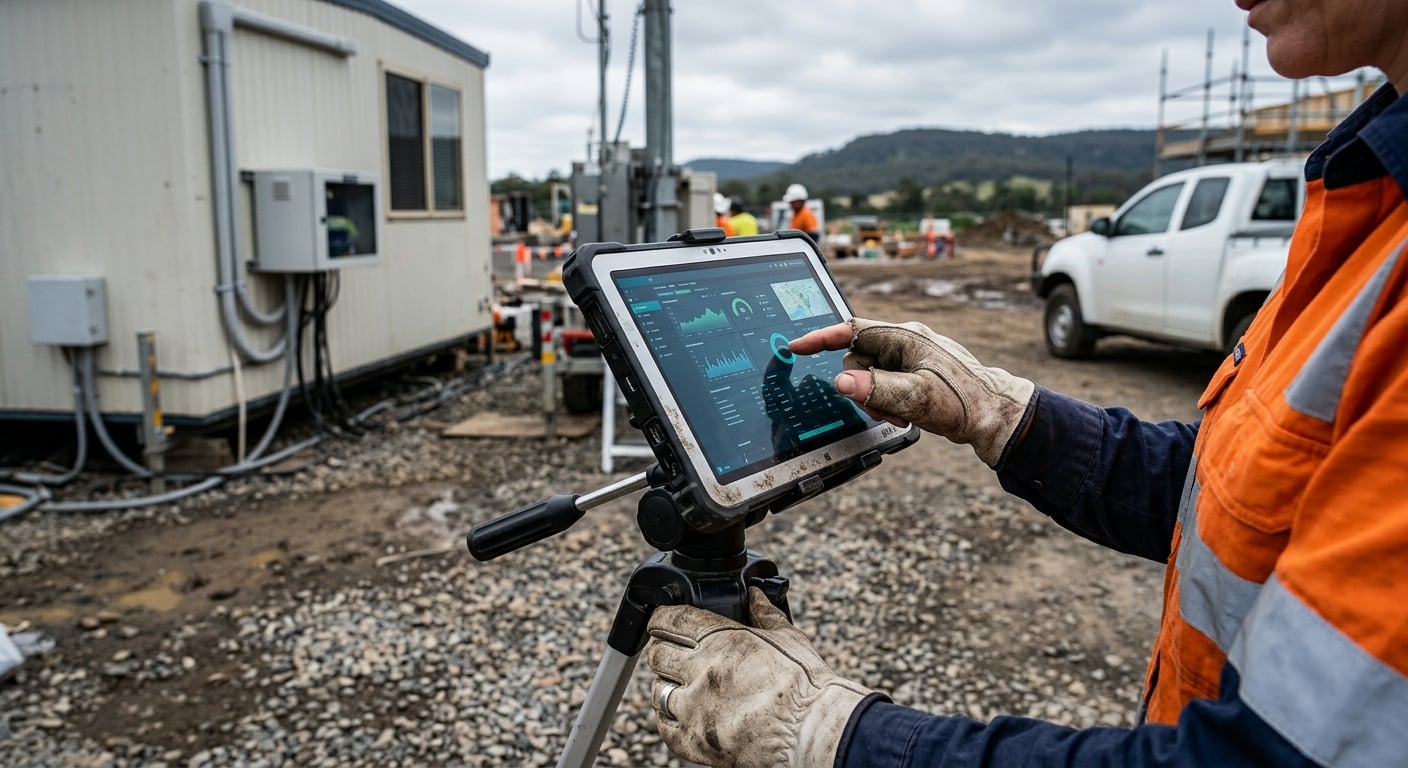
Closing these nine risks requires a structured, layered approach managed by a business network security provider with genuine multi-site expertise. For SMBs across Newcastle, the Hunter Region, the Central Coast, and Sydney, the challenge is not just technical. It is also operational: maintaining consistent standards across geographically dispersed locations without a large internal IT team.
A managed IT Newcastle and broader regional service model delivers standardised security configurations, centralised monitoring, and proactive vulnerability remediation across every site simultaneously. This removes the inconsistency that attackers rely on. Key actions include deploying managed firewalls with unified policy management, implementing network segmentation, enforcing MFA on all remote access pathways, and adopting a SIEM platform with 24/7 alerting.
Backup and disaster recovery must also be considered across all sites, not just the head office. A breach at a branch that corrupts local data without a site-level recovery plan creates extended downtime. Reviewing your approach to cloud backup compliance for Australian SMBs is a logical next step alongside network hardening. Similarly, understanding your exposure through dark web monitoring in Australia can reveal whether credentials from any of your sites have already been compromised.
“With adversary breakout times now under two hours, multi-site businesses cannot afford to operate each branch as a separate security island. Centralised visibility and consistent controls are no longer a luxury, they are the baseline requirement for survival in today’s threat environment.” — Adept IT Solutions
Multi-site network security Australia is not a problem that resolves itself over time. The nine risks outlined above compound as your business grows. Every new site added without a consistent security framework is another potential entry point for attackers who are becoming faster, more sophisticated, and more targeted in 2026. The businesses that will withstand this environment are those that treat every branch location with the same rigour as their head office, backed by a partner with the tools and expertise to manage it all centrally. To assess your current exposure and build a roadmap toward a resilient, consistently secured multi-site environment, contact Adept IT Solutions today.
Frequently Asked Questions
Q: What is the biggest risk in multi-site network security Australia for SMBs?
A: The single biggest risk is inconsistent security controls across locations. When each branch operates with different firewall policies, unmanaged devices, or no centralised visibility, attackers can exploit the weakest site and move laterally across your entire connected environment within hours. Standardising controls across every site and deploying centralised monitoring are the most impactful steps an SMB can take to reduce this risk.
Q: How do I know if my branch offices have unmanaged switches or shadow devices?
A: A network discovery scan or audit performed by a managed IT provider will identify every connected device at each site. Many SMBs are surprised to discover rogue devices, personal phones, and unsanctioned access points connected to their business network. Running a full asset inventory across all locations is the starting point for addressing shadow IT and unmanaged infrastructure.
Q: Does network compliance for SMBs require the same standards at every site?
A: Yes. Frameworks including ISO 27001 and the Australian Government’s Essential Eight apply to your entire business environment, not just your primary office. If a branch location is outside the scope of your security controls, it is also outside the scope of your compliance posture. Regulators and cyber insurers are increasingly scrutinising branch-level controls as part of overall business network security assessments.
Q: Can a managed IT provider in Newcastle manage my business network security across multiple sites in different regions?
A: Absolutely. A managed IT provider with multi-site expertise uses centralised remote monitoring and management (RMM) platforms to apply consistent security policies, monitor traffic, and respond to incidents across all locations regardless of geography. Adept IT Solutions supports businesses across Newcastle, the Hunter Region, the Central Coast, Sydney, and nationally, delivering unified security management without the need for on-site IT staff at every branch.
Get in touch with our team of IT experts today! You can contact us via phone at 1300 423 378 or email us at info@adept-it.com.au.

