
Dark web monitoring Australia has moved from a nice-to-have security feature to an essential layer of protection for every small and medium business operating in 2026. Stolen credentials, compromised email accounts, and leaked customer records are traded openly across dark web forums, often months before a business realises anything has gone wrong. For Australian small and medium-sized businesses (SMBs), that delay is not just damaging — it is frequently catastrophic. Understanding the warning signs that your data may already be exposed is the first step toward taking control.

What Is Dark Web Monitoring and Why Does It Matter for Australian SMBs?
The dark web is a hidden layer of the internet that is not indexed by standard search engines and requires specialised software to access. It hosts a thriving criminal economy where stolen data, including login credentials, financial records, and personal information, is bought and sold at scale. For Australian SMBs, this matters because cybercriminals do not discriminate by business size. A small accounting firm in Newcastle is just as attractive a target as a large enterprise if its credentials are accessible.
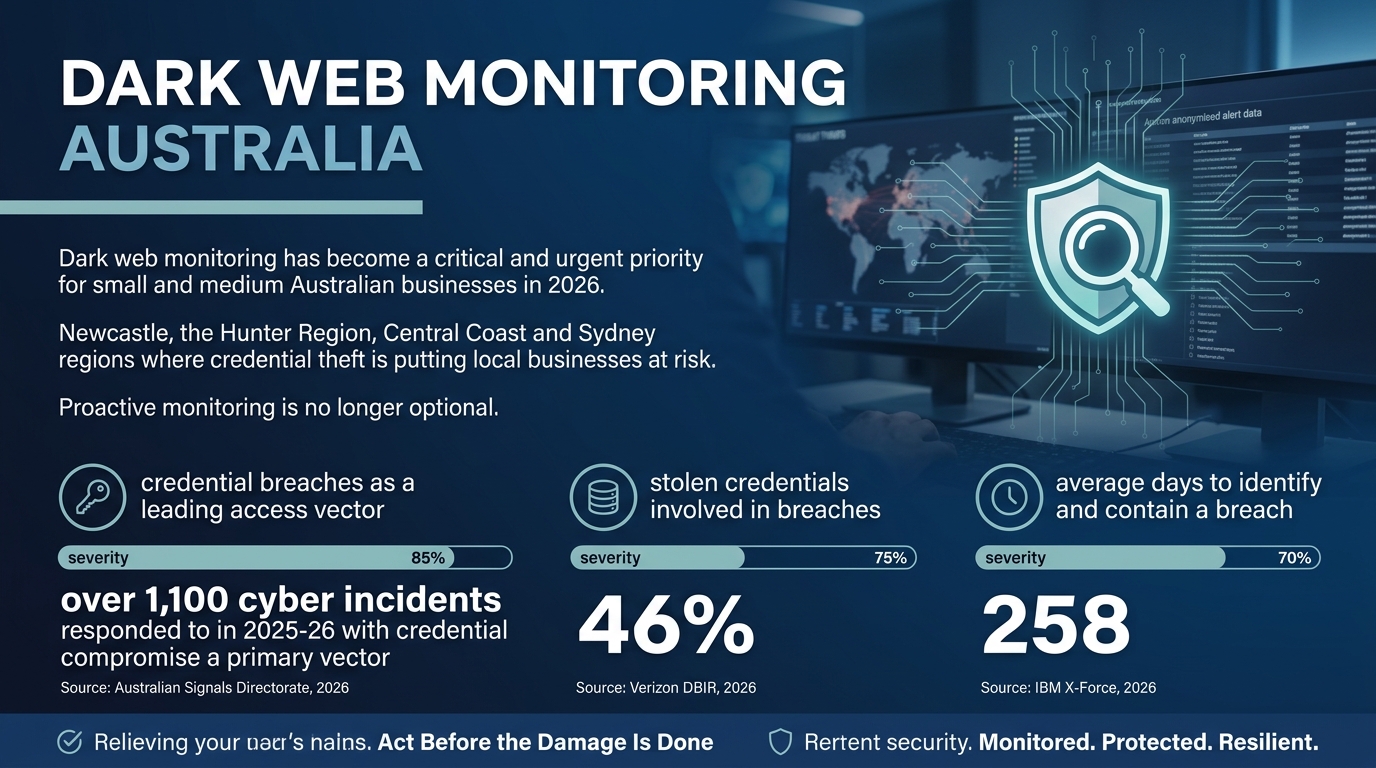
According to the Australian Signals Directorate, 2026, in 2025-26 the Australian Signals Directorate (ASD) responded to over 1,100 cyber incidents, with credential compromise remaining a leading initial access vector for attacks on SMBs. These are not isolated events. They represent a systemic vulnerability that monitoring services are specifically designed to detect and address before attackers gain a foothold.
Dark web monitoring services scan underground marketplaces, paste sites, and criminal forums for any mention of your business domain, email addresses, or credentials. When a match is found, your security team or managed service provider is alerted immediately, enabling a rapid response before further damage occurs. This proactive approach is a cornerstone of modern managed security services and is increasingly expected under Australian compliance frameworks.
How Stolen Business Credentials End Up on the Dark Web
Credentials rarely end up on the dark web through a single dramatic breach. More often, they accumulate over time through a combination of phishing attacks, third-party data breaches, malware infections, and weak password hygiene. An employee who reuses a personal password across work accounts may inadvertently expose their business credentials when that personal account is compromised through an unrelated breach.
The Verizon, 2026 Data Breach Investigations Report found that 46% of data breaches in 2026 involved stolen credentials, making dark web exposure one of the primary pathways threat actors use to compromise organisations. Once credentials are listed for sale, multiple criminal groups can purchase and deploy them simultaneously, amplifying the risk exponentially.
Supply chain vulnerabilities are another significant source. When a software vendor, cloud platform, or business partner suffers a breach, the credentials of every connected business may be harvested. For Hunter Region businesses operating within interconnected supply chains, this indirect exposure is a particularly serious risk. Our blog on supply chain cyber attacks Australia explores this threat in detail.
7 Critical Warning Signs Your Business Data Is Already Exposed
Warning Sign 1: Unexplained Account Lockouts or Login Failures
Repeated account lockouts that cannot be explained by user error are a strong indicator that someone is attempting to access systems using stolen credentials. Attackers who acquire credential lists from dark web forums will often run automated tools to test those credentials against business accounts. Multiple failed logins across different user accounts within a short period is a pattern that demands immediate investigation, not routine password resets.
Warning Sign 2: Employees Receiving Targeted Phishing Emails
Generic phishing emails are common. Targeted ones that reference actual employee names, roles, or internal business information are a different threat entirely. This level of specificity suggests that attackers already have access to internal data, possibly obtained from a previous breach. Business email compromise Australia is a growing vector that frequently originates from dark web intelligence gathering.
Warning Sign 3: Suspicious Activity in Cloud or Microsoft 365 Accounts
Logins from unusual geographic locations, unfamiliar devices, or outside of normal business hours in Microsoft 365 or other cloud platforms can indicate that compromised credentials are being used. Attackers who purchase credentials from dark web marketplaces will test them across popular platforms immediately. If your Microsoft 365 audit logs show access from locations your team has never visited, treat it as a serious incident.
Warning Sign 4: Customers or Partners Report Receiving Strange Communications
When customers or business partners begin reporting unusual emails or messages that appear to originate from your company, it is often a sign that an email account has been compromised or your domain is being spoofed. Attackers with access to your credentials may use your business identity to conduct fraud against your contacts. This kind of reputational damage can be severe and long-lasting for SMBs in close-knit communities like the Central Coast and Hunter Region.
Warning Sign 5: Unexpected Password Reset Requests
If staff members are receiving password reset emails they did not initiate, attackers may have already identified their accounts and are attempting to take control. This is a classic early-stage indicator of credential stuffing. Without robust multi-factor authentication (MFA) and identity security Australia controls in place, a single successful reset can cascade into a full account takeover within minutes.
Warning Sign 6: A Third-Party Vendor Reports a Breach
When a software vendor, cloud provider, or business partner notifies you of a data breach, your credentials may have been included in the stolen data even if you were not directly attacked. Many businesses dismiss vendor breach notifications as irrelevant to their own security posture. In reality, any shared credentials or single sign-on integrations create direct exposure pathways that should trigger an immediate credential audit and dark web scan. See our guide on third-party vendor security Australia for a fuller picture of this risk.
Warning Sign 7: Your Business Domain Appears in a Breach Database
Publicly accessible breach notification services may surface your business domain in a known data breach. While this confirms exposure has already occurred, it is rarely the complete picture. Dark web markets often list data long before it reaches publicly searchable databases. Stolen credentials detection through a professional monitoring service provides earlier visibility and faster response than relying on public notifications alone.
The Real Cost of Ignoring Dark Web Threats for SMBs in 2026
The financial stakes are significant and measurable. The IBM, 2026 Cost of a Data Breach Report found that the average time to identify and contain a data breach in 2026 was 258 days, meaning stolen credentials can circulate on dark web forums for months before a business is even aware of the exposure. Every day of undetected compromise extends the window for fraud, data theft, and ransomware deployment.
For Australian SMBs, the consequences extend beyond the immediate financial loss. Under the Privacy Act 1988 and the Notifiable Data Breaches scheme administered by the Office of the Australian Information Commissioner (OAIC), businesses have mandatory obligations to notify affected individuals and the regulator when a data breach is likely to result in serious harm. Failure to comply can attract significant penalties. Proactive monitoring helps businesses meet these obligations by detecting breaches early enough to act responsibly.
Ransomware is often the end result of undetected credential compromise. If attackers use stolen credentials to gain access to your network, they may spend weeks or months quietly establishing persistence before deploying ransomware at the worst possible moment. Our post on ransomware recovery Australia outlines what recovery looks like when prevention fails.
How Dark Web Monitoring Works as Part of a Managed Security Service
Professional dark web monitoring is not a single tool but a continuous intelligence process integrated into a broader security posture. Automated scanners crawl dark web forums, paste sites, hacker channels, and criminal marketplaces around the clock, looking for specific data signatures tied to your business, including email domains, IP addresses, and known account identifiers. When a match is detected, your security provider receives an alert and begins the investigation immediately.
Effective monitoring is paired with threat intelligence services that contextualise the findings. Knowing that a credential has been listed is useful; knowing whether it has been sold, to whom, and what systems it accesses is far more actionable. This intelligence feeds directly into incident response workflows, enabling faster containment. It also supports compliance with the ASD Essential Eight framework, particularly around access control and patch management.
For businesses that lack in-house security teams, integrating dark web monitoring into a managed security service removes the burden of continuous vigilance. Pairing monitoring with endpoint security Australia controls and network segmentation creates a layered defence that significantly reduces the risk of a successful breach. For deeper context on access controls that complement monitoring, our guide on privileged access management Australia is essential reading.
The Office of the Australian Information Commissioner continues to see significant volumes of data breach notifications, with cyber incidents accounting for a substantial proportion. Dark web monitoring provides the early detection capability that enables businesses to meet their notification obligations within the timeframes required by law.
Why Dark Web Monitoring Matters for Newcastle and Hunter Region Businesses
Businesses across Newcastle, Lake Macquarie, the Hunter Region, and the Central Coast face the same threat landscape as their Sydney counterparts, but often without the same security resources. Local SMBs in industries such as construction, healthcare, professional services, and manufacturing are attractive targets precisely because they hold valuable data while frequently operating with minimal dedicated IT security capability.
Dark web monitoring Newcastle and broader managed security services Hunter Region programs deliver enterprise-grade threat intelligence to businesses that could not otherwise sustain this level of protection independently. The managed service model means local businesses benefit from continuous monitoring, expert analysis, and rapid incident response without the cost of building an in-house security operations centre.
Adept IT Solutions works with businesses across the Hunter Region, Central Coast, and Sydney to implement comprehensive dark web monitoring as part of broader managed security service packages. Our approach integrates data breach notification, threat intelligence, and credential management into a single cohesive service that gives business owners and managers genuine visibility into their exposure. We also help businesses align with Australian compliance requirements, including the Essential Eight and Privacy Act obligations, ensuring that monitoring activities support both security and regulatory goals.
“The average breach goes undetected for 258 days. In that time, your credentials can be sold, resold, and used to compromise every system in your business. Dark web monitoring closes that window before attackers can exploit it.”

Taking Action: Why Proactive Monitoring Beats Reactive Recovery
Dark web monitoring Australia is not a reactive tool. Its value lies entirely in early detection, giving your business time to respond before attackers can leverage stolen data. For Australian SMBs, the combination of growing regulatory obligations, sophisticated criminal marketplaces, and limited internal security resources makes professional monitoring a strategic necessity rather than an optional investment.
If any of the seven warning signs described in this post are familiar to your business, the time to act is now. Waiting for a confirmed breach before investing in monitoring is a decision that consistently proves costly. Businesses across Newcastle, the Hunter Region, and beyond can access professional dark web monitoring services through Adept IT Solutions as part of a fully managed security package. Contact our team today to find out what your business’s current dark web exposure looks like and how to address it.
Frequently Asked Questions
Q: What exactly does dark web monitoring Australia cover for my business?
A: Dark web monitoring Australia services scan underground forums, criminal marketplaces, paste sites, and hacker channels for your business domain, employee email addresses, and known credentials. When a match is found, your managed security provider alerts you immediately so you can change compromised passwords, enable additional authentication controls, and investigate whether any systems have been accessed without authorisation.
Q: How quickly can stolen credentials be used after appearing on the dark web?
A: Stolen credentials can be tested against live systems within hours of being listed on dark web forums. Cybercriminals use automated tools to run credential stuffing attacks at scale, meaning time is critical. The average breach takes 258 days to detect without proactive monitoring, which is why continuous stolen credentials detection is a core component of any effective managed security service.
Q: Is dark web monitoring relevant for small businesses in the Hunter Region or Central Coast?
A: Absolutely. Cybercriminals do not target businesses based on geography or size — they target businesses based on the value of their data and the ease of access. SMBs across Newcastle, the Hunter Region, Lake Macquarie, and the Central Coast hold customer data, financial records, and operational credentials that are highly valuable on dark web markets. Managed security services Hunter Region programs make enterprise-grade monitoring accessible to local businesses at a manageable cost.
Q: Does dark web monitoring satisfy my obligations under the Australian Privacy Act?
A: Dark web monitoring is a strong supporting control for Privacy Act compliance, particularly the Notifiable Data Breaches scheme, which requires businesses to notify the OAIC and affected individuals when a breach is likely to result in serious harm. Early detection through monitoring gives businesses the time needed to assess, contain, and report breaches within required timeframes. It does not replace a full privacy compliance programme, but it is a critical component of one.
Get in touch with our team of IT experts today! You can contact us via phone at 1300 423 378 or email us at info@adept-it.com.au.

