
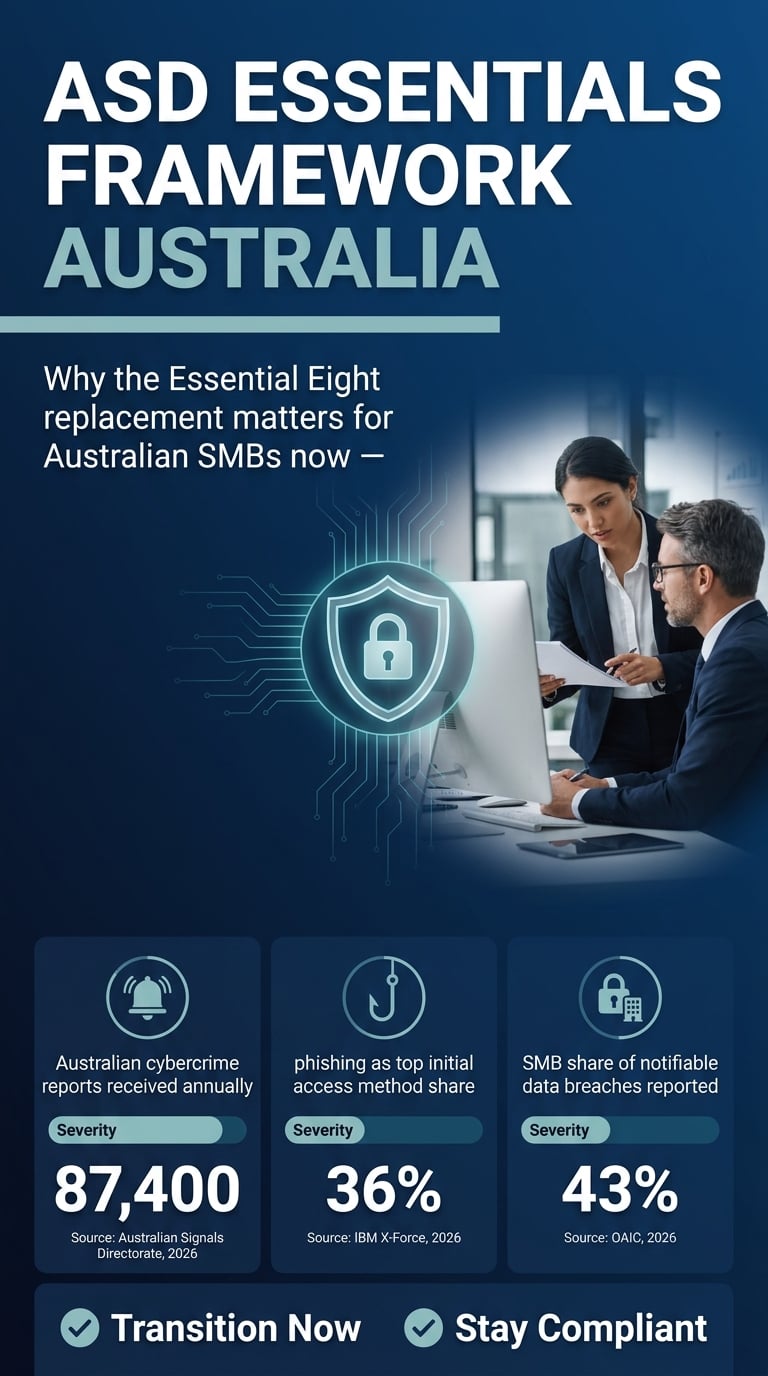
The ASD Essentials framework represents one of the most significant shifts in Australian cybersecurity compliance in recent years, replacing the long-standing Essential Eight maturity model with a broader, more structured series designed for today’s threat environment. For small and medium businesses (SMBs) across Newcastle, the Hunter Region, Central Coast, and Sydney, understanding this transition is no longer optional. Cyber threats are escalating rapidly. The Australian Signals Directorate, 2026 confirmed that during the 2024, 25 period, Australian businesses reported over 87,400 cybercrime incidents, averaging one report every six minutes. Businesses that delay compliance updates face compounding risk.

What Is the ASD Essentials Framework and Why Does It Replace the Essential Eight?
The Australian Signals Directorate (ASD) developed the Essentials series as an evolution of its earlier prescriptive approach. The Essential Eight was a powerful starting point, focusing on eight specific mitigation strategies to reduce cyber risk. However, it was increasingly viewed as insufficient for modern threat landscapes, particularly as supply chain attacks, identity-based intrusions, and cloud vulnerabilities grew in sophistication and frequency.
The ASD Essentials framework expands on this foundation by introducing a series of guidance documents that cover a wider range of security domains. Rather than measuring maturity across eight controls alone, organisations are now guided through a more holistic security posture assessment. The series acknowledges that businesses operate across diverse environments, including cloud, hybrid, and on-premises infrastructure, and that a single checklist no longer captures the full risk picture.
For businesses in the Hunter Region and beyond, this shift signals a need to revisit existing compliance programs. Many SMBs have structured their security investments around Essential Eight maturity levels without considering the broader controls the new series introduces. The transition requires both strategic and technical planning, and starting early provides a meaningful competitive and compliance advantage.
How the Essentials Series Differs From the Essential Eight Maturity Model
The Essential Eight maturity model assessed organisations across four maturity levels (zero through three) against eight specific controls: application control, patch applications, configure Microsoft Office macros, user application hardening, restrict administrative privileges, patch operating systems, multi-factor authentication, and regular backups. This model was effective but narrow in scope.
The ASD Essentials series replaces this with a collection of guidance publications, each addressing a distinct security domain. Controls are no longer assessed in isolation. Instead, they are framed within a broader risk management context that aligns with international standards such as those published by the NIST Cybersecurity Framework. This alignment makes it easier for businesses to integrate ASD guidance into existing compliance programs, including those tied to ISO 27001 or the Privacy Act 1988.
Another key difference is the explicit inclusion of guidance tailored to small organisations. The Essential Eight was often criticised for being most applicable to larger government and enterprise environments. The new series directly addresses the resource constraints faced by SMBs, offering scalable implementation pathways. For businesses in Newcastle and the Central Coast managing lean IT teams, this practical framing is a welcome change.
The Six Core Pillars of the ASD Essentials Series Explained
1. Govern: Security Governance and Risk Management
The first pillar addresses how organisations establish and maintain their security governance structures. This includes defining security responsibilities, setting risk appetite, and integrating cybersecurity into business decision-making. For SMBs that have historically treated security as an IT issue rather than a business issue, this pillar drives a fundamental cultural shift.
2. Protect: Implementing Baseline Security Controls
The Protect pillar encompasses the technical and procedural controls that reduce attack surface. This includes access control, patching disciplines, and endpoint hardening. Phishing and credential harvesting remained the top initial access method, accounting for more than 36% of all incidents investigated, according to the IBM X-Force, 2026. Robust protective controls directly counter these entry points. Our related post on endpoint security critical gaps explores how many SMBs leave themselves exposed at this layer.
3. Detect: Identifying Threats and Anomalies Early
The Detect pillar requires organisations to implement monitoring capabilities that surface threats before they cause significant damage. This includes log management, security event monitoring, and threat intelligence integration. Many SMBs currently lack any meaningful detection capability, relying instead on reactive responses after breaches occur. Investing in dark web monitoring and anomaly detection is a practical first step, as explored in our guide on dark web monitoring warning signs.
4. Respond: Structured Incident Response Capabilities
This pillar requires documented and tested incident response plans. Businesses must be capable of containing and eradicating threats in a structured manner, communicating with stakeholders, and engaging with relevant authorities including the ASD. Without a plan, even well-protected organisations can suffer disproportionate damage when an incident does occur. Our blog on ransomware recovery critical steps provides a practical starting framework.
5. Recover: Business Continuity and Data Restoration
The Recover pillar aligns with backup and disaster recovery disciplines. Businesses must demonstrate the ability to restore systems and data within defined timeframes. Tested backups, recovery runbooks, and offsite or cloud-based copies are all central requirements. For SMBs that have never formally tested their recovery capabilities, this pillar often reveals significant gaps. Our article on cloud backup compliance mistakes covers the most common errors businesses make at this stage.
6. Supply Chain: Third-Party and Vendor Risk Management
The sixth pillar addresses risks introduced through external vendors, software providers, and managed service relationships. Businesses are required to assess and manage the security posture of their supply chain participants. This is a significant addition not explicitly covered in the Essential Eight model, and it reflects the growing frequency of supply chain compromises observed in the current threat landscape.
Which Australian Businesses Must Comply With the New ASD Essentials Framework?
Formal compliance with the ASD Essentials framework is currently mandatory for Australian Government entities and their contracted suppliers. However, the series is strongly recommended for all private sector organisations, particularly those handling sensitive data, operating in regulated industries, or supplying services to government bodies at any level.
The Office of the Australian Information Commissioner, 2026 reported that small and medium businesses accounted for 43% of all notifiable data breaches in the most recent reporting period. This statistic reinforces why voluntary adoption of the Essentials series is a sound business decision, even for organisations not subject to a formal mandate. Regulatory exposure under the Privacy Act 1988 adds further incentive to align with the framework proactively.
Businesses in sectors such as healthcare, professional services, legal, and construction across the Hunter Region and Central Coast are increasingly required to demonstrate security assurance as a condition of tender or contract. Understanding the ASD Essentials series and its Australian cyber framework 2026 positioning is increasingly a commercial necessity, not just a compliance exercise.
Common Compliance Gaps SMBs Will Face Under the ASD Essentials Series
Most SMBs entering the ASD Essentials series will encounter gaps across multiple pillars. Governance is typically the weakest area. Businesses without a formal information security policy, a documented risk register, or assigned security responsibilities will need to build these foundations before any technical controls can be meaningfully assessed or verified.
Patching disciplines remain a persistent problem. Despite years of guidance, many businesses still run unpatched operating systems or applications, particularly on legacy hardware. Our post on patch management SMB mistakes outlines the most common failures observed in practice. The Protect pillar of the Essentials series makes formal patch management a non-negotiable requirement.
Incident response planning is another area where SMBs typically fall short. Most businesses have never documented a response plan, let alone tested it through a tabletop exercise. The Respond pillar will require businesses to demonstrate a structured, repeatable process, not just an informal understanding of what to do if something goes wrong. Security awareness training also frequently lags, and our analysis of security awareness training mistakes highlights gaps common to businesses of all sizes across Australia.
Supply chain risk is perhaps the area businesses are least prepared for. Few SMBs have ever formally assessed the security posture of their vendors or software providers. This pillar will require businesses to develop vendor questionnaires, review contractual security obligations, and establish ongoing monitoring processes for third-party risk. Guidance from the ISACA Journal on Third-Party Risk provides internationally recognised frameworks for structuring these assessments.
How Adept IT Solutions Helps Hunter Region Businesses Transition to ASD Essentials
Adept IT Solutions works with businesses across Newcastle, Lake Macquarie, the Hunter Region, Central Coast, and Sydney to build structured compliance programs aligned to the managed security compliance Australia requirements of the ASD Essentials series. Our approach begins with a gap assessment that maps your current security posture against each of the six pillars, identifying priority areas and establishing a realistic remediation roadmap.
We assist businesses with governance documentation, policy development, technical control implementation, and ongoing compliance monitoring. For businesses without dedicated internal IT resources, our managed helpdesk and cybersecurity services provide the expertise needed to meet Essentials series requirements without the cost of a full in-house security team. Our blog on outsourcing IT support for small business explains why this model works particularly well for growing SMBs.
We also help businesses prepare for the supply chain pillar by reviewing vendor relationships, drafting appropriate contractual security clauses, and establishing ongoing third-party risk monitoring. This is an area where many businesses underestimate the workload involved, and professional guidance substantially reduces the time and risk of getting it wrong. For businesses in regulated sectors requiring cybersecurity compliance Newcastle and surrounds, our team brings both the technical depth and compliance experience to deliver measurable outcomes.
“The ASD Essentials series marks a maturity shift in how Australia approaches cyber resilience. Businesses that treat this as a compliance exercise will miss its deeper value as a risk management architecture built for the realities of 2026.”, Adept IT Solutions, Cybersecurity Practice

Conclusion: Acting on the ASD Essentials Framework Now
The ASD Essentials framework is not a distant regulatory horizon. It is an active guidance series that businesses across Australia should be aligning with right now. With cybercrime reports averaging one every six minutes and SMBs accounting for nearly half of all notifiable data breaches, the risk of inaction is measurable and growing. Businesses that treat the Essentials series as a strategic investment rather than a compliance burden will emerge with stronger security postures, more defensible supply chains, and greater confidence in their ability to respond to incidents when they occur.
Adept IT Solutions is ready to support businesses across Newcastle, the Hunter Region, Central Coast, and Sydney through every stage of this transition. Whether you are starting from scratch or refining an existing Essential Eight program, our team brings the expertise and practical experience to help you comply with confidence. Contact Adept IT Solutions today to begin your ASD Essentials framework gap assessment.
Frequently Asked Questions
Q: What is the ASD Essentials framework and how does it differ from the Essential Eight?
A: The ASD Essentials framework is a series of cybersecurity guidance publications developed by the Australian Signals Directorate to replace and expand on the original Essential Eight maturity model. While the Essential Eight focused on eight specific technical controls assessed across four maturity levels, the Essentials series introduces six broader pillars covering governance, protection, detection, response, recovery, and supply chain risk. It is designed to be more scalable, more aligned with international standards, and more applicable to businesses of all sizes, including SMBs operating across the Hunter Region, Central Coast, and Sydney.
Q: Is compliance with the ASD Essentials series mandatory for private sector businesses in Australia?
A: Currently, formal compliance is mandated for Australian Government entities and their direct contractors. However, private sector businesses, particularly those in regulated industries or those supplying government bodies, are strongly encouraged to adopt the framework. Given that SMBs account for 43% of all notifiable data breaches reported to the OAIC, voluntary alignment with the Essentials series is a prudent risk management decision regardless of mandatory obligations. Many procurement and tender processes now ask suppliers to demonstrate alignment with Australian cyber framework 2026 standards including the ASD Essentials series.
Q: What are the biggest compliance gaps SMBs face when transitioning to the ASD Essentials series?
A: The most common gaps observed in SMBs include insufficient security governance (no formal policies or risk registers), inconsistent patching practices, absence of a documented incident response plan, untested backup and recovery processes, and a complete lack of vendor or third-party risk management. The supply chain pillar in particular is new territory for most small businesses, requiring structured vendor assessments and contractual security obligations that few have in place today. A professional gap assessment is the most effective way to prioritise remediation efforts.
Q: How can Adept IT Solutions help my business comply with the ASD Essentials framework?
A: Adept IT Solutions provides end-to-end compliance support for businesses across Newcastle, Lake Macquarie, the Hunter Region, Central Coast, and Sydney. Our services include gap assessments mapped against all six Essentials pillars, governance documentation, technical control implementation, incident response planning, backup and recovery testing, and supply chain risk reviews. For businesses without in-house IT security expertise, our managed cybersecurity services provide ongoing compliance monitoring and support. We take the complexity out of the ASD Essentials series so your business can focus on its core operations with confidence.
Get in touch with our team of IT experts today! You can contact us via phone at 1300 423 378 or email us at info@adept-it.com.au.

