
Outsourcing IT support for small business is, for many Australian organisations, the moment they finally admit a quiet but costly truth: someone on the team has been running their technology stack on goodwill, guesswork, and Google searches. Every office has one. They once fixed a colleague’s email, rebooted the router during a crisis, or remembered the Wi-Fi password nobody else could find. From that moment forward, they became the unofficial IT department, whether they wanted the role or not.

How the Accidental IT Guy Ends Up Running Your Entire Office Tech Stack
It starts innocuously. A printer refuses to connect. The accounts payable coordinator, who once studied IT for a semester, takes a look. She fixes it. Word spreads. Within weeks, she is the default contact for every technology complaint in the building, from a frozen laptop to a missing Microsoft 365 licence.
This pattern is remarkably common across small and medium businesses (SMBs) in the Hunter Region, Newcastle, the Central Coast, and beyond. The accidental IT person is rarely given a title change or a pay increase. They simply absorb the responsibility because nobody else will, and because the business has no formal IT structure to catch these problems.
The danger is not just inconvenience. It is operational risk. When your unofficial IT coordinator is also responsible for bookkeeping, sales administration, or customer service, every technology interruption pulls them away from the work that actually generates revenue. And the bigger the business grows, the worse this problem becomes.
The Hidden Productivity Cost Your Business Refuses to Talk About
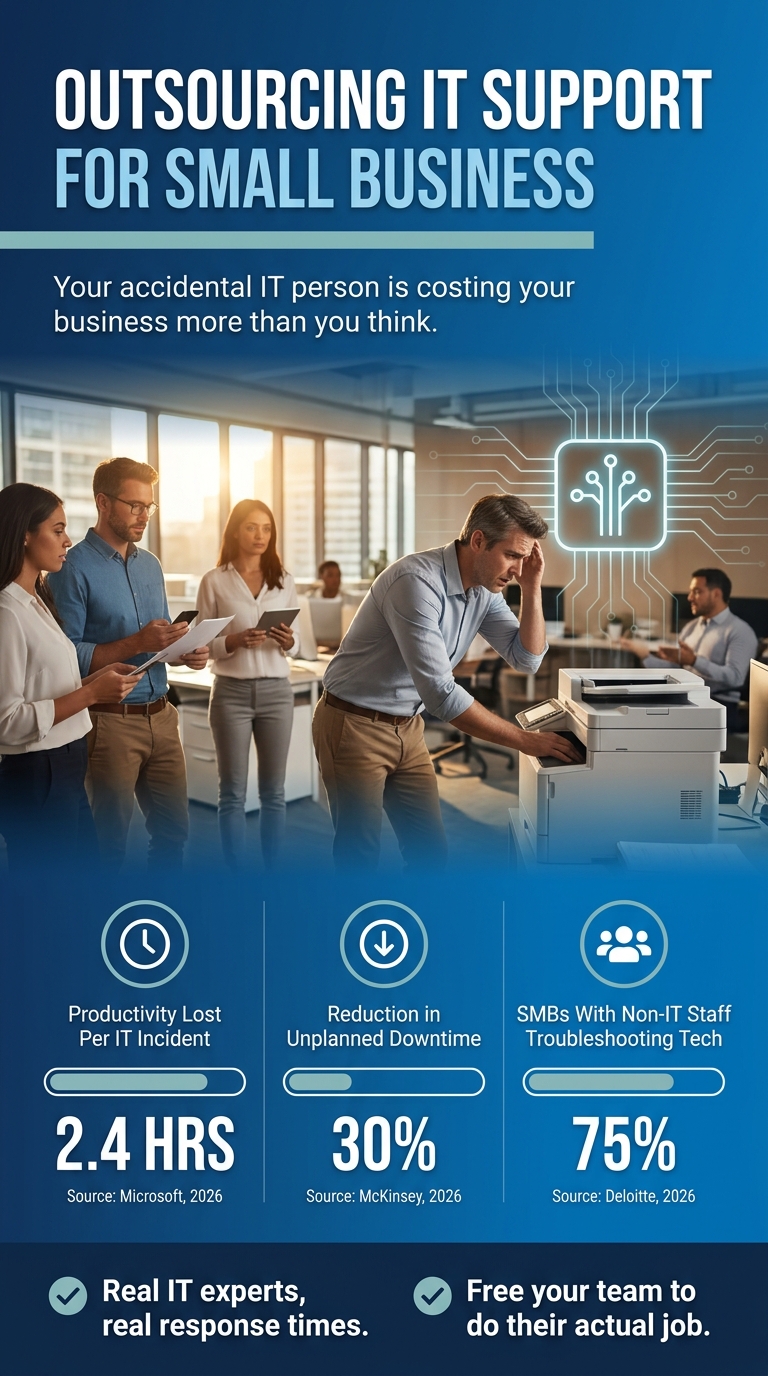
Most business owners are aware that IT problems cost time. Few are willing to calculate exactly how much time. The numbers, when examined honestly, are confronting. According to the Microsoft Work Trend Index 2026, employees who are interrupted by unplanned IT troubleshooting tasks lose an average of 2.4 hours of productive work per incident, and that loss compounds across entire teams.
That figure does not account for the knock-on effects. When the accidental IT person is pulled away from their actual role, their own work stalls. Colleagues waiting on them stall. Customer-facing tasks are delayed. A single printer incident that takes 45 minutes to resolve may consume three or four hours of collective productivity once the ripple effects are included.
Research from the Deloitte 2026 Australian Business Survey reinforces this reality: 75% of Australian SMBs report that non-IT staff spend measurable work time troubleshooting technology issues instead of performing their primary role. Three in four businesses are quietly hemorrhaging productivity through a problem they rarely name directly.
The costs extend beyond lost hours. Unmanaged IT environments accumulate risk over time. Without structured patch management for SMBs, software vulnerabilities go unaddressed. Without formal backup processes, data loss becomes a question of when rather than if. The accidental IT person, however capable they are, cannot be expected to manage cybersecurity obligations alongside their actual job description.
From ‘I Once Restarted a Router’ to Unofficial IT Manager: A Timeline
Understanding how this role evolves helps businesses recognise the pattern before it becomes entrenched. The typical trajectory follows a predictable path. In the early stages, the individual handles minor fixes: a forgotten password here, a cable reconnection there. Their colleagues appreciate the help and begin to rely on them informally.
Within months, the scope expands. They are now managing the business’s cloud accounts, setting up new staff laptops, and fielding calls from the internet provider. They may even hold administrative credentials to critical business systems, not because anyone planned this, but because someone had to.
By the time leadership acknowledges the issue, the accidental IT person has often become a single point of failure. If they leave the business, institutional technology knowledge walks out with them. If they make an error configuring security settings, there is no second pair of eyes to catch it. This is a serious privileged access management risk that many SMBs overlook entirely.
The situation is not a reflection of poor leadership. It is a structural gap that affects businesses of every size and industry. The Australian Computer Society has consistently highlighted the technology skills shortage facing Australian businesses, making it increasingly difficult for SMBs to recruit dedicated in-house IT professionals at an affordable cost.
What Outsourcing IT Support for Small Business Actually Looks Like in Practice
There is a common misconception that outsourcing IT support for small business means handing over control to an anonymous call centre. In practice, working with a quality managed service provider (MSP) is a structured, transparent arrangement built around your specific business needs.
A managed IT engagement typically begins with an assessment of your current environment: devices, software, network infrastructure, cloud services, and security posture. From there, a tailored service agreement is established, covering proactive monitoring, helpdesk support for SMBs, security management, and strategic planning. Your team gets fast, reliable support. Your accidental IT person gets their time back.
The financial case is equally compelling. The McKinsey State of AI and Operations 2026 report found that Australian businesses outsourcing IT support achieve an average 30% reduction in unplanned downtime within the first year. Fewer outages mean fewer interruptions, fewer lost hours, and fewer of those all-hands-on-deck moments that derail an entire day.
Beyond uptime, a managed IT partner introduces governance and structure. This includes proper cloud backup compliance practices, endpoint protection, and alignment with frameworks such as the Australian Government’s Essential Eight. For businesses handling personal data, compliance with the Privacy Act 1988 is no longer something the accidental IT person can be expected to manage alone.
It is also worth noting what an MSP is not. It is not a set-and-forget arrangement. The best providers function as a technology partner, participating in planning conversations, advising on software decisions, and helping your business adopt tools like Microsoft 365 and Azure in ways that genuinely improve how your team works.
Why Hunter Region and Newcastle SMBs Are Making the Switch to Managed IT
Managed IT Newcastle and the broader Hunter Region have seen a marked shift in how local businesses approach technology management. Businesses in industries from construction and professional services to healthcare and retail are recognising that ad hoc IT arrangements are no longer viable as their operations grow more complex.
The managed IT services Hunter Region market reflects broader national trends. According to research from IDC Australia, demand for outsourced IT support among Australian SMBs has grown consistently as businesses seek to close the gap between their digital ambitions and their internal capabilities. For businesses operating across multiple sites or managing remote workforces, the case is even stronger.
Local businesses also face regionally specific pressures. Connectivity infrastructure across parts of the Hunter Valley and Central Coast can be inconsistent, making proactive network monitoring particularly valuable. A managed IT partner with genuine local knowledge understands these nuances and plans around them rather than discovering them after an outage.
Cybersecurity is another driver. As threats grow more sophisticated, accidental IT arrangements leave businesses exposed. Without structured security awareness training for staff and formal incident response planning, a single phishing email can escalate into a business-defining crisis. Managed IT introduces the controls and culture that prevent this.
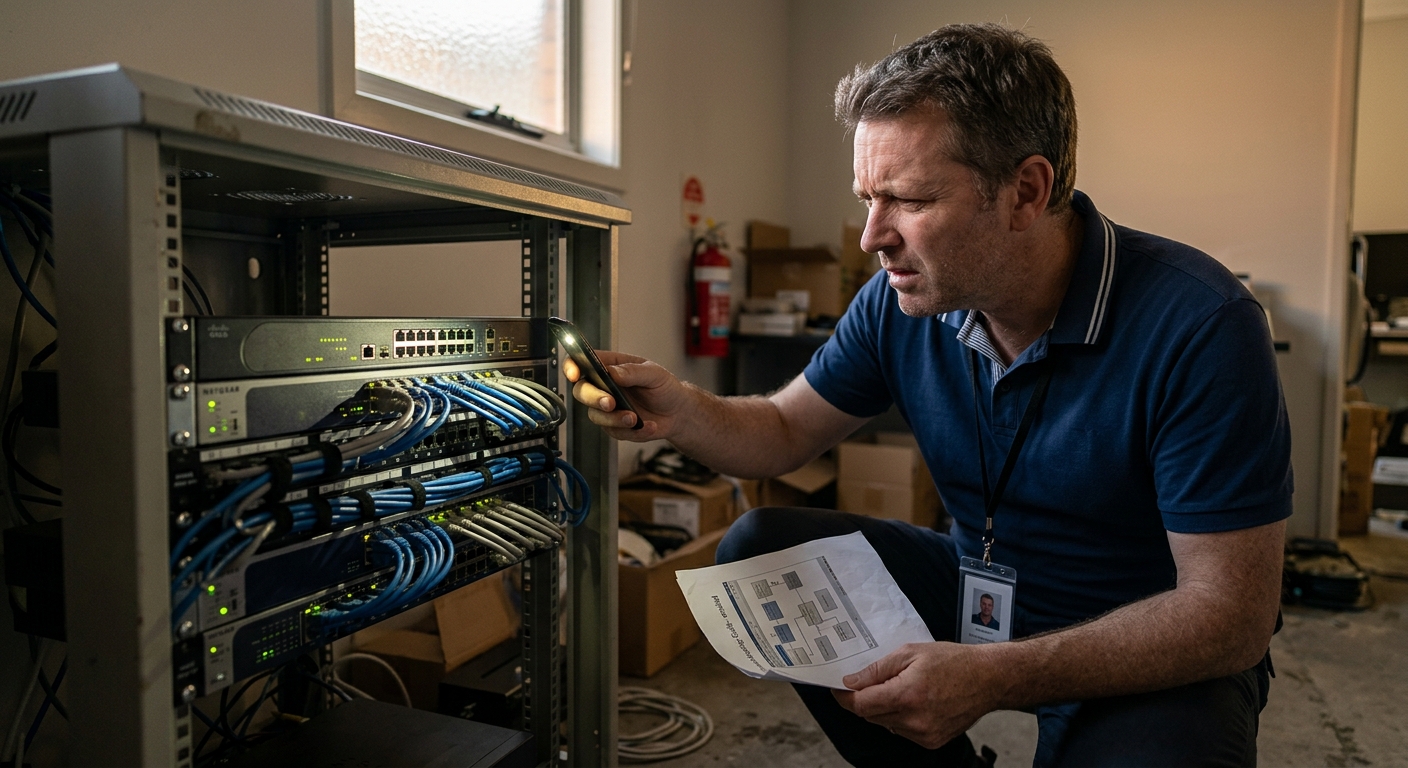
Give Your Accidental IT Guy Their Real Job Back: Next Steps for Your Business
The first step is honest recognition. If someone in your business is managing IT alongside another role, and if technology problems are regularly interrupting your team’s work, you have already identified the problem. The next step is deciding how seriously you are going to take it.
Begin by auditing the time your team currently spends on IT-related interruptions. Ask your accidental IT person to track every request they field over a two-week period. The total hours are almost always a shock. Multiply that by an hourly rate and the cost of the status quo becomes very concrete, very quickly.
Next, assess your risk exposure. Consider whether your business has a documented disaster recovery plan for SMBs, current endpoint security, and any formal approach to cybersecurity. If the answer to most of these questions is no, the gap between your current situation and an acceptable risk posture is significant.
Then have a conversation with a managed IT partner. The best providers will not try to oversell complexity. They will ask questions about your business, your team, your current environment, and your growth plans. From that conversation, a practical and appropriately scoped engagement can be designed.
“The most expensive IT decision a small business can make is to keep deferring the IT decision. Every month spent relying on an accidental IT person is a month of compounding risk, compounding cost, and compounding frustration for the person carrying the load.”
Outsourcing IT support for small business is not a sign that your business has failed to grow fast enough to afford in-house IT. It is, in most cases, the smarter and more cost-effective choice, even at scale. A dedicated MSP provides depth of expertise, coverage breadth, and strategic input that a single internal hire rarely can.
For businesses in Newcastle, the Hunter Region, the Central Coast, and Sydney, Adept IT Solutions provides fully managed IT services, cybersecurity, cloud management, and helpdesk support tailored to the needs of Australian SMBs. If your office tech hero deserves their real job back, the conversation starts at Adept IT Solutions Contact.
Frequently Asked Questions
Q: How does outsourcing IT support for small business actually save money when there is an upfront cost involved?
A: The savings come from multiple directions simultaneously. You recover the hidden cost of non-IT staff time spent troubleshooting (which Deloitte’s 2026 data shows affects 75% of Australian SMBs). You reduce unplanned downtime, which McKinsey data shows drops by an average of 30% in the first year with a managed service provider. You also avoid the cost of security incidents, data loss, and compliance failures that unmanaged IT environments routinely produce. In most cases, the managed IT investment is less than the total cost of the problem it replaces.
Q: What is the difference between helpdesk support for SMBs and a fully managed IT service?
A: Helpdesk support is reactive: your team contacts a support line when something breaks and a technician helps fix it. Fully managed IT is proactive: a managed service provider monitors your environment continuously, patches systems before vulnerabilities are exploited, and plans your technology roadmap alongside your business strategy. Most SMBs benefit from a managed model because it prevents problems rather than simply responding to them after the damage is done.
Q: Will managed IT Newcastle providers understand our local business environment and infrastructure?
A: A quality local provider absolutely should, and it matters more than businesses typically expect. Connectivity infrastructure, local compliance considerations, and the specific industries that dominate the Hunter Region all shape how technology is best deployed and managed. Adept IT Solutions operates across Newcastle, the Hunter Region, the Central Coast, and Sydney, with direct experience managing IT environments for businesses in these areas. Local knowledge is a genuine advantage, not a marketing claim.
Q: Our accidental IT person actually does a reasonable job. Do we still need managed IT services?
A: This is one of the most common questions SMBs ask, and the honest answer is yes. Even a genuinely capable accidental IT person represents a single point of failure, a gap in after-hours coverage, and a business risk if they leave. They also cannot realistically keep pace with evolving cybersecurity obligations, cloud complexity, and compliance requirements on top of their primary role. Outsourcing IT support for small business does not replace a valuable team member; it removes an unfair and unsustainable burden from them so they can focus on the work they were actually hired to do.
Get in touch with our team of IT experts today! You can contact us via phone at 1300 423 378 or email us at info@adept-it.com.au.

