
AI procurement risks are quietly dismantling the compliance foundations of small and medium-sized businesses (SMBs) across Australia, and most business owners do not see it coming until damage is already done. The pace at which artificial intelligence (AI) tools are entering the workplace is accelerating well beyond the governance frameworks that protect organisations. Many SMBs across Newcastle, the Hunter Region, the Central Coast, and Sydney are signing up to AI-powered software with little more than a quick review of a vendor’s website. That approach is no longer acceptable, and the consequences of getting it wrong now include regulatory penalties, data breaches, and reputational harm that can be difficult to recover from.

Why Most SMBs Have No Idea What They Are Actually Buying
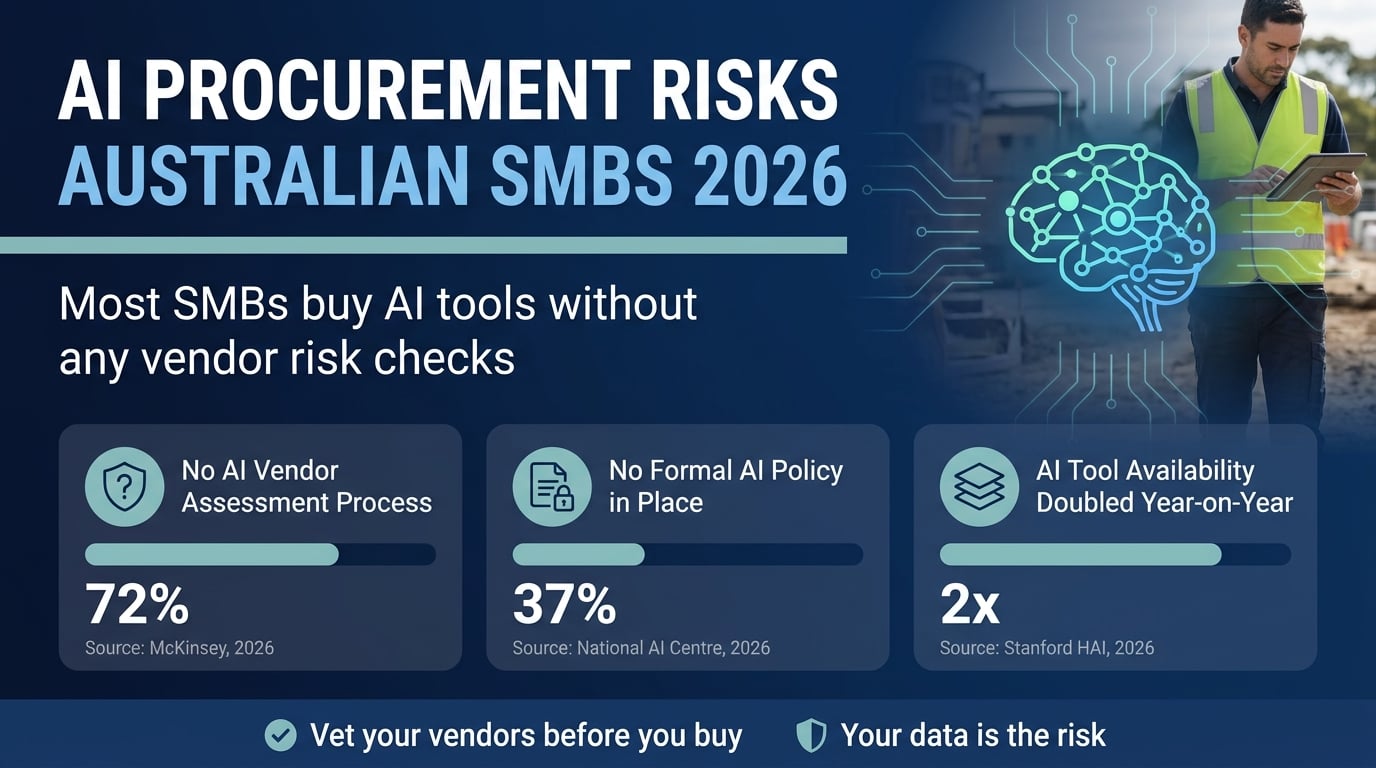
The AI software market is expanding at a rate that is genuinely difficult to keep pace with. According to the Stanford HAI AI Index 2026, the number of AI tools commercially available to businesses doubled year-on-year, increasing the complexity of safe procurement decisions. For SMBs without a dedicated IT department, this proliferation creates a serious problem: how do you choose safely when the options are growing faster than your capacity to evaluate them?
The data suggests most organisations are not evaluating these tools at all. According to McKinsey, 2026, 72% of organisations globally report they have no standardised process for evaluating AI tools before purchase or deployment. That figure should be alarming to any business owner who believes their team is handling AI adoption responsibly.
The picture is no better locally. Only 37% of Australian organisations have a formal AI policy governing how AI tools are selected, used, or reviewed internally, according to Australia’s National AI Centre, 2026. That means the majority of Australian SMBs are purchasing and deploying AI tools with no structured framework to protect them. If your business does not currently have such a policy, our post on AI governance for small business is essential reading before you proceed any further.
Trap 1: Accepting AI Vendor Privacy Claims Without Verification
AI vendors routinely publish privacy assurances in their marketing materials. Terms like “enterprise-grade security” and “fully compliant” appear frequently, yet few SMBs take the time to verify what those claims actually mean in a legal or technical context. A vendor saying they are compliant is not the same as demonstrating compliance against a recognised standard.
Before signing any contract, businesses should request a copy of the vendor’s third-party security audit results, their data processing agreements, and evidence of certifications such as ISO/IEC 27001 or ISO/IEC 42001. If a vendor cannot provide these documents, that is a significant red flag. The Office of the Australian Information Commissioner makes clear that businesses remain responsible for how third-party tools handle personal information, regardless of what a vendor’s website claims.
Proper AI vendor due diligence should be treated the same way you would treat any other supplier evaluation. The fact that a product is delivered via software does not reduce your obligations to understand what it does with your data.
Trap 2: Skipping Data Residency and Sovereignty Checks
Data residency is one of the most overlooked dimensions of AI procurement for Australian SMBs. When you use a cloud-based AI tool, your business data, your client records, and potentially sensitive personal information are processed on servers located somewhere in the world. The question is: where exactly, and under which country’s laws?
Many AI vendors host infrastructure in the United States, the European Union, or Southeast Asia. Data stored or processed outside Australia may be subject to foreign government access laws that override the protections of Australia’s Privacy Act 1988. For businesses in regulated sectors, health, legal, finance, or government supply chains, this is not a theoretical risk. It is a direct compliance exposure that can result in mandatory breach notifications and financial penalties.
Before deploying any AI tool, confirm in writing where your data is stored, where it is processed, and whether you can restrict that geography contractually. Our detailed post on Privacy Act reforms in Australia provides essential context for understanding your current obligations.
Trap 3: Ignoring How the AI Tool Trains on Your Business Data
A number of AI platforms improve their models by learning from user inputs. This means that the prompts your staff type, the documents they upload, and the queries they run may be used to train or fine-tune the vendor’s AI model. For many SMBs, this is a surprise buried deep in the terms of service that nobody read before signing up.
The implications are serious. Confidential client information, proprietary pricing structures, internal communications, and strategic plans could all become training inputs that inform a model accessible to other users. This is not speculation; it is a documented risk pattern that has already resulted in corporate data leaks at large organisations globally.
Before deploying any AI tool, review the vendor’s model training policy. Check whether you can opt out of data being used for training, and whether there is a separate enterprise or privacy-preserving tier that keeps your inputs isolated. Our post covering AI tools in the workplace explores additional risks that SMBs frequently underestimate when onboarding these platforms.
Trap 4: How AI Procurement Risks Compound When Tools Conflict With Essential Eight or Privacy Act Obligations
The Australian Signals Directorate’s (ASD) Essential Eight framework provides a baseline set of cyber security controls for Australian organisations. Many SMBs that are required to maintain Essential Eight compliance, or that supply to government clients with such requirements, are inadvertently undermining those controls by deploying AI tools that bypass patching schedules, introduce unsanctioned application pathways, or weaken multi-factor authentication (MFA) configurations.
Similarly, AI tools that collect, store, or process personal information must be evaluated against the Australian Privacy Act 1988 and the Australian Privacy Principles (APPs). If an AI tool does not allow you to delete personal data on request, or if it cannot produce records of where data has been sent, your business may be in breach of its obligations the moment an employee starts using it.
The Department of Industry, Science and Resources has published Australia’s AI Ethics Principles and Voluntary AI Safety Standard, which provides a useful framework for evaluating whether a tool aligns with responsible AI use. However, these are not a substitute for formal compliance assessments. Engaging a managed service provider to map each AI tool against your compliance obligations before purchase is the only reliable approach. See also our guidance on cloud backup compliance in Australia for related considerations when AI tools interact with your backup and storage environment.
Trap 5: No Exit Strategy When the AI Vendor Fails, Pivots, or Gets Acquired
The AI software market is consolidating rapidly. Vendors that are independent today may be acquired, merged, or shut down within a year. When that happens, the data you have stored with them, the integrations you have built, and the workflows your team depends on can disappear or change overnight with very little notice.
Many SMBs do not think about exit strategy at the point of procurement. This is a significant oversight. Before committing to any AI platform, your procurement process should include a data portability review. Confirm that you can export all your data in a usable format at any time. Confirm what happens to your data if the vendor ceases operations or is sold to a competitor in your industry.
For businesses without in-house IT expertise, this is precisely the type of scenario where outsourcing IT support for small business delivers clear and measurable value. A managed IT partner can draft the right contractual questions before you sign, monitor vendor stability, and ensure your business continuity plan accounts for AI tool dependency risks. We also recommend reviewing our post on ransomware recovery in Australia, as vendor lock-in and data portability failures often compound incident recovery timelines significantly.
“Responsible AI procurement is not about slowing down adoption. It is about ensuring the tools you bring into your business do not quietly introduce risks that outweigh their benefits. The time to ask hard questions is before you sign the contract, not after you receive a breach notification.”

Building a Safer AI Procurement Process for Your Business
Addressing AI procurement risks does not require a large internal team or an expensive legal department. What it requires is a structured approach applied consistently every time a new AI tool is considered. That means defining who has authority to approve AI tool adoption, establishing a minimum set of questions every vendor must answer in writing, and mapping each tool to your existing compliance obligations before it touches your business data.
The Australian Government’s AI Ethics Framework provides a practical starting point for businesses that want to formalise their evaluation criteria. Combining those principles with technical controls aligned to Essential Eight compliance and the Privacy Act gives your business a defensible and repeatable procurement standard.
The five traps outlined above represent the most common ways AI procurement risks materialise in Australian SMBs today. None of them are inevitable. All of them are preventable with the right guidance and a disciplined procurement process. If your business is ready to take a more structured approach to AI tool evaluation, the team at Adept IT Solutions is available to assist. Contact Adept IT Solutions to arrange a consultation and start protecting your business from preventable AI-related risk today.
Further reading: Stanford HAI.
Frequently Asked Questions
Q: What are the most common AI procurement risks for Australian SMBs?
A: The most common AI procurement risks include accepting unverified vendor privacy claims, failing to confirm data residency within Australia, overlooking model training policies that use your business data, deploying tools that conflict with Essential Eight compliance or the Privacy Act, and not having a documented exit strategy before committing to a platform. Each of these risks can result in regulatory penalties, data breaches, or operational disruption if left unaddressed.
Q: Does the Privacy Act apply to AI tools used by small businesses in Australia?
A: Yes. If your business uses an AI tool that collects, stores, or processes personal information about customers, employees, or other individuals, the Australian Privacy Act 1988 applies. This includes tools used for customer support, HR functions, marketing automation, and document processing. Your business remains responsible for how that data is handled, even when a third-party vendor is processing it on your behalf. Formal AI vendor due diligence is essential before deployment.
Q: How does AI governance in Australia differ from general IT governance?
A: AI governance in Australia extends beyond standard IT governance because AI tools introduce unique risks around automated decision-making, data training, model bias, and transparency. General IT governance addresses access controls, patch management, and infrastructure security. AI governance specifically addresses how AI tools are selected, how they use your data, how decisions made by AI are audited, and how your business remains accountable for AI-generated outputs. Both layers are necessary for businesses deploying AI tools for small business operations in a compliant environment.
Q: How can a managed IT provider in Newcastle or Sydney help with AI procurement?
A: A managed IT provider experienced in AI governance can help your business develop a structured evaluation checklist, review vendor contracts for data residency and training clauses, assess whether a proposed tool conflicts with Essential Eight or Privacy Act obligations, and build a supplier risk register that includes all AI platforms in use. For SMBs across Newcastle, the Hunter Region, the Central Coast, and Sydney, having a local managed IT partner conduct this review before purchase is the most cost-effective way to avoid the AI procurement risks that are causing compliance failures across the market.
Get in touch with our team of IT experts today! You can contact us via phone at 1300 423 378 or email us at info@adept-it.com.au.

