
AI governance for small business is no longer a future concern reserved for enterprise legal teams. It is an immediate operational risk that Australian small and medium-sized businesses (SMBs) are navigating right now, often without realising the exposure they carry. Artificial intelligence (AI) tools have moved from novelty to necessity across industries, and the pace of adoption has significantly outpaced the development of internal policies and oversight structures.
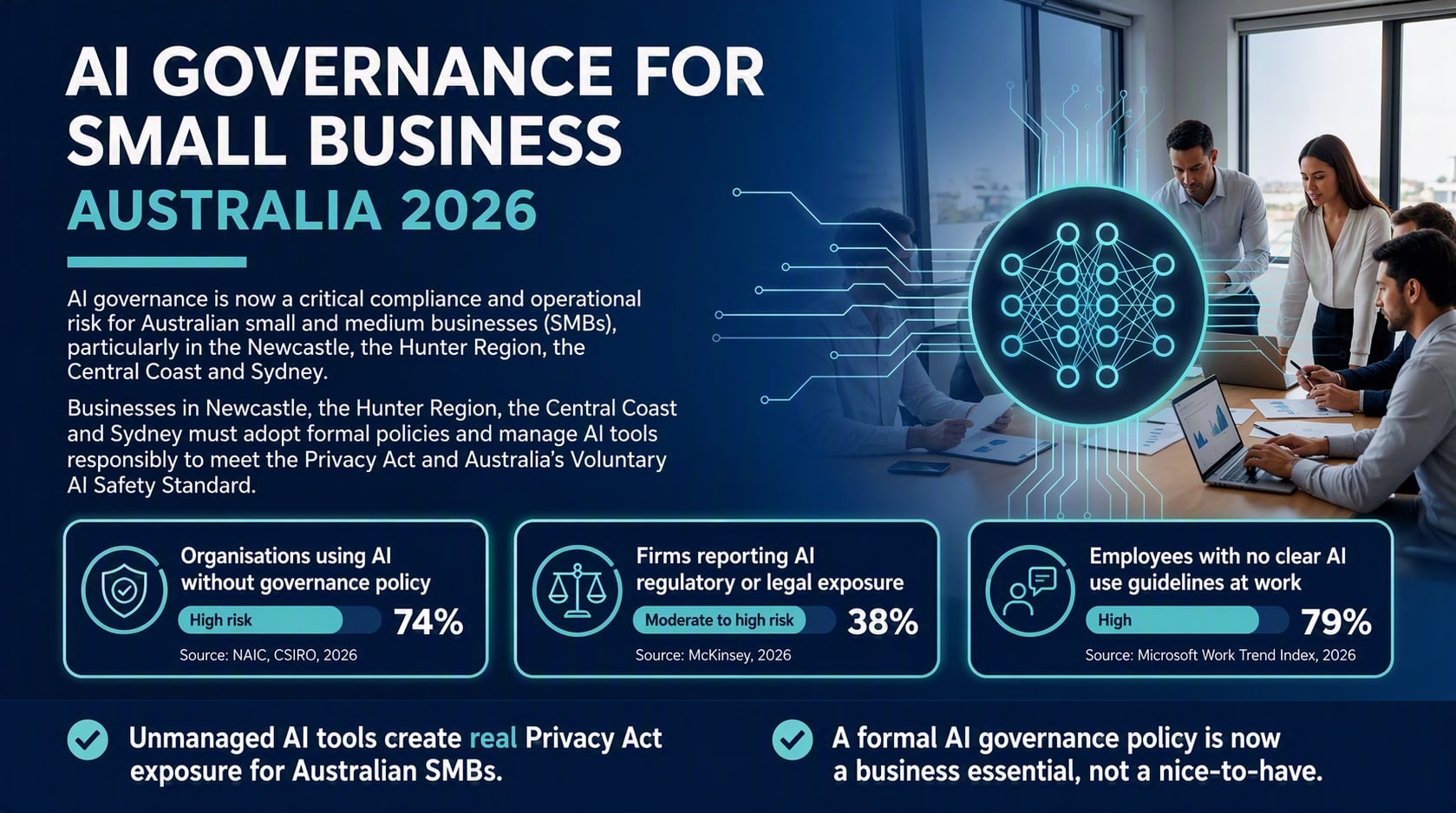
According to Australia’s National AI Centre (NAIC), CSIRO, 2026, 74% of Australian organisations reported using AI in 2025, yet fewer than one in three had a formal AI governance policy in place. That gap between adoption and accountability is where real business risk lives. For SMBs across Newcastle, the Hunter Region, the Central Coast, and Sydney, the consequences of that gap are becoming harder to ignore.
This post identifies the five most critical governance gaps that Australian SMBs are falling into in 2026, and what you need to address each one before regulators, clients, or a data incident forces the issue.

Why AI Governance for Small Business Cannot Wait Any Longer
Many SMB owners assume that AI governance is something large enterprises worry about. That assumption is increasingly dangerous. The McKinsey, The State of AI 2026 report found that globally, the share of organisations reporting AI-related regulatory or legal exposure doubled between 2024 and 2026, rising to 38% of surveyed firms. That figure spans businesses of all sizes, and SMBs are not exempt.
Australian regulatory expectations around AI are tightening. The Department of Industry, Science and Resources has published Australia’s AI Ethics Principles and the Voluntary AI Safety Standard, both of which signal the direction of future mandatory obligations. The Privacy Act 1988 already applies to how businesses handle personal data, including data processed by AI tools. SMBs that ignore governance today are building compliance debt that will become far more expensive to resolve once legislation catches up.
Understanding the specific gaps in your AI policy framework is the first step toward meaningful protection. Below are the five gaps most commonly seen across Australian SMBs in 2026.
Gap 1: No Acceptable Use Policy for AI Tools Across the Business
The most fundamental gap in AI governance for small business is the absence of a written acceptable use policy. Staff are using AI tools every day, from generative writing assistants to automated scheduling, data analysis, and customer service bots. Without a policy defining what is and is not permitted, each employee is making their own judgement calls about appropriate use.
An acceptable use policy should specify which AI tools are approved, what categories of data may be entered into those tools, and what approval process applies when staff want to introduce a new AI application. It should also address the reputational and legal risks of publishing AI-generated content without human review. This is foundational work, and it is not technically complex. It requires business leadership to make deliberate decisions and document them clearly.
Many of the same principles that apply to security awareness training for SMBs also apply here. Policies are only effective when staff understand them, acknowledge them, and receive periodic reminders of their obligations.
Gap 2: Staff Are Using AI With Customer Data and No One Knows
Shadow AI is one of the most significant AI compliance gaps facing Australian SMBs in 2026. Staff routinely paste customer names, email addresses, financial details, and other sensitive information into publicly accessible AI tools without understanding that this data may be retained, used for model training, or stored on overseas servers.
The Microsoft Work Trend Index 2026 found that only 21% of employees say their organisation has communicated clear guidelines on appropriate AI use at work, despite 85% regularly using AI tools. That disconnect creates serious exposure under the Privacy Act 1988 and the Office of the Australian Information Commissioner (OAIC) notifiable data breach scheme.
The Office of the Australian Information Commissioner has made clear that organisations remain responsible for the personal data they collect, regardless of where that data travels after collection. If a staff member uploads a client list into an unapproved AI tool, the business may face a notifiable data breach obligation. For businesses in the Hunter Region and beyond, this is not a theoretical scenario. It is happening now.
Businesses concerned about broader privacy compliance should also review our post on Privacy Act reforms for Australian SMBs, which outlines the steps businesses need to take to meet current obligations.
Gap 3: AI Outputs Are Not Validated Before Being Used in Business Decisions
AI tools produce outputs with confidence. They do not always produce outputs that are accurate. The phenomenon known as hallucination, where AI models generate plausible-sounding but factually incorrect responses, is well documented across every major AI platform in use today.
In a business context, this matters when AI outputs are used to inform quotes, contracts, compliance submissions, financial reports, or client-facing communications. If no validation step exists, errors propagate from the AI directly into business decisions. The risk is compounded in regulated industries such as financial services, healthcare, and legal services, all of which have significant representation across Newcastle and the Central Coast.
The international standard ISO/IEC 42001 for AI management systems explicitly requires organisations to establish verification and validation processes for AI outputs used in decision-making. While ISO/IEC 42001 certification is not yet mandatory for most SMBs, its framework provides an excellent benchmark for building internal review protocols. At a minimum, every AI-generated output used in a business decision should be reviewed by a qualified human before it is acted upon.
This gap connects directly to the broader issue of AI-powered cyber threats targeting SMBs, where adversaries exploit over-trust in automated outputs to manipulate business processes.
Gap 4: AI Vendor Contracts Are Not Reviewed for Data Sovereignty or Privacy Compliance
Most SMBs adopt AI tools through a standard software-as-a-service model. They click through terms of service without reviewing what those terms say about data storage, data retention, cross-border data transfers, or the vendor’s right to use submitted data for model improvement. This is one of the most consequential AI compliance gaps an Australian business can carry.
Australian Privacy Principle (APP) 8 under the Privacy Act governs cross-border disclosure of personal information. If a business sends personal data to an AI vendor with servers located outside Australia, and the vendor’s terms do not provide adequate protections, the Australian business may carry liability for any resulting privacy breach. This applies whether the business realised the data was leaving Australia or not.
The minimum due diligence for any AI vendor contract includes understanding where data is stored, what the vendor’s data retention policy is, whether the vendor uses submitted data to train its models, and whether an enterprise or private deployment option is available. Businesses that have already reviewed their cloud backup compliance obligations will recognise this type of vendor scrutiny as part of a broader data management discipline.
Gap 5: There Is No Owner or Accountable Role for AI Risk in the Organisation
Governance without accountability is not governance. Yet the majority of Australian SMBs have no designated owner for AI risk. No one is tracking which AI tools are in use across the business, monitoring vendor changes to data policies, reviewing AI-related incidents, or maintaining an AI register. When something goes wrong, there is no clear escalation path and no one with the authority or mandate to act.
Establishing an accountable role does not require hiring a dedicated AI officer. In most SMBs, this responsibility can sit with an existing senior role, such as the operations manager, chief financial officer, or IT manager, provided that person is given a defined scope, appropriate training, and the authority to enforce policy decisions. The key is that the role is documented, communicated to staff, and reviewed at least annually.
The Department of Industry, Science and Resources AI Ethics Framework identifies human oversight and accountability as core principles of responsible AI use. Embedding these principles requires an actual human with actual responsibility, not a policy document sitting in a shared drive that no one reads. For SMBs working toward Essential Eight AI controls or broader cybersecurity maturity, accountability structures are a prerequisite.
Businesses building out their risk management frameworks should also consider how AI governance connects to privileged access management risks for SMBs, particularly where AI tools are granted elevated system permissions.
“AI adoption without governance is not digital transformation. It is digital risk accumulation. The organisations that will lead in 2026 and beyond are those that treat AI accountability as a business priority today, not a compliance afterthought for later.”

Closing the AI Governance Gap for Small Business in Australia
Addressing AI governance for small business does not require a massive budget or a team of specialists. It requires intentional leadership, documented policies, and a willingness to treat AI risk with the same seriousness applied to cybersecurity and financial compliance. The five gaps outlined above are all solvable with the right support and a clear starting point.
Businesses that invest in governance now will be better positioned to meet evolving regulatory obligations, build client trust, and avoid the reputational and financial costs of an AI-related incident. Those that delay will find the gap between where they are and where they need to be growing wider with every month of inaction.
Managed IT providers play a practical role in helping SMBs close these gaps. From deploying approved AI governance tools for Australian businesses to auditing vendor contracts and establishing internal accountability structures, experienced IT partners can accelerate what would otherwise take months to build internally. Businesses dealing with related challenges around insider threat risks in Australia will find that AI governance and internal threat management share significant common ground.
If you are ready to close these gaps, the team at Adept IT Solutions is here to help. We work with SMBs across Newcastle, the Hunter Region, the Central Coast, Sydney, and Australia-wide to build practical, compliant, and sustainable AI governance frameworks. Contact Adept IT Solutions today to start the conversation.
Further reading: Verizon Data Breach Investigations Report.
Frequently Asked Questions
Q: What does AI governance for small business actually involve in practice?
A: AI governance for small business involves creating documented policies that define how AI tools may be used, which data can be entered into AI systems, who is accountable for AI-related decisions, and how AI outputs are validated before being acted upon. It also includes reviewing vendor contracts for data sovereignty and privacy compliance, maintaining an AI tool register, and training staff on acceptable use. It does not need to be complex, but it does need to be deliberate and documented.
Q: Are Australian SMBs legally required to have an AI policy framework?
A: As of 2026, Australia does not have a single mandatory AI governance law that applies universally to SMBs. However, existing legislation, including the Privacy Act 1988 and the notifiable data breaches scheme administered by the OAIC, already creates legal obligations around how AI tools handle personal data. The Department of Industry, Science and Resources has also published a Voluntary AI Safety Standard that signals the direction of future mandatory requirements. Businesses that build governance now are better positioned to meet evolving obligations.
Q: How do Essential Eight AI controls relate to AI governance for SMBs?
A: The Essential Eight is Australia’s primary cybersecurity mitigation framework, developed by the Australian Signals Directorate. While it was not originally designed specifically for AI, its principles around application control, patch management, and privileged access management apply directly to AI tools. As AI becomes more embedded in business operations, Essential Eight AI controls are increasingly interpreted to cover AI applications and the data they process. SMBs working toward Essential Eight maturity should ensure their AI governance policies align with these controls.
Q: What AI governance tools are available to help Australian SMBs manage this risk?
A: A range of AI governance tools for Australian businesses are now available to help SMBs track AI tool usage, enforce acceptable use policies, and monitor for shadow AI activity across the organisation. Microsoft Purview, for example, includes capabilities for data classification and policy enforcement that extend to AI-generated content within Microsoft 365 environments. Beyond tooling, governance frameworks based on ISO/IEC 42001 provide a structured approach to AI risk management that any SMB can adapt to their size and industry. A managed IT provider can help identify the right combination of tools and frameworks for your specific business context.
Get in touch with our team of IT experts today! You can contact us via phone at 1300 423 378 or email us at info@adept-it.com.au.

