
VoIP security risks are no longer a fringe concern for small and medium-sized businesses (SMBs) in Australia. Voice over Internet Protocol (VoIP) has become the backbone of business communications across Newcastle, the Hunter Region, the Central Coast, and Sydney, replacing traditional phone lines with internet-based calling. That connectivity brings significant efficiency gains, but it also exposes businesses to a threat surface that most SMB owners have not fully mapped. In 2026, attackers are actively targeting VoIP security risks and infrastructure with the same sophistication they once reserved for enterprise networks.

What Makes VoIP Systems a High-Value Target for Cybercriminals
VoIP security risks not only threaten sensitive communications but also can lead to significant financial losses if not managed properly. Understanding these risks is crucial for SMBs aiming to protect their operational integrity.
VoIP systems sit at the intersection of telephony and internet infrastructure, which makes them attractive to cybercriminals for two distinct reasons. First, they carry sensitive voice data including client conversations, financial discussions, and internal decisions. Second, they are frequently misconfigured, under-patched, and left exposed to the public internet without adequate hardening.
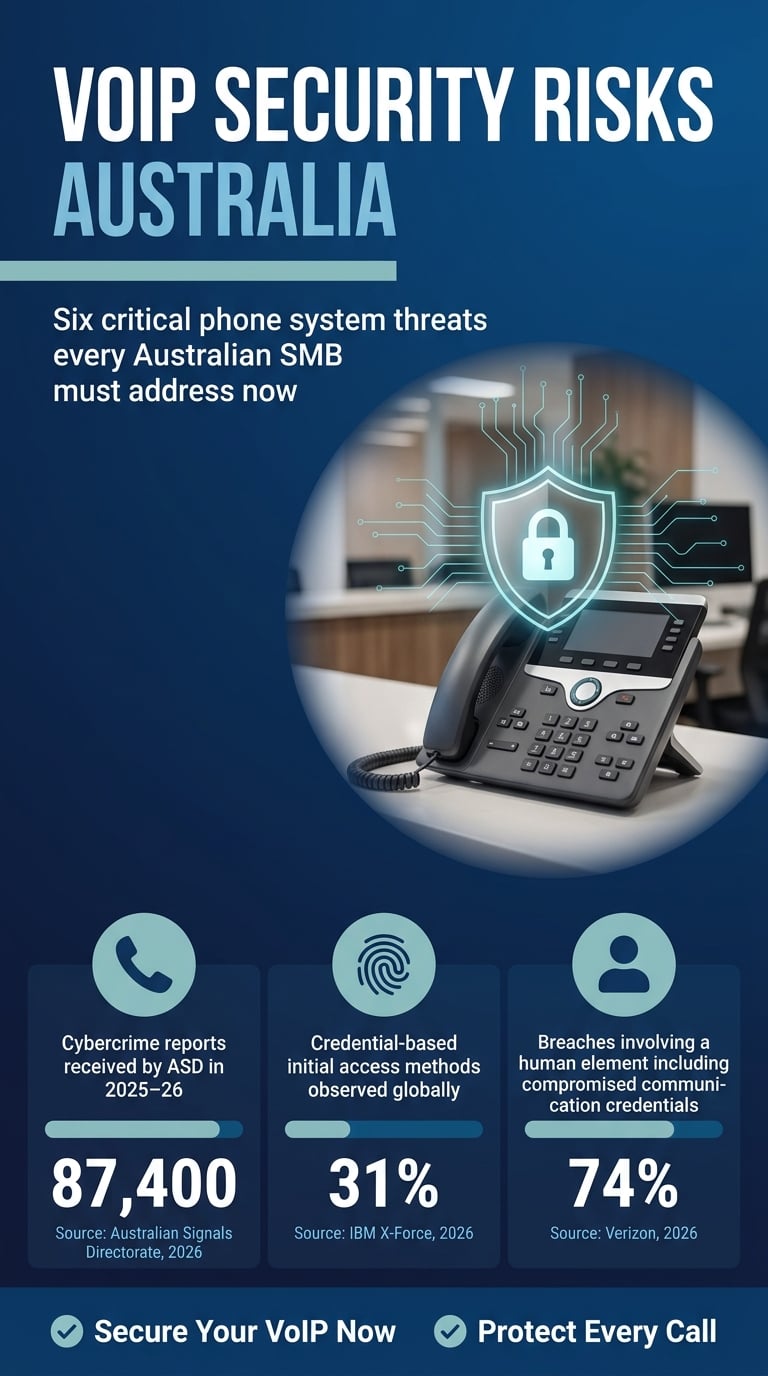
According to the Australian Signals Directorate, 2026, the Australian Signals Directorate (ASD) received over 87,400 cybercrime reports in the 2025, 26 reporting period, with telecommunications and internet services among the top targeted sectors for Australian small businesses. That figure signals a threat environment where communication platforms, including VoIP, are a primary attack surface.
SMBs are disproportionately exposed because they often deploy VoIP systems without the same rigour applied to their core IT infrastructure. Default credentials, unencrypted Session Initiation Protocol (SIP) trunks, and open UDP ports are common findings in businesses across regional New South Wales and metropolitan Sydney alike. Understanding the specific threats is the first step toward building a secure business phone system.
To mitigate VoIP security risks, businesses must stay vigilant against unauthorized access and ensure their VoIP systems are regularly audited for vulnerabilities.
Threat 1: Toll Fraud and How Attackers Ring Up Thousands on Your Account
Toll fraud is the most financially damaging VoIP attack type affecting Australian SMBs today. Attackers gain unauthorised access to a business phone system and place thousands of calls, typically to international premium-rate numbers they control, running up charges that can reach tens of thousands of dollars in a single weekend.
Toll fraud for small businesses is particularly devastating because VoIP providers often hold the account holder responsible for fraudulent call charges unless the business can demonstrate it took reasonable security precautions. Many SMBs discover the breach only when they receive their monthly bill.
Attackers exploit weak SIP credentials, exposed SIP registration ports, and unmonitored dial plans to route calls through compromised systems. Businesses should restrict outbound calling to whitelisted destinations, implement per-call spending limits, and require strong authentication on all SIP accounts. Reviewing your secure remote access practices is a logical starting point, as the same misconfigurations that expose remote access tools also expose VoIP systems.
Threat 2: Vishing and AI Voice Cloning Over Business Phone Lines
Addressing VoIP security risks should be a priority for every business operating in today’s digital landscape, as the consequences of neglect can be severe.
Vishing (voice phishing) has evolved significantly in 2026 with the emergence of AI-generated voice cloning. Attackers can now synthesise a convincing replica of a director’s or manager’s voice using as little as three seconds of publicly available audio, then use that clone to call finance staff and authorise fraudulent transfers or extract credentials.
VoIP infrastructure makes this easier to execute at scale. Caller ID spoofing over SIP trunks allows attackers to display a legitimate internal number, reinforcing the deception. For Hunter Region and Newcastle businesses that operate with lean teams, a convincing call from what appears to be the business owner can bypass normal approval processes entirely.
Businesses should implement out-of-band verification procedures for any financial request received by phone. Our related post on deepfake fraud detection outlines practical steps for identifying AI-generated voice impersonation. Staff training is non-negotiable when phone-based social engineering is this sophisticated.
In addition to operational disruptions, VoIP security risks can also expose businesses to legal repercussions if sensitive data is compromised.
Threat 3: Eavesdropping and Call Interception on Unencrypted VoIP
Mitigating VoIP security risks requires a proactive approach to cybersecurity, including continuous monitoring and employee training on best practices.
It is essential for businesses to recognise the evolving nature of VoIP security risks and adapt their strategies accordingly to counteract new threats.
When VoIP calls travel over unencrypted connections, they can be intercepted and recorded by anyone with access to the same network segment or an upstream network device. This is not a theoretical risk. Tools capable of capturing and reconstructing VoIP audio from unencrypted Real-time Transport Protocol (RTP) streams are freely available online.
For businesses handling legally privileged conversations, medical information, or financial negotiations, unencrypted calls represent a direct compliance exposure under the Privacy Act 1988. Organisations in regulated industries face particular risk, especially where call content could constitute personal information as defined by the Office of the Australian Information Commissioner (OAIC).
Implementing Secure Real-time Transport Protocol (SRTP) for call encryption and Transport Layer Security (TLS) for SIP signalling eliminates most eavesdropping vectors. Network segmentation is equally important. Isolating VoIP traffic onto a dedicated virtual local area network (VLAN) limits the blast radius of any interception attempt. See our guide on network segmentation mistakes for practical hardening steps.
By addressing VoIP security risks proactively, businesses can safeguard their customer relationships and maintain operational continuity.
Ultimately, recognising and addressing VoIP security risks is not just about compliance but about fostering trust with clients and stakeholders.
Threat 4: Denial-of-Service Attacks That Silence Your Business Completely
A Denial-of-Service (DoS) attack targeting a VoIP platform floods it with illegitimate traffic, consuming processing resources and bandwidth until the system becomes unable to handle legitimate calls. For a business that relies on phone lines for client support, sales, or service delivery, even one hour of downtime has measurable revenue impact.
SIP-based DoS attacks are particularly common because SIP servers are often internet-facing by design. Attackers scan for exposed SIP ports and launch floods of malformed INVITE or REGISTER requests. Some attacks are financially motivated, used as leverage for extortion. Others are competitive sabotage or the result of opportunistic automated scanning.
Protection requires rate-limiting at the firewall level, fail2ban-style intrusion prevention for SIP, and hosted VoIP services with built-in Distributed Denial-of-Service (DDoS) mitigation. Businesses should also maintain a continuity plan for phone communications. Our post on cloud backup compliance addresses the broader question of business continuity planning for internet-dependent services.
As VoIP security risks continue to evolve, businesses must remain educated and prepared to protect their communications infrastructure.
Threat 5: Credential Stuffing Attacks Against VoIP Platforms
Credential stuffing involves using large lists of previously breached username and password combinations to attempt login to other platforms. VoIP management portals, hosted PBX dashboards, and SIP account registration interfaces are all viable targets when businesses reuse credentials across systems.
The IBM X-Force, 2026 threat intelligence report found that credential-based attacks accounted for 31% of all initial access methods observed globally across the 2026 threat landscape. This is the same attack class used to compromise VoIP platforms when staff reuse passwords or rely on vendor-default credentials.
Mitigating credential stuffing requires enforcing multi-factor authentication (MFA) on all VoIP management interfaces, monitoring for unusual login patterns, and integrating with dark web monitoring services to identify when staff credentials appear in breach data. Our coverage of dark web monitoring warning signs is directly relevant to this threat vector.
Threat 6: Misconfigured SIP Trunks and What SMBs Consistently Miss
Misconfigured SIP trunks represent one of the most widespread and underappreciated VoIP security risks facing Australian SMBs today. A SIP trunk connects a business’s internal phone system to the public telephone network via the internet. When provisioned without proper access controls, authentication, and IP whitelisting, it becomes an open door for external attackers.
Common misconfigurations include allowing SIP REGISTER requests from any IP address, leaving management interfaces on default ports, and failing to disable unused SIP features. These oversights are compounded when VoIP deployment is handled by IT generalists rather than specialists with telecommunications compliance awareness. This is especially common in Central Coast and regional Hunter Valley businesses that have grown their IT stack organically without a formal review.
The Verizon, 2026 Data Breach Investigations Report (DBIR) found that 74% of data breaches in 2026 involved a human element, including compromised communication credentials and misconfigured internet-facing services such as VoIP systems. SIP trunk hardening, combined with regular configuration audits, is the most direct control available. Businesses should also align their VoIP security posture with the ASD Essentials Framework, which now explicitly references internet-facing service hardening as a priority control.
“Telecommunications and internet services remain among the most targeted sectors for Australian small businesses. A single unpatched VoIP misconfiguration can be the entry point for fraud, data theft, or complete communications blackout.” (Adept IT Solutions, drawing on ASD Annual Cyber Threat Report 2025)26 findings.
How to Address VoIP Security Risks Before They Cost Your Business
The six threats outlined above share a common characteristic: they are all preventable with the right controls in place. Encryption, authentication, network segmentation, monitoring, and regular configuration audits collectively address the vast majority of VoIP security risks that Australian SMBs face in 2026. The challenge for most businesses is not awareness but execution, particularly without in-house telecommunications expertise.
Working with a VoIP provider managed IT partner means your phone system is treated as a security asset rather than a utility. That includes integrating VoIP monitoring into your broader security operations, applying patch management discipline to PBX firmware, and ensuring your telecommunications compliance posture aligns with both the Privacy Act and the ASD Essentials Framework.
Adept IT Solutions also recommends reviewing adjacent risk areas that interact with VoIP security. Our posts on DNS security for small business and security awareness training mistakes cover controls that directly reduce the human-element risk flagged by the Verizon DBIR. The Australian Cyber Security Centre also publishes practical hardening guides for SIP-based systems that SMBs can reference as a baseline.
VoIP security risks will continue to grow in 2026 and beyond as attackers refine their automated scanning tools and AI-assisted social engineering. The businesses that come through this period without a major incident will be those that treated their phone systems with the same seriousness as their servers and endpoints. If your organisation has not conducted a formal VoIP security assessment, now is the time to act. Contact Adept IT Solutions to book a no-obligation review with our managed security team.
Frequently Asked Questions
Q: What are the most common VoIP security risks for Australian small businesses in 2026?
A: The most prevalent VoIP security risks include toll fraud, vishing and AI voice cloning, call interception on unencrypted connections, denial-of-service attacks, credential stuffing against management portals, and misconfigured SIP trunks. Each of these can result in financial loss, data exposure, or complete communications failure. Businesses in VoIP security Newcastle and surrounding regions should conduct a formal assessment to identify which of these risks apply to their specific setup.
Q: How does toll fraud work and can my business be held liable for fraudulent call charges?
A: Toll fraud occurs when attackers compromise your VoIP system and use it to place calls to premium-rate numbers they control. In many cases, the account holder is contractually responsible for all charges unless they can demonstrate reasonable security measures were in place. Implementing strong SIP credentials, outbound call restrictions, and spending alerts significantly reduces both the risk and your liability exposure.
Q: Does using a hosted VoIP provider mean my system is automatically secure?
A: No. Hosted VoIP providers secure the platform infrastructure, but businesses remain responsible for securing their own accounts, user credentials, SIP configurations, and network endpoints. Credential stuffing, toll fraud, and misconfigured dial plans can all occur within hosted environments when the business-side configuration is weak. A secure business phone system requires active management on both sides of the service boundary.
Q: What telecommunications compliance obligations do Australian businesses have regarding VoIP security?
A: Australian businesses must comply with the Privacy Act 1988 when call recordings or voice data constitute personal information. The ASD Essentials Framework also includes internet-facing service hardening as a priority control, which directly applies to SIP trunks and hosted PBX systems. Businesses in regulated industries such as health, legal, and financial services face additional obligations. Engaging a managed IT partner with telecommunications compliance experience is the most reliable way to maintain a compliant posture.
Get in touch with our team of IT experts today! You can contact us via phone at 1300 423 378 or email us at info@adept-it.com.au.

