
Deepfake fraud detection is no longer an optional capability for Australian small and medium-sized businesses (SMBs): it is a frontline defence requirement in 2026. Synthetic media technology has advanced to the point where cybercriminals can convincingly clone an executive’s voice, fabricate a video call, and authorise a fraudulent bank transfer without ever setting foot near your business. The threat is no longer theoretical. Australian SMBs across Newcastle, the Hunter Region, the Central Coast, and Sydney are increasingly being targeted by AI-powered impersonation attacks that bypass traditional security controls entirely.
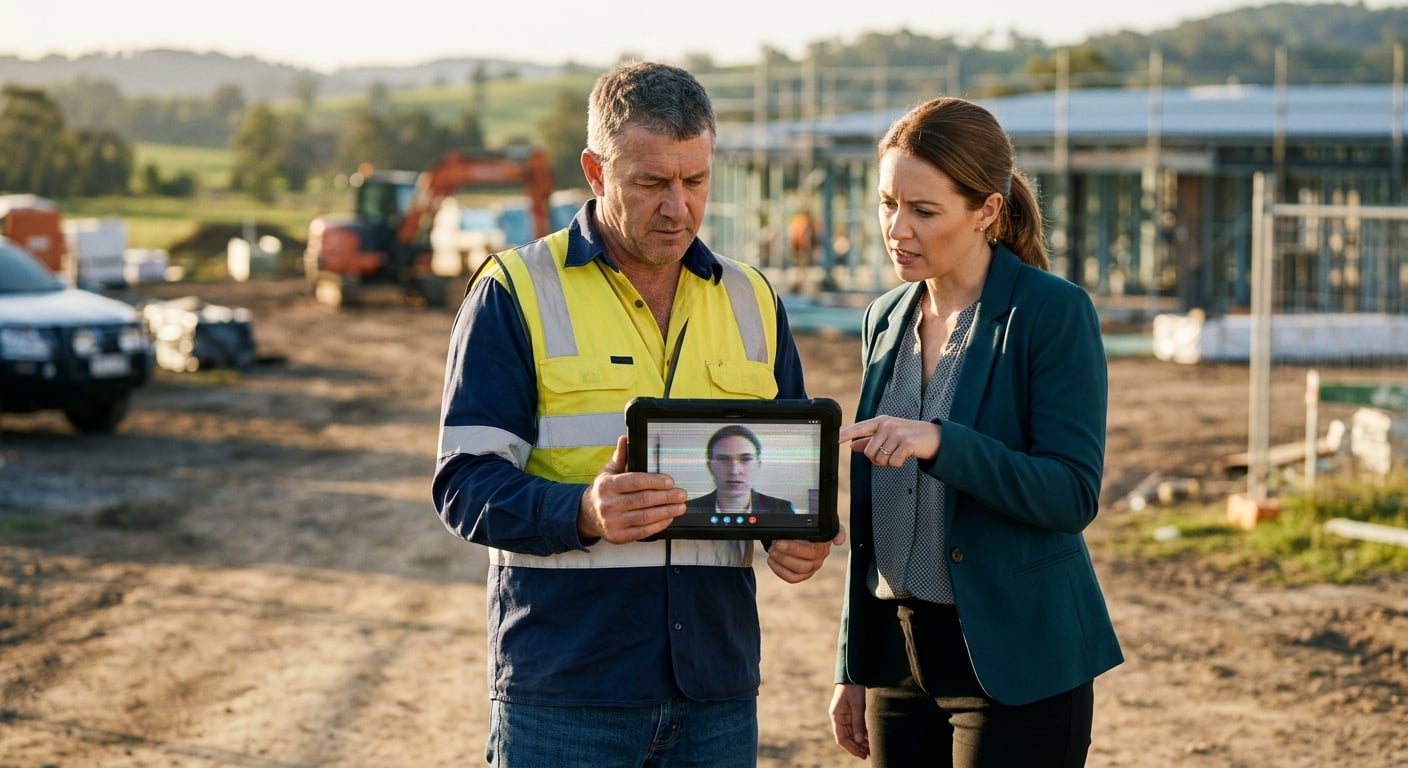
What Is Deepfake Fraud and Why Are Australian SMBs Now Prime Targets
Deepfake fraud refers to the use of artificial intelligence (AI) to generate synthetic audio, video, or images that convincingly impersonate a real person. What was once the domain of well-resourced nation-state actors is now accessible to low-skilled cybercriminals using freely available tools. The barrier to entry has collapsed, and Australian businesses are paying the price.
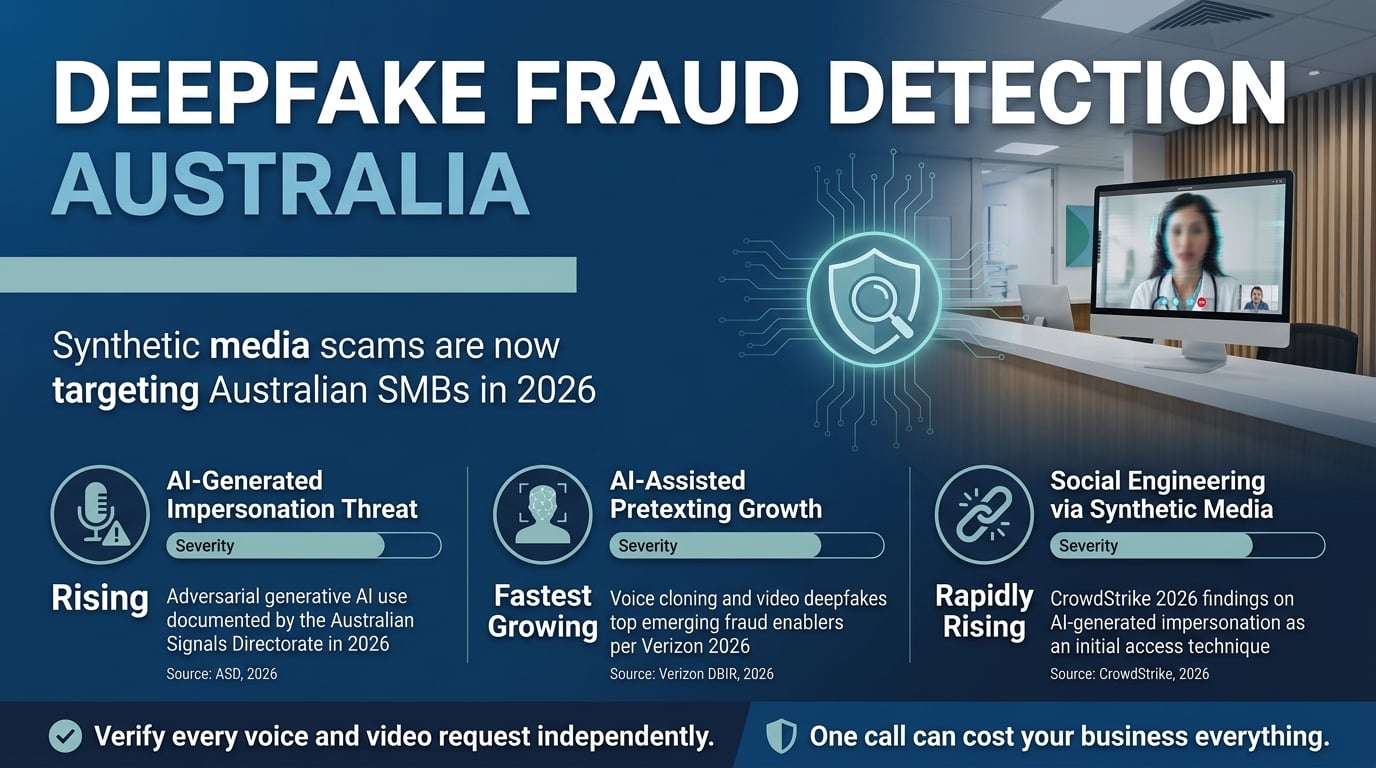
According to the Australian Signals Directorate, 2026, adversarial use of generative AI, including deepfake voice and video fraud, was identified as a rapidly growing threat vector, with AI-generated content used to impersonate executives and authorise fraudulent transactions. SMBs are disproportionately targeted because they typically lack the dedicated security teams and verification protocols that larger enterprises maintain.
A CrowdStrike, 2026 analysis found that social engineering attacks incorporating synthetic media such as deepfake audio and video rose significantly, with threat actors using AI-generated impersonation as an initial access technique across financial and professional services sectors. For businesses in the Hunter Region and Central Coast without mature security frameworks, this represents a critical and growing exposure.
How Cybercriminals Use Voice Cloning to Authorise Fake Payments
Voice cloning is one of the most prevalent and damaging forms of synthetic identity attack in operation today. A cybercriminal requires as little as a few seconds of audio sourced from a podcast, a video interview, or a social media post to generate a convincing replica of a person’s voice. That cloned voice can then be used to call a finance team member and instruct them to process an urgent payment.
These voice cloning business scams follow a predictable pattern. The fraudster impersonates a CEO or financial controller, creates a sense of urgency, and requests that normal approval procedures be bypassed. Without a robust out-of-band verification process, employees who trust the voice they hear have no reliable mechanism to detect the deception. This is explored further in our post on Business Email Compromise warning signs, which shares many of the same social engineering mechanics.
Video Deepfakes in the Boardroom: The Executive Impersonation Threat
Video deepfake technology has matured to the point where real-time impersonation during video calls is now feasible. Attackers using synthetic video can simulate a live boardroom conversation, complete with realistic facial expressions and lip-sync. Employees who would otherwise verify a request over video are no longer guaranteed a trustworthy signal.
This threat is particularly acute in environments where remote work is normalised. Businesses across Newcastle and Sydney with distributed teams relying on video conferencing for approvals are especially vulnerable. The Verizon, 2026 report confirmed that phishing and pretexting accounted for the majority of social engineering breaches, with AI-assisted pretexting including voice cloning and video deepfakes emerging as one of the fastest-growing fraud enablers targeting organisations of all sizes.
Understanding the broader landscape of AI cyber attacks targeting SMBs is essential context for any business evaluating its exposure to executive impersonation fraud.
9 Practical Deepfake Fraud Detection Controls Your Business Can Implement Today
Implementing effective deepfake fraud detection does not require enterprise-scale resources. The following nine controls are practical, proportionate, and achievable for most Australian SMBs operating across any sector.
1. Establish Out-of-Band Verification for All Payment Requests
Any financial instruction received via phone, video call, or email must be verified through a separate, pre-established channel. Call back the requestor using a number stored in your internal directory, not a number they provided during the suspicious interaction. This single control defeats the majority of voice cloning business scams currently targeting Australian SMBs.
2. Implement Code-Word Protocols for Sensitive Authorisations
Assign rotating verbal code words or challenge phrases to key personnel who regularly authorise transfers or sensitive system changes. A legitimate executive will know the current code word. A deepfake or impersonator will not. This low-cost control adds a layer of human authentication that synthetic media cannot easily defeat.
3. Deploy AI-Powered Deepfake Detection Tools
Deepfake detection tools Australia-based organisations can access include software-based solutions that analyse audio and video streams for artefacts indicative of synthetic generation. These tools examine micro-inconsistencies in facial movement, audio frequency patterns, and lighting that are imperceptible to the human eye but detectable algorithmically. Integrating these into video conferencing workflows adds automated fraud prevention compliance capability.
4. Enforce Multi-Person Approval for High-Value Transactions
No single employee should have the authority to authorise a significant financial transaction based on a voice or video instruction alone. Requiring two or more approvals, ideally from people in different departments or locations, ensures that a single successful impersonation attack cannot result in a completed fraudulent transfer.
5. Conduct Regular Synthetic Media Awareness Training
Employees who understand how deepfakes work are significantly better equipped to detect suspicious interactions. Training should include examples of synthetic voice and video content, red flags to watch for, and clear escalation procedures. Our detailed guide on security awareness training mistakes for Australian SMBs outlines how to build a programme that actually changes behaviour.
6. Limit Executive Public Exposure of Voice and Video Content
The more publicly available audio and video of your executives, the easier it is for attackers to train a cloning model. Review what is publicly accessible on LinkedIn, YouTube, podcast platforms, and corporate websites. Where possible, limit long-form audio and video content from senior leaders who hold financial authorisation responsibilities.
7. Review and Harden Identity and Access Management Controls
Deepfake attacks often target the human layer, but they frequently aim to trigger actions within IT systems. Ensuring that privileged access is tightly controlled means that even a successful social engineering attempt has limited downstream impact. Our resource on privileged access management for Australian SMBs provides a practical starting framework.
8. Establish and Test an Incident Response Plan for Synthetic Media Attacks
Your business needs a documented response plan specifically for deepfake fraud incidents. This should cover who to contact, how to freeze affected accounts, how to preserve evidence, and how to notify relevant authorities including the Australian Cyber Security Centre (ACSC). Testing this plan through tabletop exercises ensures it works under pressure.
9. Align Deepfake Defences with Your Broader Cybersecurity Governance Framework
Deepfake fraud controls should not exist in isolation. They must be integrated into your organisation’s broader risk management and governance posture. Businesses that have not yet addressed foundational AI governance gaps are especially vulnerable. Our analysis of AI governance gaps for small business is a recommended companion resource for any SMB building a synthetic media defence strategy.
Building a Human-Centred Verification Culture to Counter Synthetic Media Attacks
Technology controls are necessary but not sufficient. The most reliable defence against deepfake fraud is a workplace culture in which employees feel empowered and even obligated to question unusual requests, regardless of who appears to be making them. When a finance officer receives a call from someone sounding exactly like the CEO, the procedural reflex to verify must override the instinct to comply.
This requires deliberate cultural investment. Leaders must model scepticism and make it safe for staff to challenge instructions. The NIST Cybersecurity Framework reinforces the importance of governance and people controls alongside technical measures. Organisations that treat deepfake defences as purely a technology problem will continue to be exposed through their human attack surface.
It is also worth considering how IT security Newcastle and Hunter Region businesses can approach this from a practical standpoint. Local professional services firms, construction businesses, and healthcare providers are all being approached by fraudsters who have done their research and can convincingly mimic internal communication styles.
“The most dangerous deepfake is not the most technically perfect one. It is the one that arrives at the moment of least resistance, when a staff member is under pressure, distracted, or simply trusts the voice they hear.”
How Adept IT Solutions Helps Hunter Region Businesses Defend Against AI-Powered Fraud
Adept IT Solutions works with SMBs across Newcastle, the Hunter Region, the Central Coast, and Sydney to implement layered defences against AI-powered fraud, including the full range of deepfake fraud detection and response capabilities described in this post. Our managed security services combine technical controls, staff training, policy development, and incident response readiness into a single, cohesive programme.
We align our approach with the ACSC Essential Eight framework, which provides a baseline of prioritised mitigation strategies relevant to the current Australian threat environment. Businesses that have completed their Essential Eight uplift are significantly better positioned to resist social engineering, including synthetic media attacks.
For organisations that have not yet reviewed their exposure to insider threats, supply chain vulnerabilities, or credential-based attacks that often accompany deepfake fraud campaigns, our posts on insider threats for Australian SMBs and supply chain cyber attacks in Australia provide essential supplementary reading.
Deepfake fraud detection is one component of a comprehensive security posture. Australian SMBs that treat it as a standalone problem rather than part of an integrated defence strategy will remain exposed. The businesses best protected in 2026 are those that combine the right technology, trained people, and verified processes into a resilient and tested system. To find out where your business stands and how Adept IT Solutions can help, visit our contact page and speak with our team today.
Frequently Asked Questions
Q: What is deepfake fraud detection and why do Australian SMBs need it?
A: Deepfake fraud detection refers to the combination of technical tools, verification protocols, and staff training used to identify and prevent synthetic media attacks. Australian SMBs need it because AI-generated voice and video impersonation is now a primary social engineering technique used to authorise fraudulent payments, access sensitive systems, and manipulate staff. Without active detection controls, businesses have no reliable way to distinguish a real executive instruction from a cloned one.
Q: How does a voice cloning business scam typically work?
A: A voice cloning business scam begins when an attacker collects publicly available audio of a target executive, often from a video interview, podcast, or social media post. They use AI tools to generate a synthetic voice replica and then call a staff member, posing as the executive to request an urgent bank transfer or system access change. The call sounds authentic, and without a pre-established out-of-band verification process, the employee has no easy way to detect the deception.
Q: What deepfake detection tools are available for small businesses in Australia?
A: Several software platforms offer deepfake detection tools for Australian businesses, analysing audio and video streams for the subtle artefacts that synthetic generation introduces. These include anomalies in facial movement, unnatural blinking patterns, audio frequency inconsistencies, and lighting mismatches. Many of these tools can be integrated into existing video conferencing and communication platforms. An experienced managed IT provider can assess which solution best fits your workflow and risk profile.
Q: Is deepfake fraud covered by cyber insurance policies in Australia?
A: Coverage varies significantly between insurers and policies. Some cyber insurance products cover social engineering fraud including synthetic media impersonation, while others exclude it or require specific endorsements. Australian SMBs should review their policy wording carefully, particularly around social engineering, funds transfer fraud, and AI-assisted attacks. Our post on cyber insurance coverage gaps for Australian SMBs provides detailed guidance on what to check before assuming you are protected.
Get in touch with our team of IT experts today! You can contact us via phone at 1300 423 378 or email us at info@adept-it.com.au.

