
Third-party vendor security Australia has become one of the most scrutinised areas in enterprise and mid-market IT audits throughout 2026. Australian businesses are increasingly finding themselves on the wrong side of these audits, often because vendor risk programmes were built for a simpler threat environment. Whether you are a manufacturer in the Hunter Region, a professional services firm in Sydney, or a healthcare provider on the Central Coast, the stakes have never been higher. Auditors are no longer accepting vague assurances about supplier controls. They want documented evidence, and most businesses simply do not have it.
WHAT IS THIRD-PARTY VENDOR RISK AND WHY DOES IT MATTER FOR AUSTRALIAN BUSINESSES

Third-party vendor risk refers to the cybersecurity, operational, and compliance exposure that arises when an organisation grants external suppliers, contractors, or service providers access to its systems, data, or networks. Every vendor connection is a potential entry point for a threat actor. Australian businesses rely on dozens or even hundreds of third-party relationships to function, from cloud software providers to logistics partners to financial platforms.
The Office of the Australian Information Commissioner has consistently highlighted third-party access as a recurring source of notifiable data breaches under the Privacy Act 1988. When a supplier is breached and your data is exposed, your organisation still carries significant legal and reputational liability. Auditors assessing your security posture will examine exactly how you manage, monitor, and restrict that access.
The consequences of failing a vendor security audit range from lost contracts and regulatory penalties to mandatory remediation programmes and reputational damage with customers. For businesses operating in regulated sectors such as financial services, health, or government supply chains, audit failure can mean losing the right to operate within that supply chain entirely.
THE 7 MOST COMMON REASONS AUSTRALIAN BUSINESSES FAIL VENDOR SECURITY AUDITS
1. No Formal Vendor Risk Register
Many businesses have no documented inventory of their third-party relationships. Auditors expect a risk register that categorises vendors by criticality, data access level, and inherent risk. Without this foundation, every subsequent control is essentially unanchored.
2. Contracts Lacking Security Clauses
Supplier contracts that omit minimum security standards, breach notification obligations, and audit rights are a common audit failure point. Auditors reviewing vendor agreements will flag any contract that does not align with the organisation’s own security policy or with relevant frameworks such as ISO 27001 Annex A controls.
3. No Ongoing Monitoring After Onboarding
A one-time vendor assessment at onboarding is no longer sufficient. Auditors expect continuous or periodic reassessment, especially as vendors change their own technology stacks, staffing, and subcontractors. Many Australian businesses complete the initial questionnaire and never revisit it.
4. Excessive Privilege Granted to Third Parties
Vendors are frequently granted broader system access than their role requires. This violates the principle of least privilege and creates significant audit risk. IT security audit Australia findings consistently identify over-privileged vendor accounts as a critical gap, particularly when those accounts are not subject to multi-factor authentication.
5. No Incident Response Procedure for Vendor Breaches
When a vendor is breached, your organisation needs a clear, documented response procedure. Many businesses lack this entirely. Auditors will ask to see how your team would detect a third-party compromise, isolate affected systems, and notify regulators within the required timeframes under Australian law. Our post on IT incident management covers the foundational elements your team needs.
6. Failure to Assess Fourth-Party Risk
Your vendor’s vendors also pose risk to your organisation. Fourth-party risk is frequently overlooked in Australian small and mid-sized businesses. Sophisticated audits now include questions about subprocessors and nested subcontractor relationships, particularly where personal data is involved.
7. No Evidence of Staff Awareness Training on Vendor Risks
Employees who interact with vendor platforms, handle supplier communications, or approve vendor access need specific training on the risks involved. Generic cybersecurity awareness training rarely covers vendor-specific attack vectors such as business email compromise originating from a trusted supplier domain.
HOW SUPPLY CHAIN BREACHES SPREAD: REAL-WORLD ATTACK PATTERNS IN 2025-26
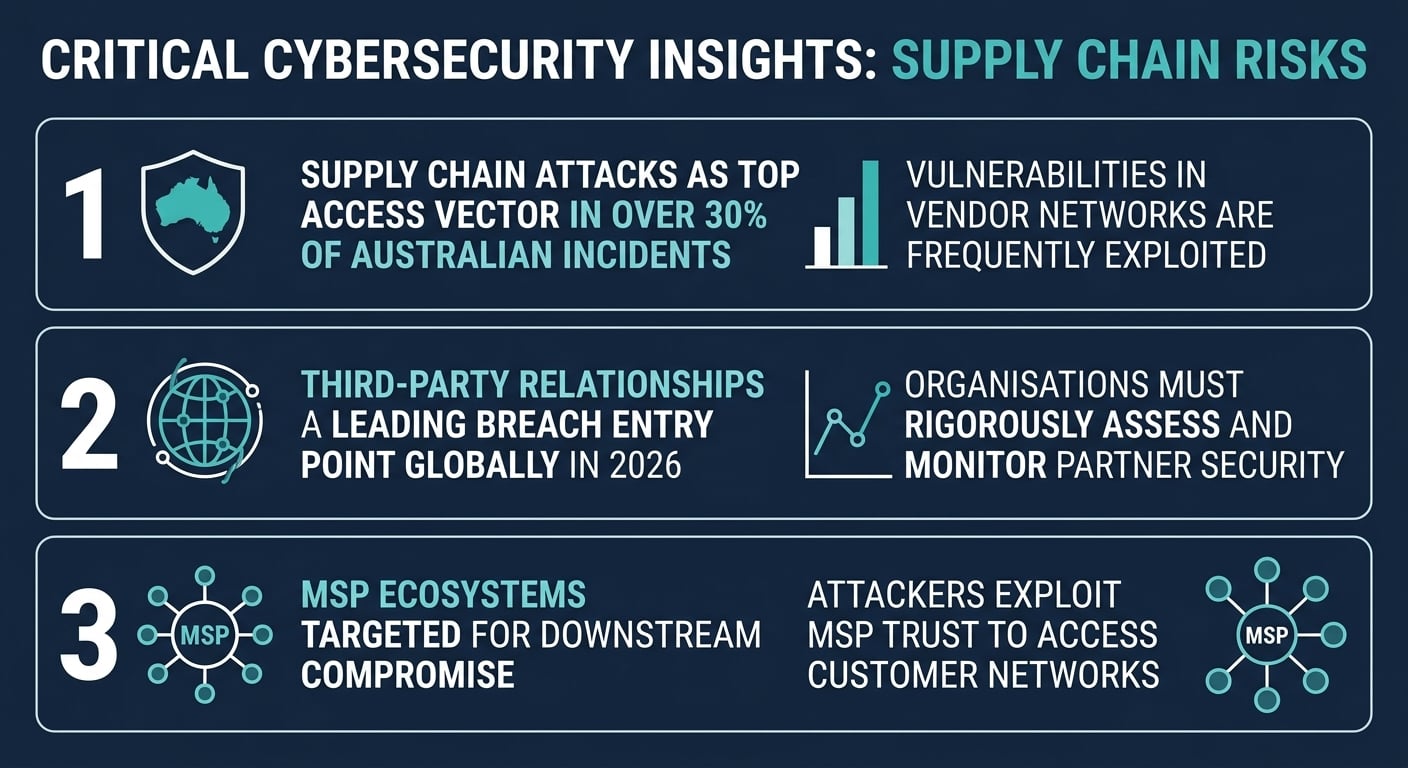
The 2026 threat landscape has made supply chain breach prevention a board-level conversation. According to the Australian Signals Directorate, 2026, supply chain and third-party compromises were identified as a top initial access vector in over 30% of incidents investigated in Australia during 2025-26. That figure represents a dramatic escalation from previous years and confirms that threat actors view supplier relationships as a preferred entry point.
The Verizon, 2026 data breach investigations report confirms that phishing and exploitation of trusted third-party relationships accounted for a significant share of the 2026 breach population, with partner and supplier access a recurring entry point. Attackers do not need to break through your perimeter when they can walk through the door using a vendor’s legitimate credentials.
CrowdStrike, 2026 reports that adversaries are increasingly targeting software supply chains and managed service provider ecosystems to achieve broad downstream compromise across multiple victim organisations simultaneously. A single compromised vendor can cascade into dozens of affected businesses, all of whom face audit, regulatory, and contractual consequences. Understanding advanced persistent threats is critical to appreciating how these supply chain attacks are executed over extended periods.
Threat actors do not distinguish between a large enterprise and a small regional business when they identify a vulnerable supplier relationship. Every organisation in the supply chain is a potential target.
ISO 27001 COMPLIANCE AND ESSENTIAL EIGHT: WHAT VENDOR CONTROLS AUDITORS ACTUALLY EXPECT
ISO 27001:2022 dedicates specific controls within Annex A to supplier relationships, including A.5.19 through A.5.22. These controls require documented supplier security policies, security requirements embedded in contracts, monitoring of supplier service delivery, and management of changes to supplier services. Auditors assessing ISO 27001 compliance will test all four areas and request evidence, not simply policy documents.
The Australian Cyber Security Centre Essential Eight framework addresses vendor risk indirectly but significantly. Application control, patching of third-party software, and restricting administrative privileges all apply directly to vendor-supplied tools and remote access accounts. Businesses achieving Maturity Level Two or above must demonstrate that these controls extend to vendor-managed environments, not just internal systems.
The gap most businesses fail to close is the documentation gap. Auditors want to see evidence that controls are operating, not just that they exist on paper. Activity logs, access review records, vendor questionnaire responses, and periodic reassessment reports are the types of evidence that determine whether a business passes or fails. Our overview of cybersecurity in 2026 provides additional context on how frameworks are evolving to meet the current threat environment.
BUILDING A VENDOR RISK MANAGEMENT PROGRAMME THAT PASSES SCRUTINY
A robust vendor risk management programme is built on four pillars: identification, assessment, control, and monitoring. Each pillar requires its own documented process, assigned ownership, and regular review cycle. Businesses that approach vendor risk as a checkbox exercise rather than a living programme will struggle to satisfy auditors who now expect maturity, not just intention.
Start by building a comprehensive vendor register that captures every third-party relationship, the data and systems each vendor can access, the criticality of each vendor to business continuity, and the inherent risk tier. Classify vendors as high, medium, or low risk and apply proportionate controls. High-risk vendors with access to sensitive data or critical infrastructure should undergo annual security assessments at minimum.
Embed security requirements into every vendor contract. These requirements should specify minimum security standards, the right to audit, mandatory breach notification timelines, and data handling obligations aligned with the Privacy Act 1988 and the Notifiable Data Breaches scheme. Contracts without these clauses are consistently flagged during audits as critical gaps.
Implement ongoing monitoring through automated tools where possible. This includes reviewing vendor access logs, monitoring for unusual authentication patterns, and tracking vendor security certifications such as ISO 27001 or SOC 2. Periodic vendor questionnaires, at least annually for high-risk suppliers, should be documented and retained as audit evidence. Applying a zero-trust cybersecurity model to vendor access removes implicit trust entirely and enforces verification at every touchpoint.
HOW ADEPT IT SOLUTIONS HELPS NEWCASTLE AND HUNTER REGION BUSINESSES CLOSE VENDOR SECURITY GAPS

Adept IT Solutions works with businesses across Newcastle, Lake Macquarie, the Hunter Region, the Central Coast, and Sydney to build third-party vendor security programmes that withstand real audit scrutiny. Our managed IT Newcastle team understands the specific compliance obligations facing Australian businesses in 2026, whether those obligations arise from customer contracts, government frameworks, or industry regulators.
We begin with a structured vendor risk assessment that maps every third-party relationship against your data assets and critical systems. From there, we develop tiered vendor security policies, update contracts with enforceable security clauses, and implement access controls that restrict vendor privileges to the minimum required. We also configure monitoring tools that generate the audit-ready evidence your auditors will request.
For businesses pursuing ISO 27001 certification or Essential Eight compliance, we provide gap analysis reports that map your current vendor controls against framework requirements and deliver a prioritised remediation roadmap. Our team has hands-on experience supporting businesses through formal audits and understands exactly what evidence auditors need to see.
Third-party vendor security Australia is not a one-time project. It is an ongoing management discipline that requires sustained attention, updated controls, and continuous evidence collection. Adept IT Solutions provides the expertise, tooling, and structured processes to make that discipline manageable for businesses of any size. Reach out to our team today to book a vendor security review and ensure your business is prepared for your next audit.
Book a free consultationFrequently Asked Questions
Q: What does an auditor look for when assessing third-party vendor security Australia programmes?
A: Auditors typically look for a documented vendor risk register, security requirements embedded in supplier contracts, evidence of ongoing monitoring, access control reviews, and records of periodic vendor reassessments. They want documented evidence that controls are operating, not just that policies exist. In Australia, auditors also check alignment with frameworks such as ISO 27001 and the Essential Eight, as well as compliance with the Privacy Act 1988 and Notifiable Data Breaches obligations.
Q: How does a supply chain breach differ from a direct cyberattack?
A: In a supply chain breach, the attacker compromises a trusted vendor or supplier and uses that access to move laterally into your organisation’s environment. Unlike a direct attack that targets your perimeter, a supply chain breach exploits legitimate credentials and trusted network pathways. This makes it significantly harder to detect and often means your organisation carries liability even though the initial compromise occurred in a third-party environment.
Q: What is the difference between third-party risk and fourth-party risk in vendor risk management?
A: Third-party risk refers to the exposure created by your direct vendors and suppliers. Fourth-party risk extends to the subcontractors and technology providers that your vendors rely on. If your cloud software vendor uses a subprocessor that suffers a breach, your data may still be exposed and your organisation may still face regulatory consequences. Effective vendor risk management programmes must account for both layers, particularly where personal or sensitive data is involved.
Q: How often should Australian businesses reassess their vendor security controls?
A: High-risk vendors with access to sensitive data or critical systems should be reassessed at least annually. Medium-risk vendors should be reviewed every one to two years, or whenever there is a significant change such as a new subcontractor, a reported incident, or a change in the scope of access. IT security audit Australia expectations in 2026 reflect a continuous monitoring approach rather than point-in-time assessments, so businesses should implement tooling that provides ongoing visibility into vendor security posture between formal reviews.
Get in touch with our team of IT experts today! You can contact us via phone at 1300 423 378 or email us at info@adept-it.com.au.

