
A vendor cyber risk assessment is no longer optional for small and medium-sized businesses supplying technology services or system access to the New South Wales Government. As of 5 August 2026, Directive DCS-2026-03 is a binding obligation for all NSW Government departments and agencies, and its requirements extend directly to their vendor ecosystem. If your business operates in Newcastle, the Hunter Region, the Central Coast, or Sydney and holds any form of access to a government system or dataset, this directive affects your commercial standing today.
The directive supersedes the previous Directive DCS-2025-04 and forms part of the staged rollout of the 2026, 2028 NSW Government Cyber Security Strategy. For technology vendors, this is not a background compliance exercise. It is a commercial necessity with direct consequences for contract eligibility, procurement outcomes, and ongoing supplier relationships.

What Is NSW Directive DCS-2026-03 and Who Does It Affect?
The NSW Government Circular DCS-2026-03, published via the Authorised Records Publication at NSW Government ARP Directive DCS-2026-03, imposes mandatory cyber risk management and governance requirements across all NSW Government agencies. Critically, agencies must now identify the risk level associated with each vendor’s access to government systems and information.
In practical terms, this means any NSW Small and Medium-sized Business (SMB) that provides managed IT services, software platforms, cloud connectivity, or any form of remote access to a government agency is now subject to assessment. Agencies are required to classify their vendors by risk tier and confirm whether those vendors meet the cyber security obligations defined under both the NSW Cyber Security Policy and the broader 2026, 2028 strategy.
The directive applies to all NSW Government departments, statutory bodies, and agencies. For SMBs across Newcastle, the Hunter Region, and Sydney who count government contracts among their client base, the message is clear: demonstrating a credible cyber security posture is now a condition of doing business with the NSW public sector.
Why Vendor Cyber Risk Assessment Is Now a Commercial Necessity
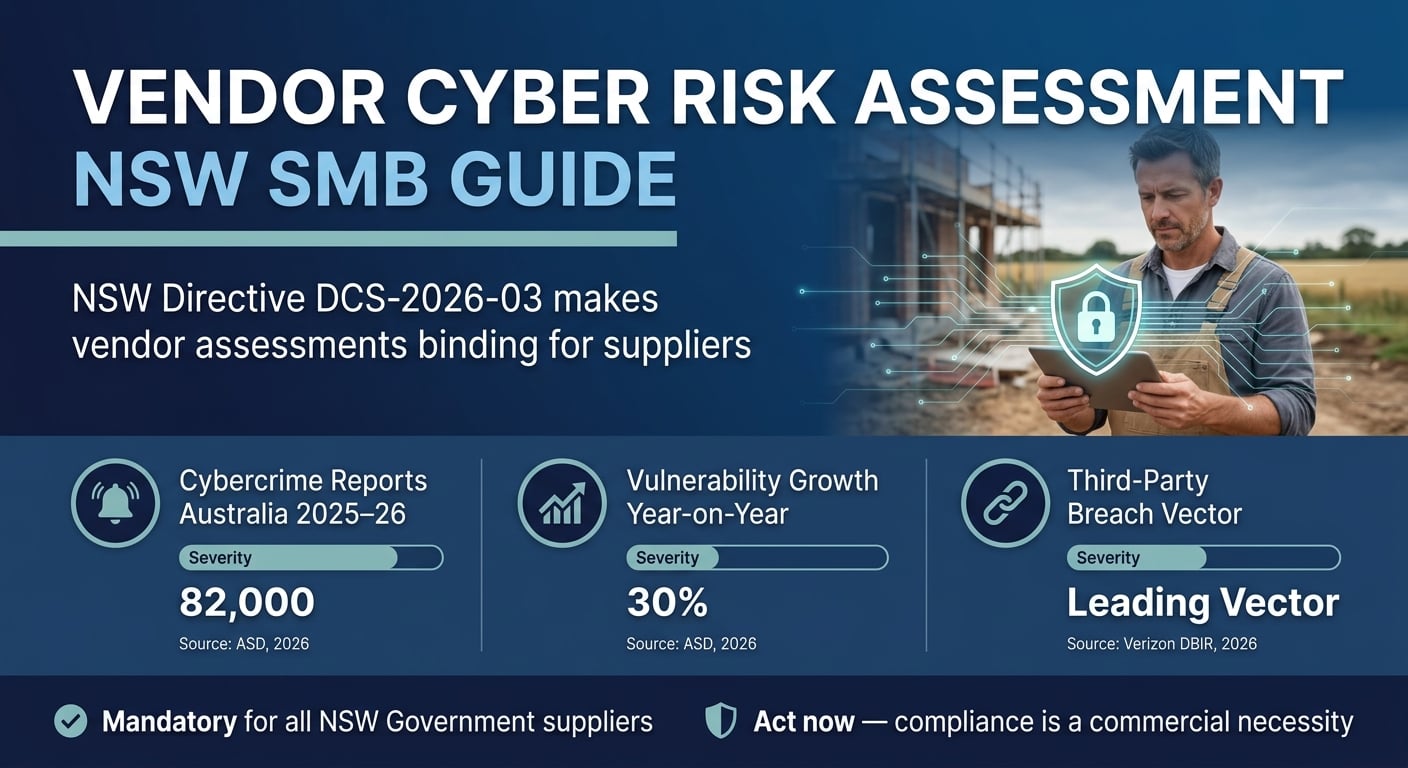
The threat landscape driving this directive is not theoretical. The Australian Signals Directorate, 2026 annual report confirms that more than 82,000 cybercrime reports were made in the 2025, 26 financial year, averaging one report every six minutes. That scale reflects a threat environment that has outpaced many businesses’ security investments.
The same report notes that publicly reported software vulnerabilities rose 30 per cent over the 2025, 26 financial year, with some exploited within 48 hours of patch release. Businesses that delay patching or fail to manage third-party software exposure are therefore operating with a rapidly narrowing window of safety. Our post on patch management for small business addresses exactly this vulnerability window in detail.
Beyond incident volumes, third-party and supply-chain intrusions remain a leading breach vector globally. According to the Verizon Data Breach Investigations Report 2026, vendor-originated incidents appear in a significant share of confirmed data breaches worldwide. NSW Government agencies are acutely aware of this exposure, which is precisely why DCS-2026-03 targets the vendor relationship as the primary risk management lever.
For SMBs operating in the government supply chain across the Central Coast and Newcastle, completing a credible vendor cyber risk assessment is now the minimum standard for contract retention and renewal. Agencies that cannot confirm a vendor’s risk tier may be obliged to restrict or terminate access arrangements.
How to Complete Your Vendor Cyber Risk Assessment: 6 Steps
Step 1: Identify All Government-Connected Systems and Access Points
Begin by cataloguing every system, platform, credential, or network pathway your business uses to access NSW Government environments. This includes remote desktop tools, cloud portals, managed service platforms, and any application programming interfaces (APIs) used for data exchange. Without a complete inventory, risk classification is impossible and gaps in your assessment become liabilities.
Step 2: Classify Each Access Point by Risk Tier
Not all vendor access carries equal risk. DCS-2026-03 requires agencies to assign a risk level to each vendor relationship. As the vendor, you should proactively self-assess using a tiered model: low-risk access involves read-only or public data; medium-risk involves internal business data; high-risk involves sensitive, personal, or critical infrastructure data. Aligning your self-classification with the agency’s framework accelerates their assessment process and signals maturity.
Step 3: Map Your Controls Against the Essential Eight
The Australian Signals Directorate (ASD) Essential Eight framework remains the baseline control set referenced in NSW Government cyber security obligations. For each access point identified in Step 1, assess your current implementation of patching, multi-factor authentication (MFA), application control, and backup practices against the relevant maturity level. Our post covering the ASD Essentials Framework changes in 2026 provides a detailed breakdown of current maturity requirements.
Step 4: Assess Your Own Sub-Vendors and Supply Chain
If your business relies on sub-contractors, cloud platforms, or third-party software vendors to deliver services to NSW Government clients, those relationships create additional exposure. DCS-2026-03 reinforces that cyber risk governance must extend through the supply chain. Document each sub-vendor, assess their security posture, and obtain written confirmation of their compliance status. If a sub-vendor cannot provide this, that gap must be reflected in your own risk register.
Step 5: Document Your Risk Register and Treatment Plan
A vendor cyber risk assessment is only credible when it is documented. Compile a risk register that records each identified risk, its likelihood and impact rating, the existing controls in place, and the treatment actions underway or planned. NSW Government procurement teams increasingly expect vendors to present a live risk register, not a static spreadsheet. For SMBs new to formal risk documentation, the ISO 27001 Information Security Standard provides a recognised governance framework adaptable to businesses of any size.
Step 6: Establish an Ongoing Review and Reporting Cadence
A one-time assessment does not satisfy the intent of DCS-2026-03. The directive supports ongoing governance obligations under the NSW Cyber Security Policy, which requires continuous risk management rather than periodic snapshots. Establish a quarterly review cycle at minimum, with triggers for out-of-cycle reviews following any security incident, significant system change, or new sub-vendor onboarding. Record each review with a date-stamped output so agencies can verify your ongoing compliance posture on demand.
Common Gaps SMBs Miss When Responding to Government Cyber Directives
Many SMBs responding to NSW cyber compliance requirements make the same avoidable mistakes. The first is treating the assessment as a documentation exercise rather than a genuine IT risk management activity. Agencies are increasingly sophisticated in evaluating vendor responses, and a superficial submission that does not reflect actual controls will generate further scrutiny, not approval.
A second common gap is failing to account for user access controls. Privileged accounts, shared credentials, and unreviewed access permissions are consistent findings in government vendor assessments. If your business has not recently audited who can access government-connected systems, you are likely carrying risk you have not documented. See our related post on secure remote access mistakes Australian SMBs make for a practical overview of this exposure.
A third gap is inadequate backup and disaster recovery posture. Agencies assessing vendor risk will consider whether a supplier incident could disrupt government operations. Businesses that cannot demonstrate tested, recoverable backups covering all government-connected workloads are unlikely to satisfy a high or medium-risk vendor classification. Our post on cloud backup compliance mistakes Australian SMBs make outlines the most common deficiencies in this area.
How the ASD Annual Cyber Threat Report 2025, 26 Shapes This Obligation
The Australian Signals Directorate Annual Cyber Threat Report 2025–26 provides the intelligence context that informs directives like DCS-2026-03. The 30 per cent rise in publicly reported software vulnerabilities over the 2025, 26 financial year, combined with exploitation timelines shrinking to as little as 48 hours, signals that the window between disclosure and active attack is now measured in days, not weeks.
For NSW Government agencies, this intelligence directly shapes how they classify vendor risk. A vendor running unpatched systems, lacking MFA, or operating without endpoint detection is now assessed as a high-risk supplier regardless of the nature of their contract. The ASD report’s findings on cyber fatigue and under-resourced security teams are also relevant here. Businesses experiencing these challenges are discussed in our post on cyber fatigue warning signs for SMBs.
The report also reinforces the importance of zero-day vulnerability management within any NSW government supplier requirements response. SMBs who have not addressed this exposure should review our post on zero-day exploits and SMB blind spots as a companion resource to their assessment work.

How Adept IT Solutions Helps Newcastle and NSW SMBs Meet DCS-2026-03
Adept IT Solutions provides managed IT services specifically designed to support SMBs operating in the NSW Government supply chain. Our team works with businesses across Newcastle, the Hunter Region, the Central Coast, and Sydney to structure and document a credible vendor cyber risk assessment aligned to DCS-2026-03 requirements and the broader NSW Cyber Security Policy framework.
Our engagements typically begin with a gap analysis against the ASD Essential Eight, followed by a structured access inventory, risk register build, sub-vendor assessment, and a treatment roadmap with prioritised remediation actions. For businesses already engaged with Microsoft 365 environments, we incorporate cloud security controls into the assessment scope. Our post on Microsoft 365 changes Australian SMBs must act on covers several of the configuration controls directly relevant to government vendor assessments.
We also support the ongoing review cadence required to maintain compliance beyond the initial assessment, including quarterly reporting, incident response planning, and sub-vendor oversight. For businesses that are new to formal IT risk management, our managed helpdesk service provides the continuous monitoring foundation that underpins a credible compliance posture.
“NSW Directive DCS-2026-03 has shifted vendor cyber risk assessment from a best-practice recommendation to a binding commercial requirement. SMBs that act now protect both their security posture and their position in the government supply chain.”
The release of DCS-2026-03 on 5 August 2026 marks a turning point for NSW SMBs in the technology supply chain. Completing a thorough vendor cyber risk assessment is now the prerequisite for maintaining government contracts, not a future aspiration. Businesses across Newcastle, the Hunter Region, the Central Coast, and Sydney that move quickly to document their controls, classify their access, and engage their sub-vendors will be positioned ahead of those who treat this as a low-priority administrative task. Adept IT Solutions is ready to help your business meet this obligation with confidence. Contact the team today at Adept IT Solutions contact page to begin your assessment.
Frequently Asked Questions
Q: What is a vendor cyber risk assessment and why does DCS-2026-03 require one?
A: A vendor cyber risk assessment is a structured process by which a business identifies, classifies, and documents the cyber security risks associated with its access to a client’s systems and data. NSW Directive DCS-2026-03 requires all NSW Government agencies to assess the risk level of each vendor with system access. This means any SMB supplying technology services or holding credentials to government environments must be able to demonstrate a credible and documented security posture to remain eligible for contracts.
Q: Does DCS-2026-03 apply to small businesses in Newcastle or regional NSW?
A: Yes. The directive applies to all vendors with access to NSW Government systems and information, regardless of business size or geographic location. Any SMB in Newcastle, the Hunter Region, the Central Coast, or elsewhere in NSW that holds remote access credentials, manages government IT infrastructure, or provides software platforms used by an agency falls within scope. Business size does not reduce the obligation under NSW government supplier requirements.
Q: How does the ASD Essential Eight relate to completing a vendor cyber risk assessment under DCS-2026-03?
A: The ASD Essential Eight is the primary baseline control framework referenced across NSW Government cyber security obligations. When completing a vendor cyber risk assessment aligned to DCS-2026-03, businesses should map their existing controls against the eight mitigation strategies: application control, patch applications, configure Microsoft Office macro settings, user application hardening, restrict administrative privileges, patch operating systems, MFA, and regular backups. Each access point’s risk tier should correspond to a minimum Essential Eight maturity level.
Q: How often does an SMB need to update its vendor cyber risk assessment to stay compliant?
A: DCS-2026-03 supports ongoing governance rather than a one-time review. As part of sound IT risk management for SMBs, a minimum quarterly review cycle is recommended, with additional out-of-cycle reviews triggered by security incidents, new sub-vendor relationships, significant system changes, or updates to the NSW Cyber Security Policy. Maintaining a date-stamped, living risk register is the most effective way to demonstrate to NSW Government agencies that your cyber compliance NSW posture is current and actively managed.
Get in touch with our team of IT experts today! You can contact us via phone at 1300 423 378 or email us at info@adept-it.com.au.

