
The joint cyber command centre NSW pilot launched on 24 November 2026 by the Minns Labour Government is one of the most significant developments in state-level cybersecurity in recent memory. By uniting Cyber Security NSW specialists with New South Wales (NSW) Police Force cybercrime investigators inside a single operational structure, the initiative fundamentally changes how cyber incidents are detected, prosecuted, and reported across the state. For small and medium-sized businesses (SMBs) in Newcastle, the Hunter Region, the Central Coast, and Sydney, that change carries real and immediate consequences.

What the Joint Cyber Command Centre NSW Means for Your Business
The NSW Government Ministerial Release confirms the new centre will provide shared strategic and operational intelligence, alongside a joint incident response and reporting mechanism for NSW Government agencies. This is not purely a government initiative. The closer alignment between law enforcement and cyber specialists means cybercrime affecting private businesses is increasingly within scope of coordinated investigation and prosecution.
For SMBs, this shift has two dimensions. First, reporting a cyber incident now feeds into a more capable, coordinated response framework. Second, businesses that fail to implement basic security controls may find themselves with less sympathy from investigators and insurers who expect reasonable due diligence. The standard of what constitutes “adequate” cybersecurity is rising.
Why the $87.7 Million Commitment Signals a Threat Level SMBs Cannot Ignore
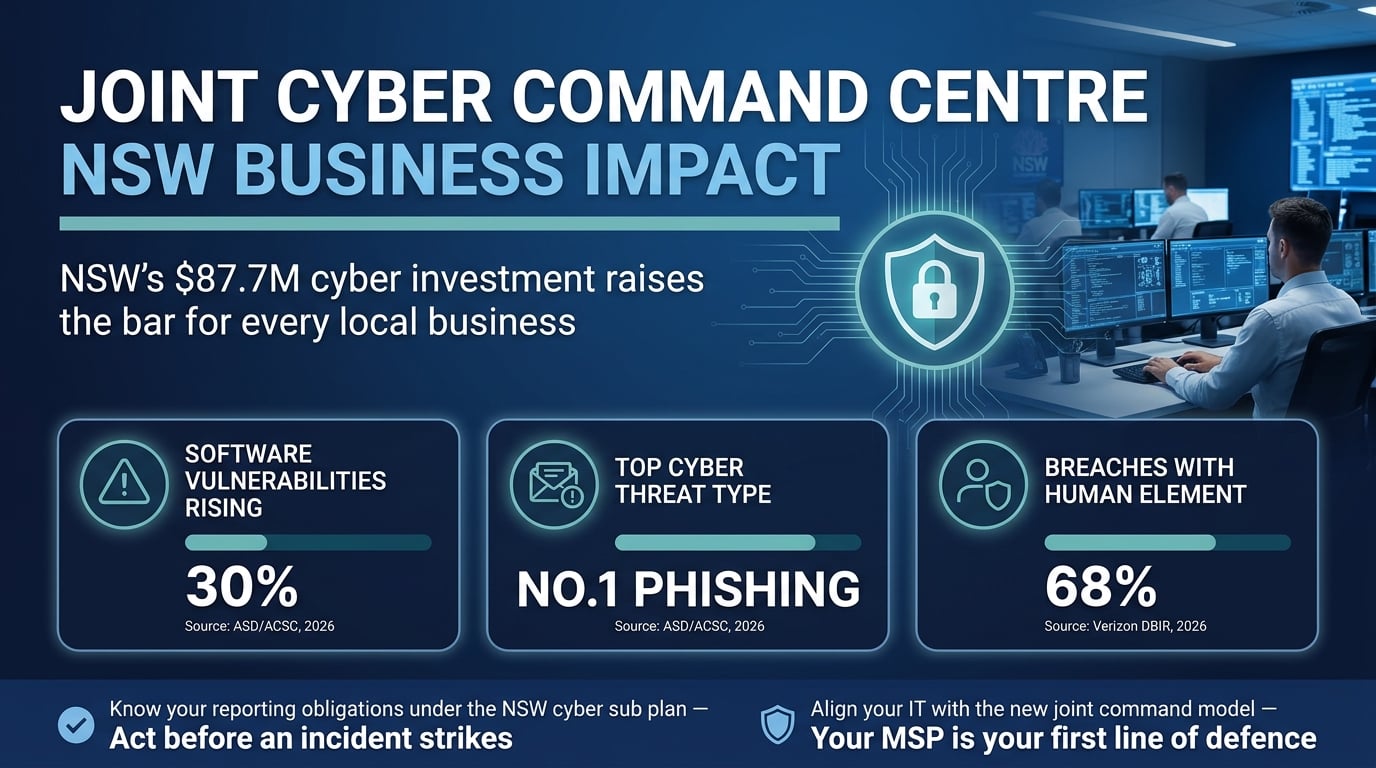
The NSW Government has committed $87.7 million over four years to Cyber Security NSW as part of this announcement. Governments do not invest at this scale without compelling threat intelligence driving the decision. For cybersecurity Newcastle businesses and SMBs across the region, that figure is a signal worth taking seriously.
The underlying threat environment supports that urgency. According to the Australian Signals Directorate / ACSC, 2026, publicly reported software vulnerabilities rose 30% during the 2025-26 financial year, with attackers exploiting flaws within 48 hours of disclosure. The same report identified phishing and business email compromise (BEC) as the top two cyber threats reported by Australian organisations, accounting for the majority of cybercrime losses in 2025-26.
Compounding this, the Verizon DBIR, 2026 found that 68% of breaches involved a human element, including phishing, stolen credentials, or social engineering, making people the primary attack surface for threat actors. SMBs without formal security training programs are especially exposed.
How the Joint Agency Model Changes Cyber Incident Reporting in NSW
The joint agency model introduces a unified incident response and reporting mechanism. Previously, a business experiencing a cyberattack might report to NSW Police, to the Australian Cyber Security Centre (ACSC), or to the Office of the Australian Information Commissioner (OAIC) under the Privacy Act, with limited coordination between those channels. The new centre is designed to consolidate that intelligence.
For SMBs, the practical implication is clearer: incident reporting now matters more than ever. A business that documents and reports an incident promptly contributes to the state’s collective threat picture and may access faster assistance. A business with no incident response plan (IRP) will struggle to participate meaningfully in that process. If you have not reviewed your vendor cyber risk assessment recently, now is the time.
Strengthening Your Defences: What the Joint Cyber Command Centre NSW Expects of Local Businesses
The launch of the joint cyber command centre NSW also strengthens community awareness programs around cybersecurity threats. This signals that government expects businesses, not just agencies, to lift their security posture. Below are seven concrete actions every NSW SMB should take in direct response to this development.
Action 1: Establish a Formal Incident Response Plan
Every business operating in NSW needs a documented cyber incident response plan. This plan should define who does what when a breach occurs, which authorities to notify, how to preserve evidence, and how to communicate with customers. The joint reporting mechanism only helps businesses that have their own process ready. Without an IRP, response time is wasted on decisions that should already be made.
Action 2: Conduct a Cybersecurity Risk Assessment
You cannot defend what you have not mapped. A structured risk assessment identifies your most critical assets, your most likely threat vectors, and the gaps between your current controls and best-practice standards. The ACSC Essential Eight Framework provides a solid baseline for Australian SMBs. For businesses in the Hunter Region and beyond, assessing your exposure before an incident occurs is far cheaper than responding after one. See our guide on ASD Essentials Framework changes for SMBs for context on current compliance expectations.
Action 3: Patch Systems Within 48 Hours of Vulnerability Disclosure
The ACSC’s 2025-26 data confirms attackers exploit newly disclosed vulnerabilities within 48 hours. This means patch management can no longer be a monthly maintenance window. It needs to be a near-real-time capability. Automated patch deployment, monitored by a managed IT provider, is the most reliable way to close this window consistently. Our post on patch management for small business outlines a practical six-step approach aligned with current ACSC guidance.
Action 4: Deploy Multi-Factor Authentication Across All Systems
Multi-factor authentication (MFA) is one of the highest-impact, lowest-cost controls available to any business. Given that 68% of breaches involve a human element such as stolen credentials, MFA directly addresses the most common initial access method used by threat actors. MFA must be enforced on email, cloud platforms, remote access tools, and administrative accounts without exception.
Action 5: Train Your Staff to Recognise Phishing and Social Engineering
Phishing and BEC remain the top two cyber threats reported by Australian organisations. Technology alone cannot stop these attacks when a staff member is persuaded to act on a fraudulent instruction. Regular security awareness training, including simulated phishing campaigns, is now a baseline expectation. The community awareness programs embedded in the new centre further reinforce that the human layer is where the battle is won or lost. Addressing cyber fatigue in your team is equally important, as desensitised staff are more likely to miss warning signs.
Action 6: Review and Test Your Backup and Disaster Recovery Plan
A ransomware incident does not announce itself with a warning period. Businesses that cannot restore operations within hours face days or weeks of downtime and significant financial loss. Your backup solution must follow the 3-2-1 rule: three copies, two different media types, one offsite or cloud location. More importantly, you must test restoration regularly. An untested backup is an assumption, not a capability.
Action 7: Understand Your Obligations Under the Privacy Act
The OAIC Notifiable Data Breaches scheme requires eligible businesses to notify both the OAIC and affected individuals when a data breach is likely to result in serious harm. With the joint command centre now coordinating incident intelligence across agencies, businesses that fail to notify as required will find that omission much harder to obscure. Know your threshold, know your timeline, and have your notification templates prepared before you need them. Our post on third-party platform breach risks outlines how notification obligations can extend beyond your own systems.
Aligning Your Cyber Incident Response Plan With NSW Government Expectations
The joint cyber command centre NSW was designed around shared intelligence and coordinated reporting. Businesses that want to benefit from this ecosystem need to speak the same language. That means aligning your cyber incident response plan with recognised frameworks such as the NIST Cybersecurity Framework and the ACSC’s incident response guidelines.
For managed IT Hunter Region clients, this alignment is something Adept IT Solutions builds into every engagement. It is not enough to have a plan in a document. The plan needs to be tested through tabletop exercises, updated after every significant threat event, and reviewed annually at a minimum. The NSW Government’s escalating investment signals that expectations will only rise from here.
How a Managed IT Provider Helps You Stay Ahead of Escalating NSW Cyber Requirements
The reality for most SMBs in Newcastle, the Central Coast, and Sydney is that they do not have the internal resources to keep pace with an evolving threat landscape and a government sector that is rapidly professionalising its cyber capability. A managed IT provider bridges that gap by delivering continuous monitoring, rapid patch deployment, security awareness programs, and incident response support as a managed service.
Adept IT Solutions works with businesses across the Hunter Region and beyond to implement the frameworks and controls that the current threat environment demands. From Essential Eight alignment to Microsoft 365 security hardening, our team translates government-level cyber requirements into practical, affordable programs for businesses of all sizes. For further reading, our post on Microsoft 365 changes for Australian SMBs covers key security configurations that every business using the platform should have in place.
“The NSW Government’s $87.7 million investment in Cyber Security NSW is not just a government story. It is a signal to every business in the state that the threat environment has escalated to a level that demands a coordinated, funded, and permanent response.”

Take Action Before an Incident Forces It
The launch of the joint cyber command centre NSW marks a turning point for how cybersecurity is governed and enforced in this state. For SMBs across Newcastle, the Hunter Region, the Central Coast, and Sydney, the seven actions outlined above are not optional extras. They are the minimum viable posture for operating in a threat environment that has prompted an $87.7 million government response. Businesses that act now will be far better positioned than those who wait for an incident to accelerate the conversation. Adept IT Solutions is ready to help. Contact our team today to discuss a tailored cybersecurity review for your business.
Frequently Asked Questions
Q: What is the joint cyber command centre NSW and who does it affect?
A: The joint cyber command centre NSW is a pilot initiative launched on 24 November 2026 by the Minns Labour Government. It brings together Cyber Security NSW specialists and NSW Police Force cybercrime investigators in a unified operational structure. While initially focused on NSW Government agencies, the centre’s shared intelligence and community awareness programs directly affect how cybercrime involving private businesses is investigated and prosecuted across the state.
Q: Does my SMB need to report cyber incidents to the new centre?
A: The reporting mechanism is currently focused on NSW Government agencies, but private businesses should still report cybercrime to the ACSC via ReportCyber and comply with the OAIC’s Notifiable Data Breaches scheme where applicable. As the centre matures, broader reporting pathways for businesses are likely to develop. Having a documented cyber incident response plan in place now ensures you can report promptly and accurately when it matters.
Q: What is the most important cybersecurity action for cybersecurity Newcastle businesses to take right now?
A: For cybersecurity Newcastle businesses and SMBs across the Hunter Region, the single most impactful starting point is a structured risk assessment aligned with the ACSC Essential Eight. This identifies your critical gaps and prioritises remediation based on real threat data. From there, enforcing multi-factor authentication and deploying automated patch management will close the most commonly exploited attack vectors quickly and cost-effectively.
Q: How can a managed IT provider help my business respond to the NSW Government’s escalating cyber requirements?
A: A managed IT provider delivers the continuous monitoring, patch management, staff training, and incident response capabilities that most SMBs cannot sustain in-house. With the NSW Government committing $87.7 million to lift state-level cyber capability, the expectation on businesses to maintain their own baseline posture is rising in parallel. Adept IT Solutions provides managed IT services across Newcastle, the Hunter Region, the Central Coast, and Sydney, helping businesses align with current compliance frameworks and prepare for the evolving threat landscape shaped by the new joint cyber command centre NSW.
Get in touch with our team of IT experts today! You can contact us via phone at 1300 423 378 or email us at info@adept-it.com.au.

