
A third-party platform breach is no longer a distant headline reserved for large corporations. In November 2026, a confirmed breach of RMS Cloud, a widely used accommodation booking platform, exposed the personal details of Australian travellers and accommodation operators across the country. According to ABC News, 3 November 2026, hackers accessed names, booking information, and contact details held within RMS Cloud’s environment. Victims then received convincing phishing emails containing accurate upcoming booking details, requesting credit card updates. The incident affected not only tourism operators but also FIFO worker housing providers and independent bed-and-breakfast businesses that rely on RMS for bookings.
For small and medium businesses (SMBs) across Newcastle, the Hunter Region, the Central Coast, and Sydney, this breach is a direct warning. When your software vendor is compromised, your customers pay the price, and your business faces the legal and reputational consequences. Below are six critical risks every Australian SMB must understand right now.

Risk 1: You Share Liability Even When a Third-Party Platform Breach Is Your Vendor’s Fault
One of the most damaging misconceptions SMBs hold is that vendor fault equals vendor liability. Under Australia’s Privacy Act 1988, if your business collected the personal information and engaged the third-party platform to process or store it, you remain an accountable party. The Office of the Australian Information Commissioner (OAIC) is clear: outsourcing data handling does not outsource legal obligation.
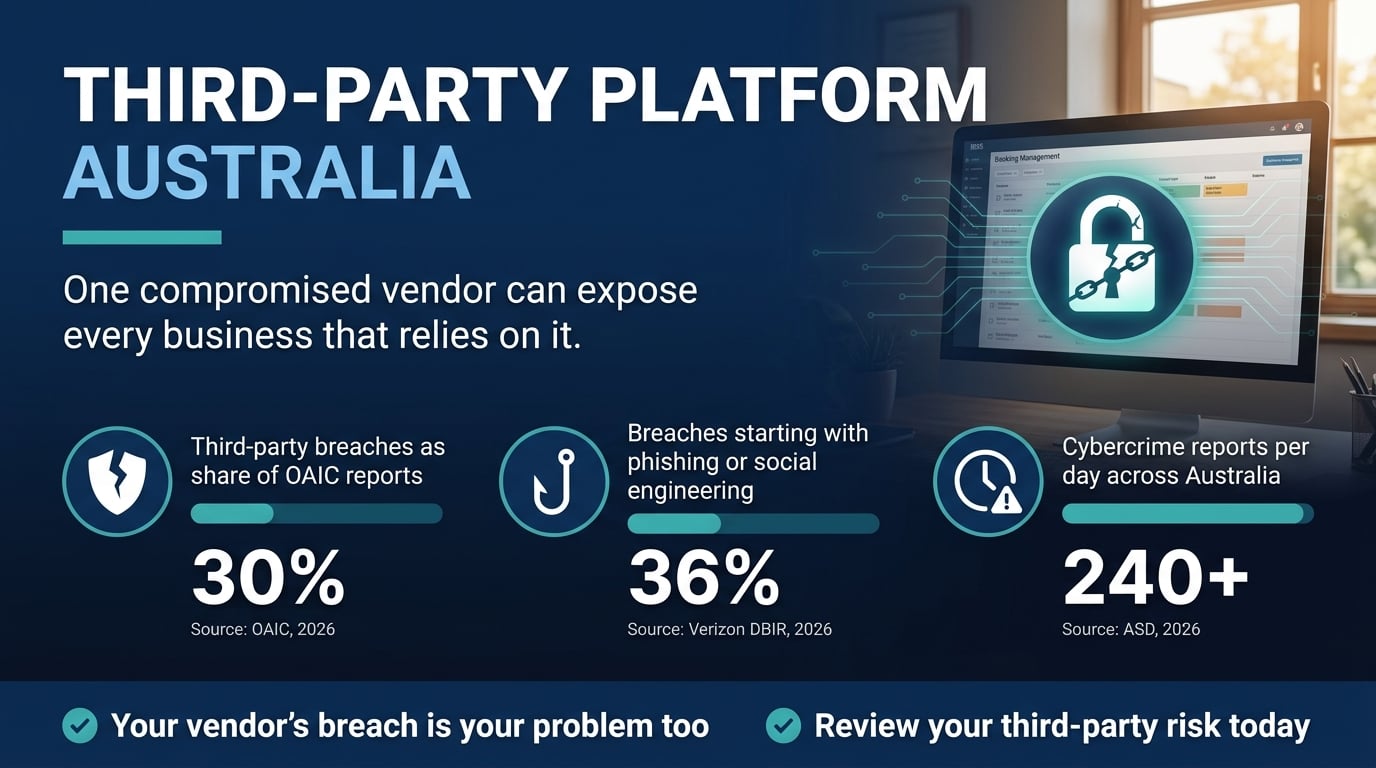
The Office of the Australian Information Commissioner, 2026 confirmed that in 2025-26, 30% of data breaches reported under the Notifiable Data Breaches scheme involved unauthorised access to personal information held by third-party service providers. That means nearly one in three breaches traced back to a vendor, yet the business that collected the data was still the entity required to notify affected individuals and the OAIC. For an SMB managing accommodation bookings, vendor data security arrangements need to be formalised in writing before a platform is ever deployed.
Our post on vendor cyber risk assessment for NSW SMBs outlines how to build formal contractual and technical controls before your next platform relationship begins.
Risk 2: Stolen Contextual Data Makes a Third-Party Platform Breach Far More Dangerous
What made the RMS Cloud incident particularly damaging was not just the volume of data stolen, but its contextual richness. Attackers obtained upcoming booking details, meaning they could contact victims with personalised, time-sensitive messages that referenced real reservations. Cybersecurity experts quoted in the ABC News investigation warned that scammers were “weaponising urgency” to trick victims into handing over payment details before they had time to verify the communication.
This tactic has measurable global traction. The Verizon Data Breach Investigations Report, 2026 found that phishing and social engineering accounted for the initial access vector in 36% of breaches globally. When booking system data breach scenarios involve real, upcoming reservation data, the success rate of these attacks climbs dramatically because victims have no reason to doubt the communication is legitimate.
SMBs that use cloud-based booking, scheduling, or customer relationship platforms should understand that any data stored on those systems becomes a potential phishing asset. Our article on deepfake fraud detection for SMBs covers how attackers combine stolen contextual data with AI-driven impersonation to create fraud scenarios that are increasingly difficult to detect.
Risk 3: Your Customers’ Privacy Act Rights Apply Regardless of Who Was Breached
When a customer books with your business and their data is later exposed through a platform you use, they have Privacy Act notification rights that your business is responsible for fulfilling. This includes the obligation to notify individuals at likely risk of serious harm, notify the OAIC, and take steps to contain the breach and mitigate its effects.
The challenge for SMBs is that most do not have documented breach response procedures in place. When a booking platform breach occurs, the business often discovers the event through customer complaints rather than vendor notifications. By that point, phishing attacks may already be underway, trust has eroded, and the statutory notification window may already be closing.
Privacy Act notification obligations require prompt action, not reactive scrambling. Businesses with cloud platform risk assessment processes built into their operations are better positioned to detect anomalies, engage their IT provider, and begin the notification process before regulators come knocking. For further reading, our post on AI data governance risks for Australian SMBs addresses how data handling obligations are evolving across cloud-dependent business models.
Risk 4: Most SMBs Have No Vendor Incident Response Plan in Place
The Australian Signals Directorate (ASD) reported in its ACSC Annual Cyber Threat Report 2025-26 that a cybercrime report was filed every six minutes on average, with supply chain and third-party compromises among the fastest-growing attack categories. Despite this, the majority of Australian SMBs still lack a documented vendor incident response plan.
A vendor incident response plan is distinct from an internal one. It should specify how your business will be notified by a vendor in the event of a breach, what your obligations are under those circumstances, and who internally is responsible for escalation. Without this, most SMBs discover a third-party platform breach from a news article or customer complaint, by which time the damage is already in motion.
The ASD’s Essential Eight framework recommends third-party access controls and application control as foundational mitigations. Our guide on the ASD Essentials Framework for SMBs explains how these controls apply specifically to businesses using cloud-hosted third-party platforms.
Risk 5: Reputational Damage Falls on Your Business, Not the Platform Provider
When a customer receives a convincing phishing email that references their booking with your business, they do not blame the cloud platform. They blame you. The reputational fallout from a third-party platform breach is felt at the customer-facing level, regardless of where technical fault lies. For small accommodation operators, tourism businesses, and FIFO housing providers in regional areas like the Hunter Region, negative reviews and social media backlash can have an immediate impact on bookings.
Reputation recovery is significantly more expensive than prevention. Research consistently shows that customers who experience a data-related breach of trust are far less likely to return. The challenge is that many SMBs operating on thin margins in tourism, hospitality, or workforce accommodation have no crisis communications plan and no IT support structure to help them respond credibly and quickly.
Our article on cyber fatigue warning signs for SMBs examines how decision-makers who are worn down by ongoing security demands often deprioritise vendor risk, leaving this exact gap unaddressed until a breach forces the issue.
Risk 6: Weak Vendor Contracts Leave SMBs Without Recourse After a Breach
Many SMBs sign up to cloud-based booking or operational platforms through a standard online agreement without negotiating security terms. These contracts often include broad liability limitations that protect the vendor while leaving the business exposed. If a booking system data breach occurs and the contract does not specify breach notification timeframes, security audit rights, or data deletion obligations, the SMB has very limited legal recourse.
The ISACA Journal, 2026 has repeatedly highlighted that third-party contract clauses addressing cybersecurity responsibilities remain one of the most underdeveloped areas of SMB risk management. Businesses engaging any cloud platform should ensure contracts include: mandatory breach notification within 72 hours, the right to audit security controls, data processing terms aligned with the Privacy Act, and incident response obligations from the vendor’s side.
Our resource on secure file sharing risks for SMBs complements this point, covering how data shared through third-party platforms needs governance controls at both the contractual and technical layer.
How Adept IT Solutions Helps Newcastle and Hunter Region SMBs Manage Third-Party Platform Risk
Managed IT Newcastle businesses trust Adept IT Solutions to go beyond break-fix support and address structural risks like third-party vendor exposure. Our team conducts cloud platform risk assessment reviews for SMBs across the Hunter Region, Lake Macquarie, the Central Coast, and Sydney, covering everything from contract review and security questionnaire frameworks to continuous monitoring and breach notification readiness.
We help clients identify every third-party platform that processes or stores customer data, assess each one against recognised frameworks including the ASD Essential Eight and ISO 27001, and implement technical controls that reduce the blast radius of a vendor breach. Where gaps exist in vendor contracts, we work alongside your legal advisors to ensure security obligations are explicitly captured.
Our approach also includes staff awareness training focused on recognising contextually convincing phishing attempts, the exact attack type demonstrated in the RMS Cloud breach. When employees know how to identify urgency-weaponised scam emails, even those containing accurate booking or customer data, they become a meaningful line of defence. For more on building layered defences, see our post on patch management for small business.
“The RMS Cloud incident is a textbook example of why SMBs cannot treat third-party vendor security as someone else’s problem. When customer data is in your supply chain, your name is on the line, regardless of which server it was sitting on when it was stolen.”

Conclusion: Take Action Before the Next Third-Party Platform Breach Hits Your Business
The RMS Cloud breach is a turning point for how Australian SMBs should think about their technology supply chains. A third-party platform breach can expose your customers, trigger your Privacy Act notification obligations, damage your reputation, and leave you without legal recourse, all while the fault lies technically with a vendor you trusted. The six risks outlined above are not theoretical. They are playing out right now across accommodation, tourism, workforce housing, and hospitality businesses throughout Australia.
The good news is that each of these risks is manageable with the right IT partner and the right processes. Adept IT Solutions specialises in helping Newcastle, Hunter Region, Central Coast, and Sydney SMBs assess their vendor risk exposure and build practical protections that do not require enterprise budgets. Contact Adept IT Solutions today to book your no-obligation vendor risk consultation and ensure your business is not the next cautionary headline.
Frequently Asked Questions
Q: What is a third-party platform breach and how does it affect my business?
A: A third-party platform breach occurs when a software vendor or cloud service your business uses is compromised, exposing the customer data you entrusted to them. Even though the breach occurs on the vendor’s systems, your business retains legal responsibility under the Privacy Act 1988 for notifying affected customers and the OAIC. The RMS Cloud incident in 2026 is a clear example, where accommodation operators were held accountable for data their booking platform provider failed to protect.
Q: Does my SMB need to notify customers if the breach was caused by our booking system provider?
A: Yes. Under Australia’s Notifiable Data Breaches scheme, the business that collected and is responsible for the personal information must issue notifications, regardless of which party in the supply chain was technically breached. This includes notifying affected individuals at likely risk of serious harm and reporting to the OAIC. Privacy Act notification obligations apply to the data controller, not just the data processor. If you are unsure how this applies to your vendor relationships, consult a managed IT provider experienced in Australian compliance.
Q: How can I assess whether my cloud booking or operational platform is a security risk?
A: A cloud platform risk assessment should cover the vendor’s security certifications (such as ISO 27001), their breach notification procedures, the contractual protections in place, and what data they store and where. Many SMBs skip this process when onboarding new tools, which is a significant gap. Adept IT Solutions provides structured vendor risk assessments for businesses across Newcastle, the Hunter Region, and the Central Coast to identify exposure before a booking system data breach occurs.
Q: What steps should my business take immediately after learning a third-party vendor has been breached?
A: Act quickly and document everything. First, confirm the scope of data exposed with the vendor in writing. Second, engage your IT provider or cybersecurity team to assess the risk to your customers. Third, determine whether the breach meets the threshold for notification under the Privacy Act. Fourth, alert your customers as a precaution, particularly warning them about phishing scams using their data. Fifth, review your vendor contract to understand your rights. Having a vendor incident response plan prepared in advance makes all of these steps faster and far less stressful.
Get in touch with our team of IT experts today! You can contact us via phone at 1300 423 378 or email us at info@adept-it.com.au.

