
AI data governance is no longer a concern reserved for enterprise legal teams or government departments. For small and medium-sized businesses (SMBs) across Newcastle, the Hunter Region, Central Coast, and Sydney, the rapid adoption of artificial intelligence (AI) tools has created a data management crisis that many organisations have not yet recognised. The risks are real, the regulatory consequences are growing, and the window to act responsibly is narrowing. This post outlines the six most pressing risks your business faces right now.

Why Australian SMBs Are Losing Control of Their Data in the AI Rush
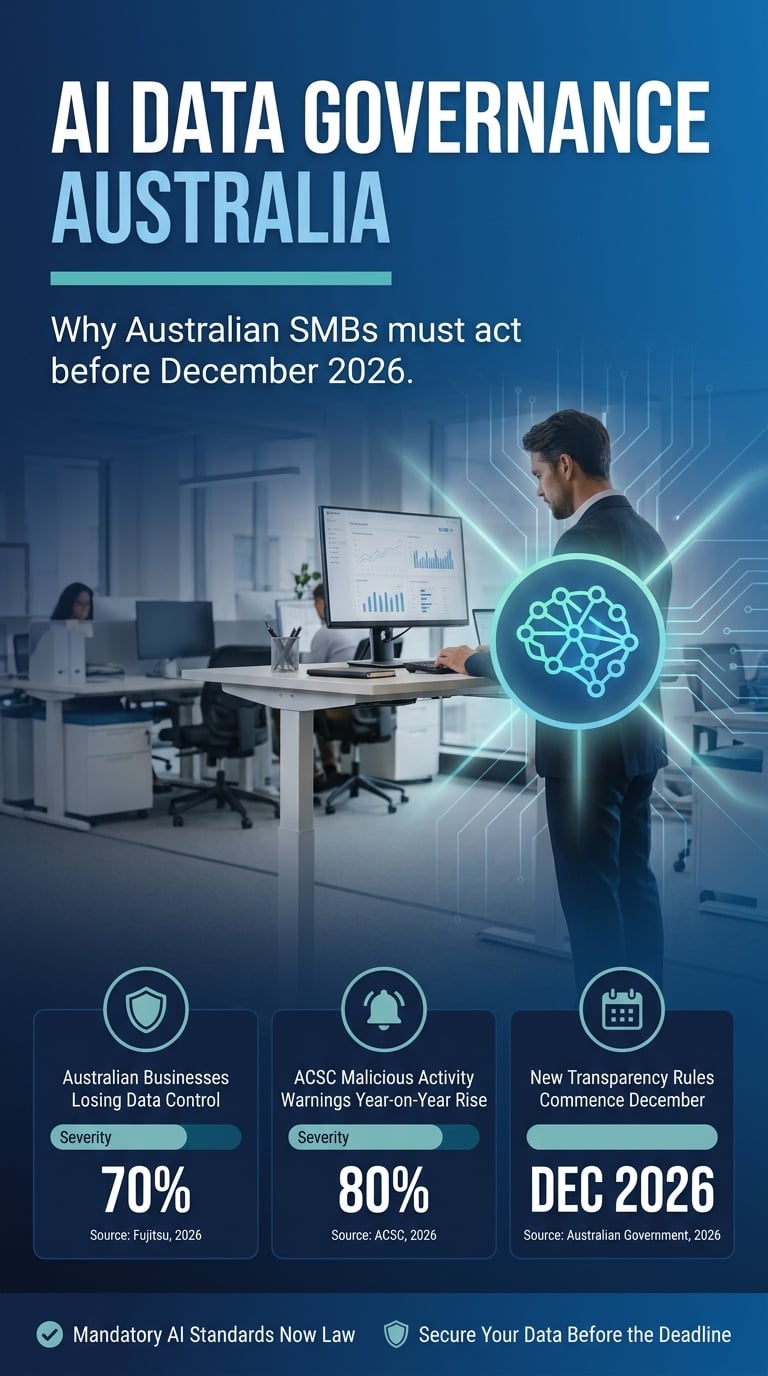
The pace of AI adoption in Australian businesses has outrun the policies designed to manage it. According to the Fujitsu Uvance Wayfinders Research, 2026, 70% of Australian businesses admit AI deployment is pushing them to share data more widely than their existing governance frameworks can safely support. This exceeds the 60% rate reported in the United States, suggesting Australian organisations are moving faster than their governance infrastructure can follow.
For SMBs, the gap is even more pronounced. Without dedicated compliance teams or chief data officers, day-to-day decisions about which data enters an AI system are often left to individual employees. That informal approach creates exposure across privacy, security, and regulatory dimensions simultaneously. If you are relying on staff intuition rather than documented policy, the risks below apply directly to your business.
Our post on AI governance for small business explores the structural gaps behind this problem in more detail. Understanding those gaps is the starting point for building meaningful protection.
What Australia’s Mandatory AI Standards Mean for Your Business
The regulatory landscape shifted significantly in late 2026. The Australian Government, Department of Industry Science and Resources, 2026 confirmed that mandatory automated decision-making transparency requirements for businesses will commence on 10 December 2026, following the announcement of mandatory AI safety standards and a new AI safety regulator on 10 November 2026.
These are not voluntary guidelines. Businesses that use AI to make or inform decisions affecting individuals must be able to explain how those decisions are reached, what data was used, and how bias was managed. For SMBs without a formal AI compliance framework, meeting these obligations by December 2026 requires immediate action. The compliance burden falls on the organisation deploying the tool, not the vendor who built it.
The Office of the Australian Information Commissioner has also reinforced that the Privacy Act 1988 applies fully to AI systems that process personal information. Businesses need to understand both regulatory streams simultaneously.
Risk 1: Oversharing Data Without Governance Guardrails
The most common failure point is also the most preventable. Employees across Hunter Region businesses regularly paste client data, internal financials, and personally identifiable information into public-facing AI tools because no policy prohibits it. Without data classification rules integrated into your AI data governance approach, sensitive information travels outside your controlled environment with every prompt submitted.
Data loss prevention (DLP) controls, enforced through tools like Microsoft Purview within Microsoft 365, can intercept this behaviour before it becomes a breach. However, technology alone is insufficient without clear written policy defining what categories of data may never enter an AI system. Our guide on secure file sharing at work outlines the classification principles that apply equally in AI contexts.
Risk 2: Shadow AI Tools Operating Without Oversight
Shadow AI refers to AI tools adopted by employees or departments without formal IT or management approval. This mirrors the shadow IT problem that emerged with cloud applications a decade ago, but the data exposure is far more severe. AI tools often retain, train on, or log the content of every query submitted to them.
A Central Coast business that allows staff to use unapproved AI writing tools, image generators, or summarisation platforms has no visibility into what data has left its environment. Without an approved AI tool register and procurement review process, shadow AI is almost certainly present. Our analysis of AI tools in the workplace examines how to surface and manage this exposure before it escalates.
Risk 3: No Incident Notification Plan for AI-Related Breaches
The Australian Cyber Security Centre (ACSC), 2026 warned organisations of potential malicious activity more than 4,400 times in the last financial year, representing an 80% rise on the prior year. When an AI-related data incident occurs, businesses without a documented response plan typically take far longer to identify, contain, and report the breach than those with rehearsed procedures.
Australia’s Notifiable Data Breaches (NDB) scheme requires eligible businesses to notify the Office of the Australian Information Commissioner (OAIC) and affected individuals when a breach is likely to cause serious harm. AI systems that process personal information fall squarely within this obligation. If your incident response plan was written before AI tools entered your environment, it needs to be updated now. Our post on patch management for small business outlines response timelines that apply equally to AI-related incidents.
Risk 4: Failing Automated Decision-Making Transparency Rules
From December 2026, businesses using AI to inform decisions about individuals, including hiring, credit, service eligibility, or pricing, must meet new transparency obligations. This is not limited to large corporations. Any SMB using AI-assisted recruitment tools, customer scoring systems, or automated loan or insurance assessments will need to demonstrate that the process is explainable, auditable, and free from unlawful bias.
The practical implication is significant. If you cannot document how an AI tool reached a recommendation, you cannot defend that recommendation to a regulator. Building an AI compliance framework that captures model logic, data inputs, and human oversight checkpoints is now a legal necessity for many SMBs, not a future aspiration. Reviewing the ISO/IEC 42001 AI Management Standard provides a recognised international baseline for structuring these obligations.
Risk 5: Vendor AI Supply Chain Exposure
When your business purchases software with embedded AI features, you inherit the data governance risks of your vendor’s AI infrastructure. A Sydney-based SMB using a cloud-based customer relationship management (CRM) or accounting platform almost certainly has AI features enabled by default. The question is whether your vendor’s AI processes your data in a jurisdiction that meets Australian privacy standards, and whether their sub-processors have been properly assessed.
Vendor due diligence is a core component of responsible AI data governance. Before any AI-enabled SaaS (Software as a Service) product is adopted, your team should review data processing agreements, understand where training data is stored, and confirm that vendor AI use does not violate your obligations under the Privacy Act. Our guide on AI procurement risks for SMBs outlines the specific questions to ask before signing any AI-related contract.
Risk 6: Operating Without an AI Use Register
An AI use register is a documented inventory of every AI system your business uses, the data it accesses, the decisions it informs, and the person accountable for its governance. Without this register, you cannot demonstrate compliance, cannot respond coherently to a regulatory inquiry, and cannot identify where your highest-risk exposures actually sit.
Building this register does not require sophisticated technology. A structured spreadsheet maintained by your IT or compliance lead is an effective starting point. The discipline of recording each AI tool, its data inputs, its purpose, and its oversight arrangements creates the audit trail that regulators will expect to see. Without it, your business cannot credibly claim to have implemented managed IT controls over its AI environment.
How to Build a Practical AI Data Governance Framework Before December 2026
With the December 2026 compliance deadline approaching, Newcastle and Hunter Region SMBs need a structured, achievable path to meaningful AI data governance. The following steps form the foundation of a practical framework that can be implemented without an internal legal team or enterprise budget.
Step one is to audit and document every AI tool currently in use across your organisation, including those adopted informally by individual teams. This becomes your AI use register.
Step two is to classify your data assets and define which categories are permitted to enter AI systems, which require additional controls, and which are prohibited entirely.
Step three is to review every vendor contract for AI-related data processing clauses, confirm jurisdictional compliance, and update agreements where necessary.
Step four is to update your incident response plan to include AI-specific breach scenarios and confirm your NDB notification procedures are current.
Step five is to train staff on AI acceptable use, data classification, and the specific obligations that apply to their roles when using AI tools.
Step six is to assign clear ownership. Each AI system in your register should have a named individual accountable for its governance, review cycle, and incident response.
Our post on Microsoft 365 changes for Australian SMBs covers how Microsoft’s built-in compliance and DLP tools can support several of these steps without additional software investment. For businesses already in the Microsoft ecosystem, meaningful governance controls are closer than many realise.
“Businesses using AI to make or inform decisions about individuals must be able to explain how those decisions are reached, what data was used, and how bias was managed. The obligation rests with the organisation deploying the tool, not the vendor who built it.”, Adept IT Solutions, interpreting Australian Government mandatory AI safety standards, 2026.

The Cost of Doing Nothing Is No Longer Acceptable
Robust AI data governance is not a future project for when your business grows larger. For SMBs operating across the Hunter Region, Central Coast, and Sydney, it is an immediate operational and legal requirement. The six risks outlined here, oversharing data, shadow AI, missing incident plans, non-compliant automated decisions, vendor supply chain exposure, and the absence of an AI use register, each carry real consequences under Australian law. Waiting until December 2026 is not a strategy. Businesses that begin building their AI compliance framework now will face less disruption, less regulatory risk, and less cost than those who delay.
Adept IT Solutions partners with SMBs across Newcastle, Lake Macquarie, the Hunter Region, Central Coast, and Sydney to design and implement AI data governance frameworks that are practical, proportionate, and built for Australian compliance requirements. To begin the conversation, visit our contact page and speak with an adviser today.
Frequently Asked Questions
Q: What is AI data governance and why does it matter for Australian SMBs?
A: AI data governance refers to the policies, processes, and controls that determine how data is collected, stored, used, and protected within AI systems. For Australian SMBs, it matters because mandatory AI safety standards commencing in December 2026 impose legal obligations around transparency, accountability, and privacy that apply regardless of business size. Without a formal governance approach, SMBs risk regulatory penalties, data breaches, and reputational damage that can be difficult to recover from.
Q: Does Australia’s mandatory AI compliance framework apply to small businesses?
A: Yes. The automated decision-making transparency requirements announced by the Australian Government in November 2026 apply to businesses that use AI to inform decisions affecting individuals, regardless of company size. If your SMB uses AI-assisted hiring tools, customer scoring, or automated service decisions, you are within scope. The Privacy Act 1988 obligations enforced by the OAIC also apply to AI systems that process personal information.
Q: What is shadow AI and how can a business in the Hunter Region identify it?
A: Shadow AI describes AI tools adopted by staff or departments without formal approval from IT or management. It is identified through a combination of network traffic monitoring, software audit tools, and direct staff surveys asking which AI platforms team members currently use in their roles. Once identified, each tool should be assessed against your AI use register criteria before being approved, restricted, or blocked based on the data it accesses and the jurisdiction in which it operates.
Q: How does managed IT support help SMBs build an AI data governance framework?
A: A managed IT provider helps SMBs implement the technical controls, documentation processes, and staff training that underpin a sound AI data governance framework. This includes deploying data loss prevention tools, configuring Microsoft 365 compliance features, conducting vendor AI supply chain assessments, updating incident response plans, and building AI use registers. For Newcastle and Hunter Region businesses without internal IT governance expertise, managed IT support is the most practical path to meeting December 2026 compliance deadlines on time and within budget.
Get in touch with our team of IT experts today! You can contact us via phone at 1300 423 378 or email us at info@adept-it.com.au.

