
Supply chain cyber attacks Australian businesses face have become one of the most significant and fast-growing threats of 2026. Unlike direct intrusion attempts, these attacks exploit the trusted relationships your business maintains with vendors, software providers, and third-party service partners. For small and medium-sized businesses (SMBs) across Newcastle, the Hunter Region, Central Coast, and Sydney, the risk is no longer theoretical. Attackers are actively targeting the weakest links in connected business ecosystems, and Australian organisations are squarely in their crosshairs. Understanding how these attacks work is the first step toward meaningful protection.
What Are Supply Chain Cyber Attacks and Why Are Australian SMBs at Risk?

A supply chain cyber attack occurs when a threat actor compromises a business by first infiltrating one of its trusted third-party vendors, software suppliers, or managed service partners. Rather than attacking your organisation directly, adversaries target a less-defended point in your supplier network and use legitimate access pathways to reach your systems, data, and customers.
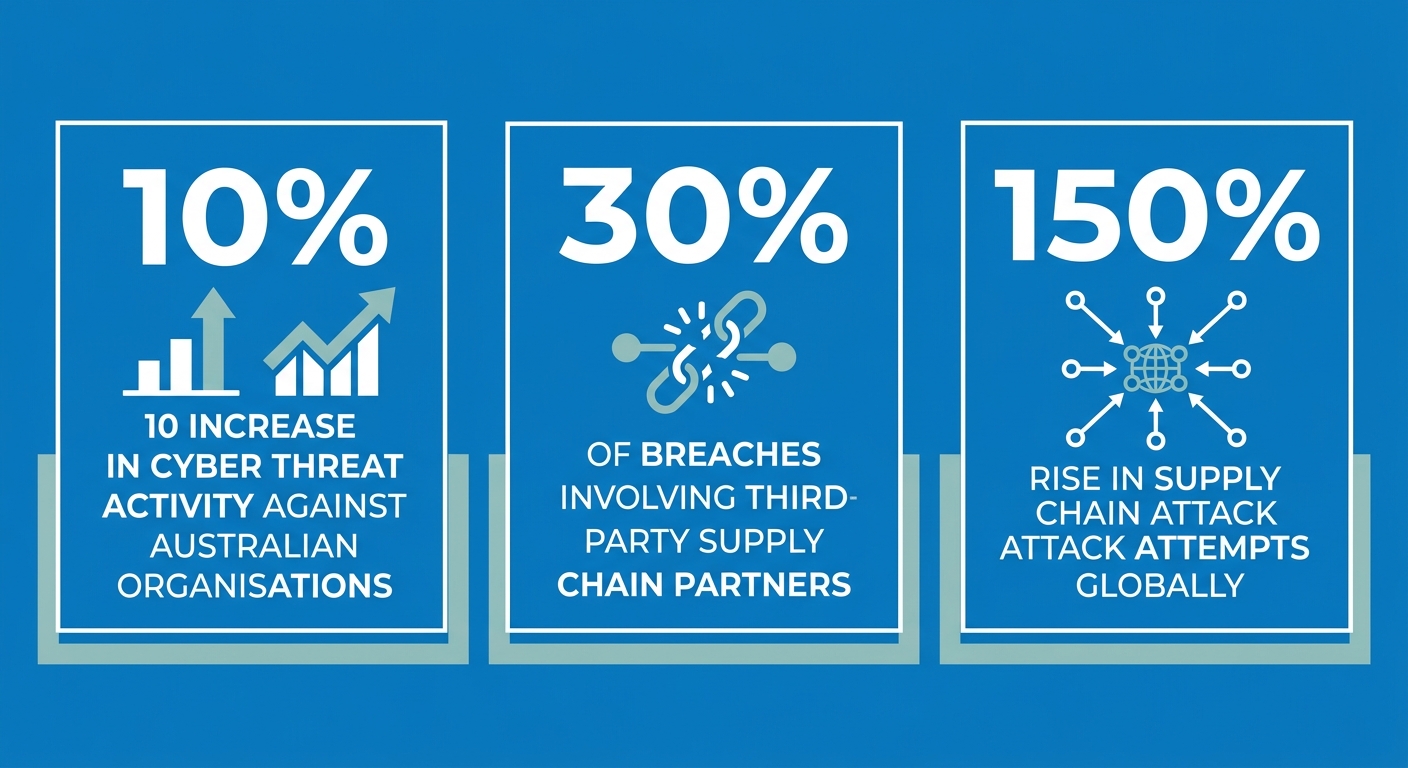
The Australian Signals Directorate (ASD) and Australian Cyber Security Centre (ACSC), 2026 report confirms that cyber threat activity targeting Australian organisations increased by over 10% in the 2025-26 reporting period, with supply chain and third-party compromises representing a growing proportion of incidents. This trend reflects a deliberate strategic shift by adversaries who recognise that SMBs often have fewer security controls than large enterprises.
Australian SMBs are particularly attractive targets because they frequently serve as suppliers, contractors, or technology partners to larger organisations. Compromising a regional business in Newcastle or the Hunter Region can give attackers a foothold into an entire connected network of clients and partners. The asymmetry between the value of that access and the security investment of the SMB is what makes this attack vector so compelling to adversaries.
How Attackers Exploit Trusted Vendor Relationships to Breach Your Business
The mechanics of supply chain attacks are sophisticated but follow recognisable patterns. Adversaries typically compromise a software vendor’s update mechanism, inject malicious code into a widely-used application, or steal credentials belonging to a trusted third-party with elevated access to your environment. Once inside, they move laterally, often undetected for weeks or months.
According to the Verizon Data Breach Investigations Report, 2026, 30% of breaches globally involved a third party, including software supply chain partners. Exploitation of trusted relationships now represents one of the fastest-growing attack vectors worldwide. For Australian SMBs, this underscores the danger of assuming your security posture ends at your own perimeter.
Common entry methods include compromised software updates, malicious plugins embedded in commercial platforms, and abuse of remote monitoring tools used by IT service providers. Attackers also exploit weak identity controls, particularly where multi-factor authentication (MFA) is absent or inconsistently applied across vendor accounts. Businesses using outdated or unpatched software face compounded exposure when their vendors are similarly unprotected.
The CrowdStrike Global Threat Report, 2026 identified a 150% year-over-year increase in adversary attempts to exploit trusted software supply chain relationships. This extraordinary growth signals that threat actors have identified a productive and scalable attack methodology. For businesses across the Central Coast and greater Sydney, the message is clear: your vendor relationships are now part of your attack surface.
Understanding how these vectors intersect with identity security is equally important. Our guide on identity security gaps for Australian SMBs outlines how credential theft and poor access management directly enable supply chain intrusions.
Real-World Impact: What a Supply Chain Breach Costs an Australian SMB
The financial and operational consequences of a supply chain breach are severe and multi-layered. Direct costs include incident response, forensic investigation, data recovery, regulatory notification, and potential fines under the Privacy Act 1988. Indirect costs, including reputational damage, client churn, and productivity loss, frequently dwarf the immediate financial exposure.
The Office of the Australian Information Commissioner (OAIC) continues to record a high volume of notifiable data breaches attributable to third-party and supply chain compromises. Organisations that fail to implement adequate safeguards over their vendor ecosystem face enforcement action and mandatory public notification, further amplifying reputational harm.
For a Newcastle or Hunter Region SMB operating on thin margins, even a mid-tier breach can be existential. Recovery timelines frequently extend to weeks, disrupting operations, delaying projects, and eroding client trust that took years to build. Cyber insurance premiums have also risen sharply in response to supply chain risk, adding further cost pressure for businesses without robust third-party vendor security controls already in place.
Supply chain breaches also create downstream liability. If your business is the compromised vendor that enables an attack on a client’s environment, you may face contractual and legal consequences from that client relationship. This liability dimension is increasingly being factored into procurement decisions across Australian industry sectors.
5 Steps to Assess and Reduce Your Third-Party Vendor Cyber Risk
Effective cyber risk management Australia-wide requires a structured approach to third-party risk. The following five steps provide a practical framework for SMBs to assess and reduce exposure through their vendor ecosystem.
1. Conduct a Vendor Inventory and Risk Classification
Begin by mapping every third-party relationship your business relies on, from software platforms and cloud services to contractors and logistics partners. Classify each vendor by the level of access they have to your systems and data. Vendors with privileged access or connections to sensitive data represent your highest-priority risk tier and require the most rigorous oversight. Our post on third-party vendor security audit failures in Australia identifies common gaps in this process.
2. Implement Contractual Security Requirements
Establish minimum cybersecurity standards as a contractual requirement for all vendors. This includes mandatory MFA, patch management schedules, data handling obligations, and incident notification timeframes. Formalising these requirements gives your business enforceable recourse and signals to vendors that security is a condition of doing business with you, not an optional extra.
3. Apply Least-Privilege Access Principles
Restrict vendor access to only the systems and data they require to perform their function. Review and revoke access when vendor relationships change or conclude. Implementing zero-trust principles, where no user or system is trusted by default, significantly limits the blast radius of any single vendor compromise. Understanding zero-trust cybersecurity fundamentals is an essential starting point for this strategy.
4. Monitor Vendor Activity Continuously
Passive vendor management is insufficient in 2026. Implement logging and monitoring of all vendor-initiated activity within your environment. Anomalous behaviour, such as access outside business hours, bulk data queries, or lateral movement between systems, should trigger immediate alerts. Continuous monitoring transforms your vendor oversight from a periodic review exercise into a live security control.
5. Align with the Essential Eight Framework
The Essential Eight framework, developed by the ACSC, provides a prioritised baseline of mitigation strategies that directly address the techniques used in supply chain attacks. Application control, patching applications, and restricting administrative privileges are particularly relevant controls. Achieving even Maturity Level One across the Essential Eight substantially reduces your organisation’s susceptibility to third-party compromise. The ACSC Essential Eight guidance provides detailed implementation advice for Australian businesses of all sizes.
How Managed IT Services Strengthen Your Supply Chain Security Posture
For many SMBs, the challenge is not understanding the threat but having the internal capability to address it consistently. This is precisely where managed IT Newcastle and regional IT security assessment Hunter Region services deliver measurable value. A qualified managed service provider (MSP) brings structured processes, security tooling, and specialist expertise that most SMBs cannot economically maintain in-house.
Managed IT services provide continuous monitoring, patch management, identity and access governance, and vendor risk oversight as integrated capabilities rather than reactive tasks. This means threats are identified and contained faster, and the operational burden of managing software supply chain security does not fall entirely on your internal team.
Adept IT Solutions also assists businesses in aligning with compliance frameworks such as ISO 27001 and the Essential Eight, both of which include explicit requirements around third-party and supply chain risk management. Formal compliance not only strengthens your security posture but also provides demonstrable assurance to clients, partners, and insurers.
Threat intelligence is another critical managed service advantage. Understanding how supply chain cyber attacks Australia businesses face are evolving in near real-time allows proactive controls to be implemented before an attack vector is exploited. Reactive security is no longer adequate in the current threat environment.
Protect Your Newcastle or Hunter Region Business Before the Next Attack

Regional businesses in Newcastle, Lake Macquarie, and the broader Hunter Region are not insulated from global supply chain threats. Threat actors do not discriminate by geography. They target opportunity, and a regional SMB with inadequate vendor controls presents exactly that. The growing volume of supply chain cyber attacks Australian organisations are reporting in 2026 reflects a threat landscape that has matured and industrialised.
Investing in proactive vendor risk management, robust identity controls, and continuous monitoring is no longer a luxury reserved for large enterprises. It is a baseline operational requirement for any SMB that handles client data, operates cloud services, or works within a broader supplier ecosystem. The cost of prevention is consistently lower than the cost of recovery.
Businesses that have already experienced a related incident can also benefit from reviewing how AI-powered threats compound supply chain risk. Our analysis of AI cyber attacks targeting Australian SMBs in 2026 explores how automation is accelerating the scale and sophistication of these campaigns.
“Supply chain attacks are not a future risk for Australian SMBs. They are a present and active threat requiring structured, ongoing mitigation rather than a one-time security review.”
The evidence is unambiguous. Supply chain cyber attacks Australian businesses face in 2026 are increasing in frequency, sophistication, and impact. The five steps outlined in this post, combined with the support of a trusted managed IT partner, provide a practical and achievable path to meaningful risk reduction. Taking action now, before an incident occurs, remains the most cost-effective and strategically sound decision any SMB can make this year.
Adept IT Solutions works with businesses across Newcastle, Hunter Region, Central Coast, and Sydney to assess vendor risk, implement security frameworks, and provide ongoing managed protection. Reach out to our team today to begin a conversation about your supply chain security posture.
Book a free consultationFrequently Asked Questions
Q: What makes supply chain cyber attacks in Australia particularly dangerous for SMBs in 2026?
A: Supply chain cyber attacks Australia SMBs face are especially dangerous because they exploit the trust your business places in vendors and software providers. Attackers bypass your direct defences by compromising a third party with legitimate access to your environment. SMBs are disproportionately targeted because they often have fewer security controls, yet they sit within supply chains connecting them to larger, higher-value organisations. The result is that a relatively small business can become a gateway into a much broader network of compromise.
Q: How can I identify which of my vendors presents the highest third-party vendor risk?
A: Begin by cataloguing all vendors with access to your systems, networks, or data. Prioritise those with privileged or persistent access, particularly software platforms, cloud service providers, and any contractor connecting remotely to your infrastructure. Assess each vendor’s security posture through questionnaires, contractual obligations, and where possible, independent security assessments. Vendors handling personal or financial data on your behalf carry the highest regulatory and operational risk and should be reviewed on a regular cycle, not just at contract renewal.
Q: Does the ACSC Essential Eight framework address software supply chain security risks?
A: Yes. The Essential Eight framework developed by the ACSC includes controls that directly mitigate software supply chain security risks. Application control prevents unauthorised software, including malicious components introduced via compromised vendor updates, from executing in your environment. Patching applications and operating systems closes vulnerabilities that supply chain attackers frequently exploit. Restricting administrative privileges limits the lateral movement an attacker can achieve once inside. Implementing the Essential Eight to even Maturity Level One provides a meaningful and measurable reduction in supply chain attack exposure for Australian SMBs.
Q: How does managed IT support from an MSP help with IT security assessment and supply chain risk in the Hunter Region?
A: An experienced managed IT provider delivers the tools, processes, and specialist expertise needed to conduct thorough IT security assessments across your vendor relationships. For Hunter Region businesses, local managed IT services mean faster response times and a provider who understands the specific compliance and operational environment of regional Australian SMBs. Ongoing monitoring, identity governance, patch management, and vendor access controls are managed continuously rather than reviewed once a year. This sustained approach to cyber risk management is significantly more effective than periodic internal reviews conducted without dedicated security tooling or expertise.
Get in touch with our team of IT experts today! You can contact us via phone at 1300 423 378 or email us at info@adept-it.com.au.

