
Patch management for small business has never been more urgent than it is right now. On 17 November 2026, the Australian Signals Directorate’s (ASD) Australian Cyber Security Centre (ACSC) issued its highest-level Critical Alert, warning that malicious actors are now exploiting software vulnerabilities within just 48 hours of security patches becoming publicly available. For small and medium businesses (SMBs) across Newcastle, the Hunter Region, the Central Coast, and Sydney, this is not a distant threat. It is an immediate operational risk that demands action today.

Why the ACSC’s 48-Hour Window Changes Everything for SMB Patching
The ACSC’s Critical Alert classification is the highest the agency issues. It is reserved for threats of immediate national significance. The November 2026 alert is unambiguous in its message: the window between a patch being released and attackers exploiting the underlying vulnerability has collapsed to as little as 48 hours. This leaves almost no margin for the “patch it next month” approach that many SMBs still rely on.
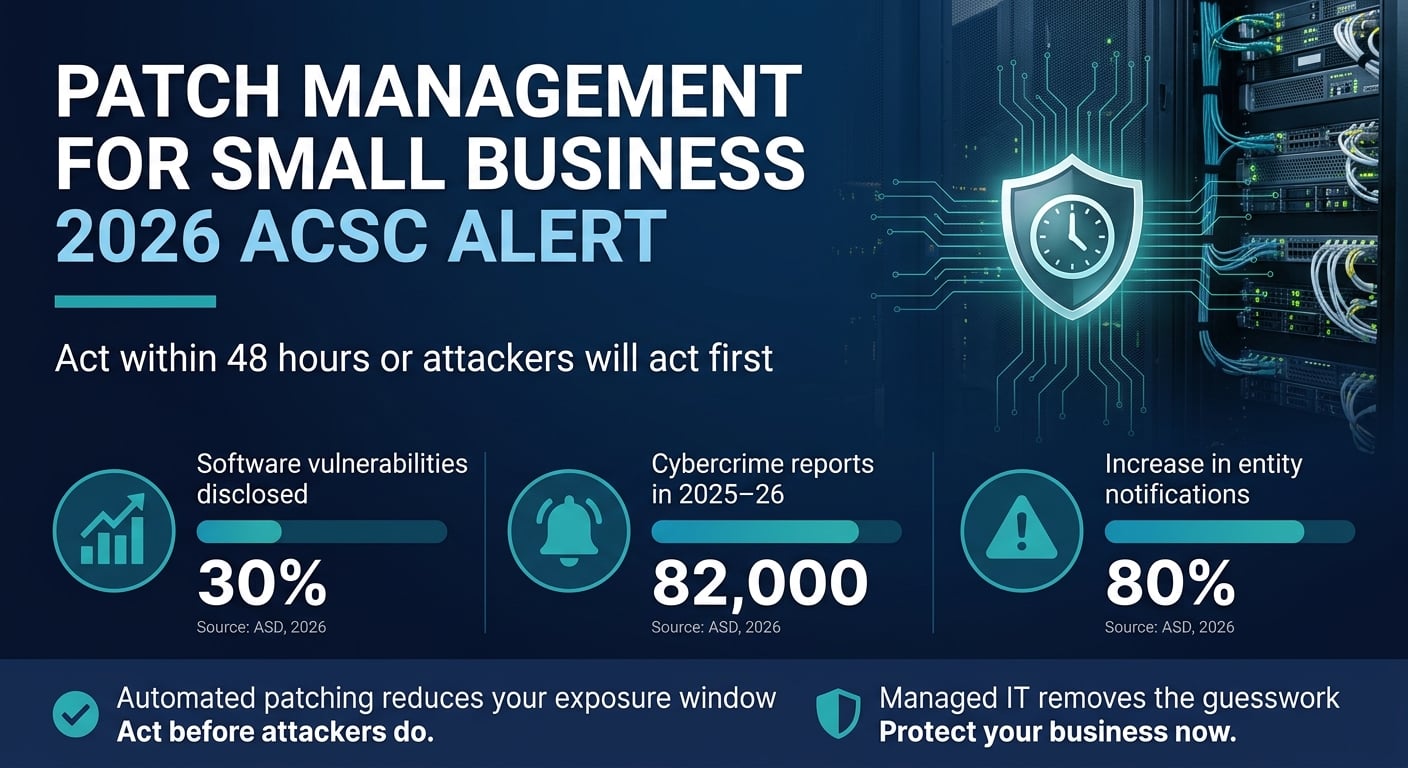
According to the Australian Signals Directorate, Annual Cyber Threat Report 2026, publicly reported software vulnerabilities rose by 30 per cent in the 2025, 26 financial year. That is a staggering volume of new attack surfaces opening up every single month. Each unpatched system represents a door left unlocked while attackers actively test handles across the internet.
The same report reveals the ACSC received more than 82,000 cybercrime reports in 2025, 26, averaging one every six minutes. The scale of activity targeting Australian organisations is extraordinary. Many SMBs assume they are too small to be targeted. In reality, automated scanning tools mean attackers do not discriminate by business size. They simply exploit whatever systems are exposed and unpatched. For more context on the growing threat landscape, the ASD Annual Cyber Threat Report 2026 is essential reading for any Australian business owner.
What the ASD Cyber Threat Report 2025, 26 Reveals About Vulnerability Exploitation
The numbers in the ASD’s latest threat report paint a confronting picture. The ACSC issued over 4,400 notifications to Australian entities about potentially malicious cyber activity in 2025, 26. That figure represents an almost 80 per cent increase on the prior year, according to the Australian Signals Directorate, ASD Cyber Threat Report 2026. The acceleration is not subtle. Threat actors are moving faster, casting wider nets, and capitalising on the gap between patch release and patch deployment.
The ASD Essential Eight compliance framework explicitly lists “patch applications” and “patch operating systems” as two of its eight foundational controls. Organisations operating at Maturity Level One are expected to patch internet-facing services within two weeks of release. The ACSC’s new 48-hour warning effectively raises the bar well beyond that baseline for high-risk systems. If your business has not reviewed its patch posture against the ASD Essentials Framework recently, our guide on ASD Essentials Framework changes for SMBs provides critical context.
Unpatched software vulnerability exploitation is also closely linked to zero-day attacks. When a vulnerability becomes publicly known but a patch has not yet been applied, it effectively functions as a zero-day for that organisation. Our post on zero-day exploits for small business explores nine critical blindspots that many SMBs are unaware of heading into 2026.
Step 1: Build a Real-Time Asset and Software Inventory
You cannot patch what you do not know exists. The first step in effective patch management for small business is establishing a complete, real-time inventory of every device, operating system, and software application in your environment. This includes workstations, servers, network devices, cloud workloads, and remote employee endpoints.
Many SMBs in the Hunter Region and Central Coast are operating with shadow IT: applications installed by staff without IT oversight. These create hidden vulnerabilities. A proper asset inventory tool, ideally integrated with your managed IT platform, will surface every installed application and flag those with outstanding security updates. Without this visibility, your organisation is making patching decisions based on incomplete information. This is one of the core gaps outlined in our coverage of vulnerability management blind spots for Australian SMBs.
Step 2: Enable Automatic Updates and Verify They Are Actually Working
The ACSC’s Critical Alert specifically urges organisations to enable automatic updates where appropriate. For most SMBs, this is the single highest-impact action available. Automated patch deployment removes the dependency on manual intervention, dramatically reducing the window between patch release and patch application.
However, enabling automatic updates is not enough on its own. Many businesses assume updates are applying successfully when they are not. Update processes fail silently for a variety of reasons: low disk space, conflicting software, devices that are off during scheduled maintenance windows, or group policy misconfigurations. Verification is essential. Your IT team or managed provider should be generating regular patch compliance reports confirming that updates have been applied successfully across every endpoint. For Microsoft 365 environments, our article on Microsoft 365 changes Australian SMBs must act on highlights related update and security obligations.
Step 3: Prioritise Internet-Facing and Critical Business Systems First
Not all systems carry the same risk. The ACSC alert specifically identifies internet-exposed systems as the highest priority for immediate patching. These include public-facing web applications, remote desktop services, virtual private network (VPN) gateways, email servers, and any cloud-hosted services with direct internet exposure.
The NIST Cybersecurity Framework recommends a risk-tiered approach to vulnerability remediation. Apply this logic to your patch queue: assess which systems, if compromised, would cause the greatest operational or data impact. Those systems should receive patches within hours of release, not days. For most Newcastle and Sydney SMBs, this means your firewall firmware, remote access tools, and business-critical applications take absolute priority.
Step 4: Test Patches in a Staged Environment Before Full Deployment
Speed is now essential, but speed without testing can cause its own operational damage. A patch that breaks a critical line-of-business application can halt productivity just as effectively as a cyberattack. The solution is a staged or ring-based deployment approach, where patches are applied to a small group of test systems first before being rolled out organisation-wide.
For most SMBs, a simple two-stage process works well: apply the patch to two or three non-critical endpoints first, monitor for 24 hours, then proceed with full deployment. Given the ACSC’s 48-hour warning, the testing window must be tight. If a patch addresses a critical internet-facing vulnerability, the risk calculation may justify bypassing the test phase entirely for that specific update. Document every decision for compliance and audit purposes.
Step 5: Document Every Patch Cycle for Compliance and Audit Readiness
Documentation is not just administrative housekeeping. Under Australia’s Privacy Act 1988 and emerging obligations under the Security of Critical Infrastructure (SOCI) Act, organisations must demonstrate reasonable steps to protect personal information and systems. A well-maintained patch log provides critical evidence in the event of a breach investigation or regulatory enquiry.
Your patch records should capture: the vulnerability or Common Vulnerabilities and Exposures (CVE) reference, the patch release date, the date your organisation applied the patch, the systems covered, and the name of the person or system responsible. The Office of the Australian Information Commissioner has consistently noted that demonstrable security controls, including timely patching, are a factor in assessing whether organisations have met their obligations following a notifiable data breach.
If your business has experienced issues with lost or stolen devices, patch documentation also complements your broader data protection posture. Our article on stolen device data protection gaps for SMBs outlines five areas where businesses commonly fall short.
Step 6: Partner With a Managed IT Provider to Close the Gap in Patch Management for Small Business
The honest reality is that effective patch management for small business requires dedicated tooling, continuous monitoring, and skilled IT personnel. Most SMBs do not have the internal resources to meet the ACSC’s new 48-hour standard on their own. This is where an IT security update service delivered by a managed IT provider becomes strategically critical.
A managed IT provider operating across managed IT Newcastle and broader Australian regions can deploy enterprise-grade patch management platforms that automate discovery, testing, deployment, and reporting. They monitor vendor security bulletins continuously, receive alerts the moment a critical patch is released, and can begin automated deployment within hours. This is the only realistic way for most SMBs to operate within the 48-hour window the ACSC now considers the minimum acceptable standard.
The risks of cyber fatigue and under-resourced IT teams are real barriers to consistent patching. If your team is showing signs of falling behind on security hygiene, our post on cyber fatigue warning signs for SMBs identifies seven indicators that your security programme may be stretched too thin. Additionally, understanding the full value of outsourcing IT support for small business can help business owners make a more informed decision about where their internal team’s limits lie.
“Organisations must prepare for more frequent security updates and shorter timeframes to act.”, ACSC Critical Alert, 17 November 2026

Act Now: What Australian SMBs Must Do This Week
Effective patch management for small business is no longer a quarterly IT task. The ACSC’s November 2026 Critical Alert has fundamentally reset expectations. With publicly reported vulnerabilities up 30 per cent and attackers exploiting weaknesses within 48 hours of patch release, every day of delay increases your exposure. The six steps outlined above provide a structured, achievable roadmap: inventory your assets, verify automatic updates, prioritise internet-facing systems, test in stages, document everything, and engage a managed IT provider to deliver the speed and consistency your business requires.
Businesses across Newcastle, Lake Macquarie, and the broader Hunter Region cannot afford to treat this as background noise. The ACSC’s alert is a direct call to action for every Australian organisation. If you are unsure whether your current patch posture meets the standard, now is the time to find out. Contact Adept IT Solutions to speak with a specialist about how we can help your business close the patching gap before attackers find it first.
Further reading: Verizon Data Breach Investigations Report.
Frequently Asked Questions
Q: How quickly do I need to apply patches after the ACSC’s 48-hour alert?
A: For internet-facing and critical business systems, the ACSC now recommends organisations aim to apply patches within 48 hours of release. For lower-risk internal systems, a 48-to-72-hour window may be acceptable, but the standard has shifted significantly upward. Effective patch management for small business now requires near-real-time monitoring of vendor security bulletins and an automated deployment capability to meet these timeframes consistently.
Q: What is automated patch deployment and do SMBs really need it?
A: Automated patch deployment refers to software-driven systems that discover, schedule, and apply security updates across all endpoints without requiring manual intervention for each device. For SMBs, it is now essential rather than optional. Given the ACSC’s warning that exploitation can occur within 48 hours, manual patching processes simply cannot operate at the required speed. A managed IT provider can deploy and manage these systems on your behalf, ensuring ASD Essential Eight compliance and consistent coverage.
Q: Does applying patches risk breaking my business applications?
A: There is always a small risk that a patch may conflict with existing software configurations. However, the risk of leaving an unpatched software vulnerability exposed to active exploitation far outweighs the risk of a temporary application issue. A staged deployment approach, where patches are applied to a small group of test devices before full rollout, significantly mitigates this risk. Your managed IT provider should handle both the testing phase and rapid rollback procedures if issues arise.
Q: How does patch management for small business relate to the ASD Essential Eight?
A: The ASD Essential Eight framework includes “patch applications” and “patch operating systems” as two of its eight core mitigation strategies. Achieving Maturity Level Two requires patching internet-facing services within two weeks and other systems within one month. With the ACSC’s new 48-hour standard, businesses should treat the Essential Eight timelines as a minimum baseline and aim to exceed them for high-risk systems. Partnering with a managed IT provider delivering a dedicated IT security update service is the most reliable path to consistent compliance.
Get in touch with our team of IT experts today! You can contact us via phone at 1300 423 378 or email us at info@adept-it.com.au.

