
Understanding password manager security risks has never been more urgent for Australian small and medium-sized businesses (SMBs) than it is right now. On 25 November 2026, Cybersecurity News, 1Password Breach Report confirmed that an attacker compromised a corporate GitHub account belonging to a 1Password employee and used that foothold to steal customer data from the company’s backend systems. 1Password is one of the most widely used enterprise password managers globally, and the breach is a direct warning for every Australian business that relies on a centralised credential store to protect access to cloud services, financial platforms, and business-critical systems.
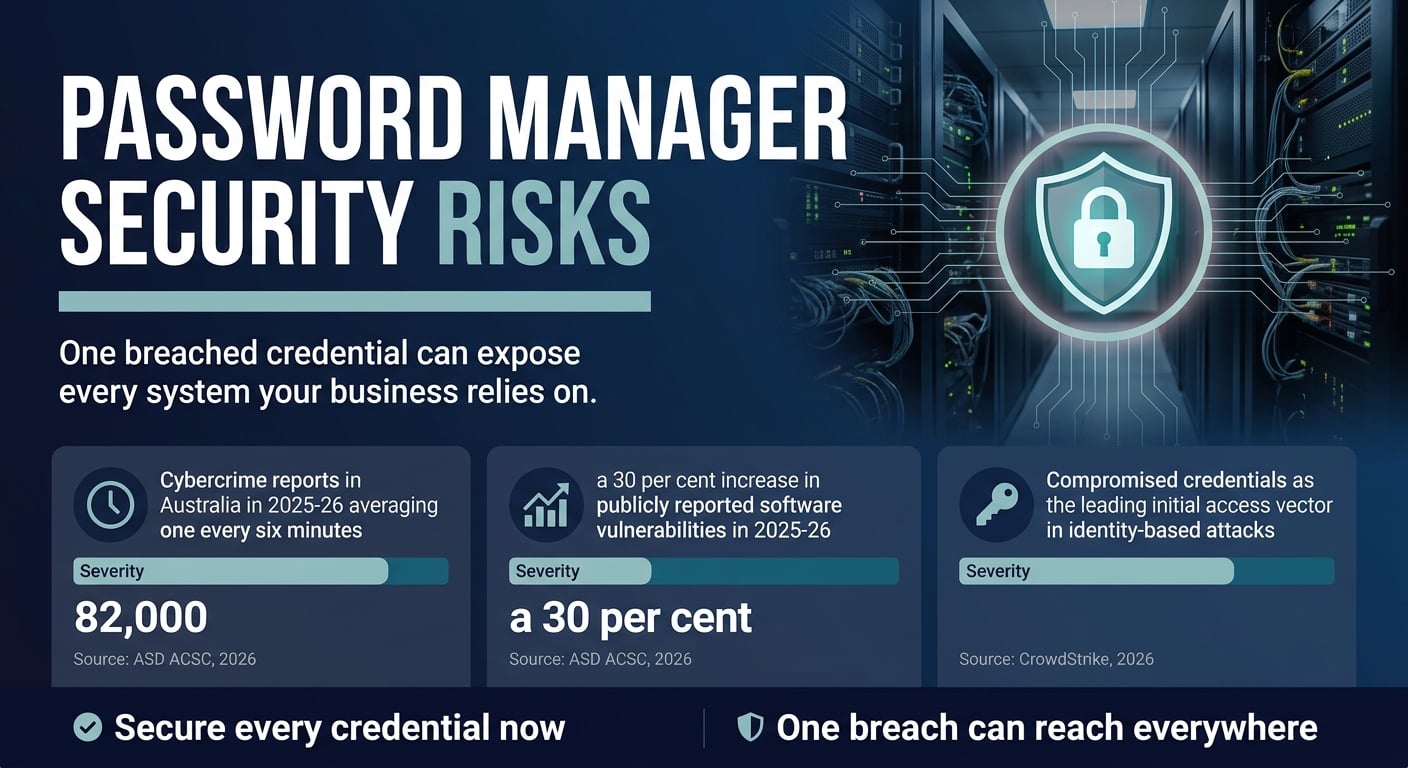
The scale of Australia’s cyber threat environment makes this event particularly significant. According to the Australian Signals Directorate, ACSC Annual Cyber Threat Report 2025-26, 2026, more than 82,000 cybercrime reports were recorded in Australia during 2025, 26, averaging one every six minutes. For Newcastle, Hunter Region, Central Coast, and Sydney businesses managing credentials through cloud-based tools, this breach is not a distant headline. It is an immediate operational risk.

Why the 1Password Breach Is a Direct Wake-Up Call for Australian SMBs
The 1Password incident illustrates how a single compromised developer credential can cascade into a large-scale customer data exposure. The attacker accessed a corporate GitHub account, not the production vault system itself, yet still reached backend customer data. This is the defining characteristic of modern supply chain and insider-access attacks: the attacker does not need to defeat every security layer, only the weakest one.
For Australian SMBs using 1Password to manage credentials across Microsoft 365, cloud accounting platforms, and customer relationship management systems, the concern is immediate. Stolen customer data could include vault metadata or access tokens that provide a pathway into those connected business systems. The full scope of the breach was still emerging at the time of reporting, which itself represents a risk: businesses may not know what data was accessed for days or weeks.
Our post on third-party platform breach risks outlines how vendor-side incidents translate directly into SMB exposure, and the 1Password event follows the same pattern precisely.
How a Single Developer Credential Unlocked Customer Data at Scale
The attack vector in this breach was a corporate GitHub account, a development environment tool. This highlights a persistent and underappreciated gap in enterprise security: developer and administrative accounts frequently hold elevated permissions but are not subject to the same access controls as production systems. A developer account with repository access can expose build pipelines, infrastructure configurations, and application secrets.
The CrowdStrike Global Threat Report 2026 confirms that identity-based attacks remain among the most prevalent intrusion techniques, with compromised credentials a leading initial access vector across reported incidents. The 1Password case is a textbook example of this pattern at an enterprise scale.
Australian businesses should also consider the velocity at which attackers move once credentials are obtained. Publicly reported software vulnerabilities increased by 30 per cent during the 2025, 26 financial year, with malicious actors exploiting flaws within 48 hours of disclosure, according to the Australian Signals Directorate – ACSC Critical Alert, November 2026. Credential theft operates on an even shorter timeline.
The 9 Password Manager Security Risks Your Business Cannot Afford to Ignore
The 1Password breach crystallises nine specific password manager security risks that every Australian SMB must evaluate today. Each risk is distinct. Each deserves individual attention.
Risk 1: Vendor-Side Credential Compromise
When the password manager vendor itself is breached, your credentials may be at risk even if your own environment is entirely secure. No amount of internal security hardening protects against a vendor whose employee account is compromised. Businesses must assess vendor security posture as part of their vendor cyber risk assessment process, not just at onboarding but continuously.
Risk 2: Access Token Exposure
Password managers frequently store more than passwords. They store application programming interface (API) keys, OAuth tokens, and session tokens used to authenticate cloud services. If an attacker reaches vault metadata, those tokens may be harvested and used to access Microsoft 365, cloud accounting software, or customer data platforms without triggering a password-based login alert.
Risk 3: Single Point of Failure Architecture
Centralising all business credentials in one platform creates a single point of failure. If that platform is breached, every credential stored within it is potentially compromised simultaneously. This is fundamentally different from a scenario where one employee’s credentials are phished. The blast radius of a password manager breach extends across every system, every account, and every user in the organisation.
Risk 4: Insufficient Multi-Factor Authentication on Vault Access
Multi-factor authentication (MFA) on the password manager itself is frequently overlooked. Many SMBs enforce MFA on their primary applications but do not apply the same rigour to the credential store that protects all those applications. If the master account is accessible with a password alone, it represents a critical exposure point regardless of which password manager is in use.
Risk 5: Shared Vault Access Without Role-Based Controls
In many SMB environments, entire teams share access to a single vault containing all business credentials. Without role-based access controls (RBAC), a compromised account belonging to any team member provides full access to every credential in the shared vault. The principle of least privilege, a core requirement under the ASD Essentials Framework, must be applied to credential stores as rigorously as to any other system.
Risk 6: No Breach Notification Monitoring
The 1Password breach was disclosed a full day after the incident was confirmed internally. Many SMBs have no mechanism for receiving and acting on vendor security notifications rapidly. Without active monitoring for vendor breach disclosures, businesses may continue operating with compromised credentials for days after an incident occurs, dramatically widening their exposure window.
Risk 7: Developer and Administrative Account Sprawl
As the 1Password breach demonstrates, developer and administrative accounts often hold permissions that far exceed what is needed for day-to-day operations. Account sprawl occurs when these elevated accounts accumulate over time without regular audits or deprovisioning. Businesses that have never audited which accounts have access to their password manager administration console are carrying significant unquantified risk. This connects directly to the server misconfiguration risks that follow from ungoverned administrative access.
Risk 8: Weak Master Password Policies
The irony of a password manager secured by a weak master password is not lost on cybersecurity professionals. Yet many SMBs allow employees to self-select master passwords without enforcing complexity, length, or rotation requirements. If an attacker gains vault access through a vendor-side breach and also captures master password hashes, weak passwords can be cracked rapidly using modern hardware.
Risk 9: No Credential Rotation Plan After a Vendor Breach
When a password manager vendor confirms a breach, businesses need an immediate credential rotation plan. Without documented procedures, teams scramble to identify which credentials were potentially exposed, in which systems, and in what order to rotate them. This is a business continuity and patch management issue as much as a security one, and most SMBs have no tested plan for this scenario.
Are Your Cloud Service Access Tokens at Risk Right Now?
One of the most concerning aspects of the 1Password breach is the potential exposure of access tokens stored within customer vaults. Access tokens are the digital keys that allow applications to communicate with cloud services without requiring a user to log in repeatedly. If an attacker captures a valid access token for a Microsoft 365 environment or a cloud accounting platform, they can operate within that environment with full user permissions until the token is revoked.
Token-based attacks are particularly dangerous because they typically bypass MFA entirely. The authentication event already occurred when the token was issued, so the attacker presents a valid credential that the system recognises as legitimate. For businesses across Newcastle, the Hunter Region, and the Central Coast relying on Microsoft 365, this represents an urgent review point. Our post on Microsoft 365 changes for Australian SMBs covers token security controls in detail.
The NIST Cybersecurity Framework recommends continuous monitoring of authentication events and token issuance as a core identity and access management control. Australian businesses that have not implemented conditional access policies with token lifetime restrictions should treat this as a priority action following the 1Password disclosure.
Reducing Password Manager Security Risks Through Layered Controls
Addressing password manager security risks effectively requires a layered approach rather than a single technical fix. Businesses should start by auditing which accounts have administrative access to their password manager platform, then apply MFA universally across all vault access points. Role-based vault segmentation should follow, ensuring that no single account holds keys to every credential in the organisation.
Beyond technical controls, businesses need a documented credential rotation procedure that can be executed within hours of a vendor breach notification. This procedure should identify mission-critical credentials, the systems they protect, and the personnel responsible for rotating each one. Without this, the 48-hour exploitation window identified by the Australian Signals Directorate (ASD) becomes a liability rather than a planning benchmark.
The Office of the Australian Information Commissioner – Notifiable Data Breaches scheme also creates legal obligations for businesses that experience or are affected by credential breaches. If a vendor breach results in the exposure of customer personal information held in your systems, your organisation may carry notification obligations under the Privacy Act 1988. Understanding this exposure now, before an incident occurs, is essential.
How Adept IT Solutions Helps Newcastle and Hunter Region Businesses Secure Their Credentials
Adept IT Solutions works with businesses across Newcastle, Lake Macquarie, the Hunter Region, the Central Coast, and Sydney to implement credential security frameworks that account for exactly these kinds of vendor-side risks. Our managed IT and cybersecurity services include identity and access management (IAM) reviews, MFA deployment, conditional access policy configuration in Microsoft 365, and vendor security assessments.
We also assist businesses with Essential Eight compliance, which directly addresses credential security through its patching, MFA, and privileged access management controls. If your business uses an enterprise password manager and has not recently reviewed the security controls around it, the 1Password breach is the signal to act. For further context on the broader threat landscape, our post on Joint Cyber Command Centre NSW actions for SMBs outlines the current government response to credential-based threats in Australia.
“A password manager is only as secure as the weakest point in the vendor’s own environment. The 1Password breach is a reminder that business credential security must extend to every third party in the credential management chain.”

What This Means for Your Business Today
The nine password manager security risks outlined above are not theoretical. The 1Password breach has demonstrated that even the most trusted credential management platforms carry inherent vendor-side risk. For Australian SMBs, the immediate priorities are clear: audit vault access, enforce MFA universally, segment credentials by role, and prepare a credential rotation plan before it is needed under pressure.
Businesses that take these steps now will be in a significantly stronger position than those that wait for the next breach notification. For guidance on building a layered credential security posture that addresses these risks comprehensively, contact Adept IT Solutions today to speak with one of our managed IT cybersecurity specialists across Newcastle, the Hunter Region, and Sydney.
Frequently Asked Questions
Q: What are the main password manager security risks exposed by the 1Password breach?
A: The 1Password breach highlights nine key password manager security risks: vendor-side credential compromise, access token exposure, single point of failure architecture, insufficient MFA on vault access, shared vaults without role-based controls, no breach notification monitoring, developer account sprawl, weak master password policies, and the absence of a credential rotation plan. Each of these risks can be mitigated through layered technical and procedural controls, ideally implemented with the support of a managed IT provider.
Q: Does my Australian business have legal obligations if a password manager vendor is breached?
A: Potentially yes. Under Australia’s Privacy Act 1988 and the Notifiable Data Breaches scheme administered by the Office of the Australian Information Commissioner (OAIC), if a vendor breach results in the exposure of personal information your business holds or processes, you may have notification obligations. The key test is whether the breach is likely to result in serious harm to any affected individuals. Legal advice and an immediate incident assessment are recommended as soon as a vendor breach is confirmed.
Q: How quickly should a business rotate credentials after a password manager breach?
A: Based on the 48-hour exploitation window identified by the Australian Signals Directorate, credential rotation for mission-critical systems should begin within hours of a vendor breach confirmation, not days. Businesses should prioritise credentials that provide access to financial platforms, cloud environments, and customer data systems first. A pre-documented credential rotation procedure with assigned responsibilities is the only reliable way to achieve this speed under pressure.
Q: Can an enterprise password manager still be safe to use after this breach?
A: Yes, enterprise password managers remain a valuable security tool when implemented correctly. The business credential security risk is not the platform itself but the absence of layered controls around it. Enforcing MFA on all vault access, applying role-based vault segmentation, regularly auditing administrative accounts, and monitoring for vendor breach notifications are all practices that significantly reduce your exposure. A managed IT provider experienced in Essential Eight compliance can help your business implement these controls effectively.
Get in touch with our team of IT experts today! You can contact us via phone at 1300 423 378 or email us at info@adept-it.com.au.

