
The Cisco Expressway vulnerability CVE-2026-76466 is being actively exploited right now, and Australian small and medium businesses (SMBs) using this platform for remote access face immediate, serious risk. On 20 November 2026, the United States Cybersecurity and Infrastructure Security Agency (CISA) added this critical flaw to its Known Exploited Vulnerabilities catalogue after confirming active exploitation in the wild. With a federal patch deadline set for 23 November 2026, this is not a theoretical threat sitting on a future risk register. It is happening today. For businesses across Newcastle, the Hunter Region, Central Coast, and Sydney, understanding exactly what is at stake is the first step toward protecting your network.

What Is the Cisco Expressway Vulnerability CVE-2026-76466?
Cisco Expressway is a widely deployed platform used by Australian businesses to enable secure remote collaboration, video conferencing, and virtual private network (VPN)-style access to corporate networks. Its reach across enterprises and mid-market organisations makes it a high-value target for threat actors seeking to exploit a single vulnerability across thousands of networks simultaneously.
CVE-2026-76466 is a critical operating system command injection flaw that allows a remote attacker to execute commands with root privileges on the affected device. In plain terms, an unauthenticated attacker on the internet can gain complete, unrestricted control of the system. No password is required. No physical access is needed. The attacker simply needs to reach the device over a network connection.
According to SecurityWeek, November 2026, CISA confirmed active exploitation in the wild, meaning real attackers are leveraging this flaw against real organisations right now. For any Australian SMB still running an unpatched Cisco Expressway instance, the exposure window is not days. It is hours.
Why Active Exploitation Makes This an Immediate SMB Threat
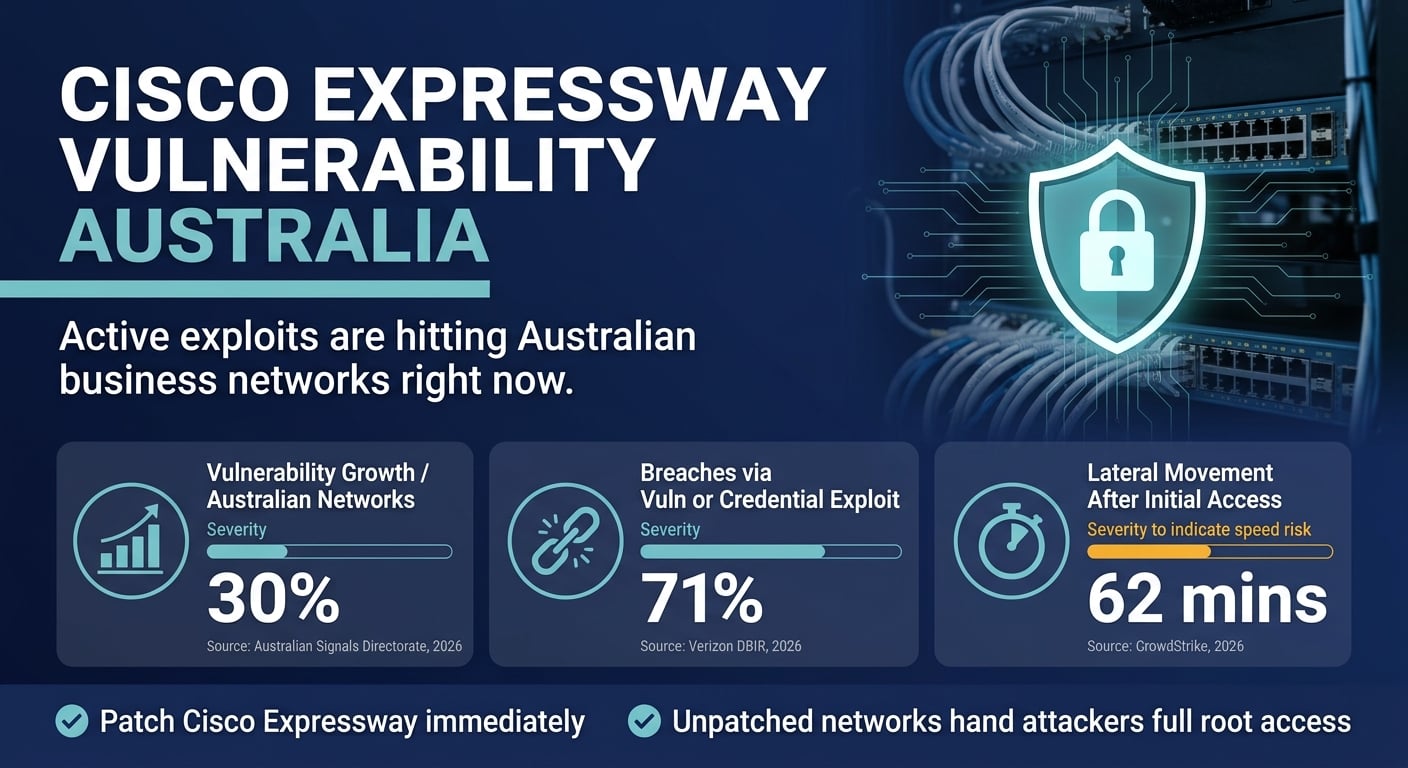
When CISA adds a vulnerability to its Known Exploited Vulnerabilities catalogue, it signals that exploitation is confirmed and widespread, not speculative. The speed at which attackers move after gaining initial access compounds the urgency dramatically. According to the CrowdStrike Global Threat Report 2026, the mean time for adversaries to move laterally after initial access dropped to under 62 minutes in 2025-26.
That figure should alarm every IT decision-maker in the Hunter Region and beyond. Within an hour of breaching your Cisco Expressway device, a threat actor can reach your file servers, your cloud credentials, and your customer data. Waiting for a scheduled maintenance window to apply a patch is not an acceptable response when attackers are operating on a one-hour clock.
The broader context reinforces how significant this moment is. The Australian Signals Directorate Annual Cyber Threat Report 2026 confirmed that publicly reported vulnerabilities rose by 30 per cent in the 2025-26 financial year across Australian networks. This Cisco Expressway vulnerability arrives at a moment when the attack surface is expanding faster than many SMBs can manage. For further context on how patch management failures become entry points, see our earlier analysis on patch management for small business.
Hard-Coded Credentials: The Hidden Second Flaw in Cisco Expressway
Alongside CVE-2026-76466, a separate disclosure revealed the presence of hard-coded credentials embedded within Cisco Expressway. This is a fundamentally different class of vulnerability. Unlike a software bug that can be patched with a firmware update, hard-coded credentials represent a design decision that bakes authentication bypass directly into the product.
Attackers who discover these credentials can use them to authenticate to the device without needing to brute-force a password or steal user tokens. Once authenticated, they can reach internal network segments that would otherwise be inaccessible from the internet. This is precisely the kind of initial access vector that enables the rapid lateral movement described above.
The Verizon Data Breach Investigations Report 2026 found that 71 per cent of breaches involved exploitation of vulnerabilities or stolen credentials as the initial access vector. Hard-coded credentials satisfy both conditions simultaneously, making them extraordinarily dangerous. SMBs that use Cisco Expressway for remote access should treat the hard-coded credential disclosure as a separate, urgent remediation task, not a footnote to the CVE-2026-76466 patch.
9 Critical Risks Australian SMBs Face From This Vulnerability
Risk 1: Complete Remote Takeover of Network Infrastructure
Root-level command execution means an attacker gains the highest possible level of system access. From this position, they can reconfigure routing, disable security controls, install persistent backdoors, and modify logging settings to erase evidence of intrusion. For SMBs in Newcastle and the broader Hunter Region, a full device takeover effectively places your entire network under hostile control.
Risk 2: Ransomware Deployment Across Your Entire Network
Once an attacker controls your Cisco Expressway device and pivots into your internal network, ransomware deployment becomes a straightforward next step. Threat actors frequently use compromised network edge devices as staging points to push ransomware payloads to every connected workstation and server simultaneously. The resulting encryption of business-critical data can halt operations entirely. For more on how zero-day exploits become ransomware launchpads, read our guide on zero-day exploits for small business.
Risk 3: Exfiltration of Customer and Employee Personal Data
Attackers with root access to your network devices can intercept and exfiltrate data traversing those systems. For Australian businesses subject to the Privacy Act 1988, a data breach involving customer or employee personal information triggers mandatory notification obligations under the Notifiable Data Breaches scheme. The reputational and financial consequences can far exceed the cost of emergency patching.
Risk 4: Credential Theft Enabling Persistent Access
With control over a network access device, attackers can intercept authentication tokens and credentials passed through it. Stolen credentials allow threat actors to maintain persistent access to your environment long after the initial exploit is detected and patched. This is a particularly dangerous scenario because businesses often believe they are safe after applying the patch, unaware that credential theft has already occurred. Our post on password manager security risks covers how to minimise credential exposure.
Risk 5: Lateral Movement to Cloud and Microsoft 365 Environments
Cisco Expressway sits at the boundary between the internet and internal resources, often bridging on-premises infrastructure with cloud platforms. An attacker who compromises it can pivot into connected Microsoft 365 tenants, Azure subscriptions, and cloud-hosted business applications. Network security in Newcastle and across Australia increasingly depends on protecting these cloud-to-premises integration points, not just the cloud environments themselves.
Risk 6: Disruption to VoIP and Unified Communications
Cisco Expressway is commonly integrated with unified communications platforms including Voice over Internet Protocol (VoIP) systems and video conferencing infrastructure. A compromised Expressway device can be used to intercept calls, redirect communications, or disable voice services entirely. For businesses that depend on VoIP for customer-facing operations, this represents both a security and a business continuity risk. Our analysis of VoIP security risks for Australian SMBs explores these threats in detail.
Risk 7: Supply Chain and Third-Party Network Compromise
SMBs that provide remote access to suppliers, contractors, or managed service partners through Cisco Expressway may inadvertently expose those third parties to compromise, or be used as a pivot point to attack them. This creates liability beyond your own organisation and can damage critical business relationships. Understanding your vendor cyber risk assessment obligations is essential in this context.
Risk 8: Compliance Failures Under the Essential Eight and ISO 27001
Failure to patch a known, actively exploited critical vulnerability within an appropriate timeframe constitutes a direct breach of the Australian Signals Directorate (ASD) Essential Eight Maturity Model, specifically the patch applications and patch operating systems controls. Organisations pursuing or maintaining ISO 27001 certification also face audit findings for delayed remediation of critical vulnerabilities. The compliance consequences can affect contracts, insurance, and regulatory standing. Our coverage of the ASD Essentials Framework changes provides further context on current patching obligations.
Risk 9: Reputational Damage and Loss of Customer Trust
Beyond the technical and regulatory consequences, a breach stemming from an unpatched, publicly known vulnerability carries significant reputational weight. Customers, partners, and procurement teams increasingly scrutinise the security posture of businesses they engage with. Being identified as a business that failed to act on a critical CVE after active exploitation was confirmed publicly is a difficult position from which to recover client confidence.
How to Assess Whether Your Network Is Exposed Right Now
The first step is straightforward: determine whether Cisco Expressway is deployed anywhere in your environment. This includes on-premises appliances, virtualised instances, and any deployments managed by third-party service providers on your behalf. If you are unsure, your IT team or managed IT provider should be able to identify all instances within hours using network scanning and asset inventory tools.
Once identified, check the firmware version against Cisco’s published advisory. If your version is affected, treat patching as an emergency change, bypassing standard change management timelines. The Australian Cyber Security Centre recommends that critical vulnerabilities with confirmed active exploitation be remediated within 48 hours wherever technically feasible. As a parallel action, review firewall rules to restrict access to Expressway management interfaces from untrusted networks, and audit logs for indicators of compromise dating back at least 30 days.
If your business lacks the internal expertise to conduct this assessment and remediation at speed, engaging a managed IT provider with cybersecurity capability is the fastest path to reducing your exposure. The Joint Cyber Command Centre NSW SMB actions outlined recently reinforce the importance of having external support ready to mobilise during exactly these kinds of critical CVE events.
How Adept IT Solutions Helps Newcastle and Hunter Region Businesses Stay Protected
Adept IT Solutions provides managed IT and cybersecurity services to businesses across Newcastle, Lake Macquarie, the Hunter Region, Central Coast, and Sydney. Our team monitors threat intelligence feeds, including CISA’s Known Exploited Vulnerabilities catalogue, as a core component of our managed security service. When a critical remote access exploit like CVE-2026-76466 is confirmed active, we initiate emergency assessment and remediation processes for all affected clients without waiting to be asked.
Our approach combines proactive network security monitoring, structured patch management for SMB environments, and compliance-aligned vulnerability management aligned to the ASD Essential Eight and ISO 27001. We understand that most SMBs do not have dedicated security operations resources, which is why rapid CVE remediation is built into our managed IT service, not offered as an expensive add-on. If your business relies on Cisco Expressway for remote access, now is the time to act.
“Active exploitation means attackers are not waiting for businesses to patch. Every hour an unpatched Cisco Expressway device remains internet-accessible is an hour in which a threat actor can gain root-level control of your corporate network. The question is not whether to act, but how quickly you can.”

What This Cisco Expressway Vulnerability Means for Your Business Going Forward
The Cisco Expressway vulnerability CVE-2026-76466 is a defining example of why reactive cybersecurity is no longer sufficient for Australian SMBs. By the time a vulnerability reaches the CISA Known Exploited Vulnerabilities catalogue with confirmed active exploitation, the window for a measured, unhurried response has already closed. The nine risks outlined above are not remote possibilities. They are the documented, real-world consequences that follow from delayed critical CVE remediation. For businesses across Newcastle, the Hunter Region, Central Coast, and Sydney, the right response is immediate assessment, emergency patching, credential auditing, and engagement with a managed IT provider capable of supporting you through the process. Contact Adept IT Solutions today to protect your network before this vulnerability costs you more than a patch ever would.
Frequently Asked Questions
Q: What is the Cisco Expressway vulnerability CVE-2026-76466 and does it affect my Australian business?
A: CVE-2026-76466 is a critical remote code execution flaw in Cisco Expressway that allows an unauthenticated attacker to run operating system commands with root privileges over a network connection. If your business in Newcastle, the Hunter Region, Central Coast, or Sydney uses Cisco Expressway for remote access or unified communications, you are potentially affected. CISA confirmed active exploitation on 20 November 2026, meaning real attackers are targeting this vulnerability right now. You should identify all Cisco Expressway instances in your environment and apply the available patch immediately.
Q: How quickly do I need to patch this critical CVE for my SMB network security?
A: Immediately. The Australian Cyber Security Centre recommends critical vulnerabilities with confirmed active exploitation be remediated within 48 hours wherever technically feasible. The CrowdStrike Global Threat Report 2026 found that attackers move laterally within your network in under 62 minutes of gaining initial access. For patch management in SMB environments, this means treating CVE-2026-76466 as an emergency change, bypassing standard maintenance windows and applying the fix as your highest priority IT task right now.
Q: What are the hard-coded credentials in Cisco Expressway and why do they matter?
A: A separate disclosure alongside CVE-2026-76466 revealed that Cisco Expressway contains hard-coded credentials embedded in the software by design. Unlike a software bug, hard-coded credentials cannot simply be changed by an administrator because they are built into the product firmware. Attackers who obtain these credentials can authenticate to the device without any stolen passwords or brute-force attacks, then pivot into your internal network. Cisco’s vendor advisory should be consulted for specific remediation guidance relating to this separate issue, and your managed IT provider should audit all affected devices accordingly.
Q: Can a managed IT provider in the Hunter Region help me respond to this remote access exploit urgently?
A: Yes. A qualified managed IT provider with cybersecurity capability can conduct an emergency asset inventory to identify all Cisco Expressway instances, apply vendor patches, audit firewall rules to restrict management interface access, and review logs for indicators of compromise. Adept IT Solutions provides exactly this service to SMBs across Newcastle, Lake Macquarie, the Hunter Region, Central Coast, and Sydney. If you do not currently have managed IT support with active vulnerability monitoring, this critical CVE event is a clear signal that the time to engage external expertise is now.
Get in touch with our team of IT experts today! You can contact us via phone at 1300 423 378 or email us at info@adept-it.com.au.

