
Cyber fatigue is quietly eroding the security posture of small and medium-sized businesses (SMBs) across Australia, and most business owners do not realise it is happening until the damage is done. Unlike a sudden system failure or a dramatic data breach, cyber fatigue creeps in gradually. It is the product of too many alerts, too much compliance pressure, and not enough support, leaving employees desensitised to genuine threats. For businesses in Newcastle, the Hunter Region, the Central Coast, and Sydney, this is not a theoretical risk. It is a live and growing vulnerability that demands immediate attention.

What Is Cyber Fatigue and Why Australian SMBs Are Most Vulnerable
Cyber fatigue, sometimes called cybersecurity burnout, refers to the state of mental exhaustion that sets in when employees are exposed to relentless security alerts, training reminders, policy updates, and incident notifications. Over time, the natural response is disengagement. Staff begin clicking through warnings without reading them. Password resets get skipped. Multi-factor authentication (MFA) prompts get dismissed. The cumulative effect is a workforce that is technically operating inside a security framework but practically ignoring it.
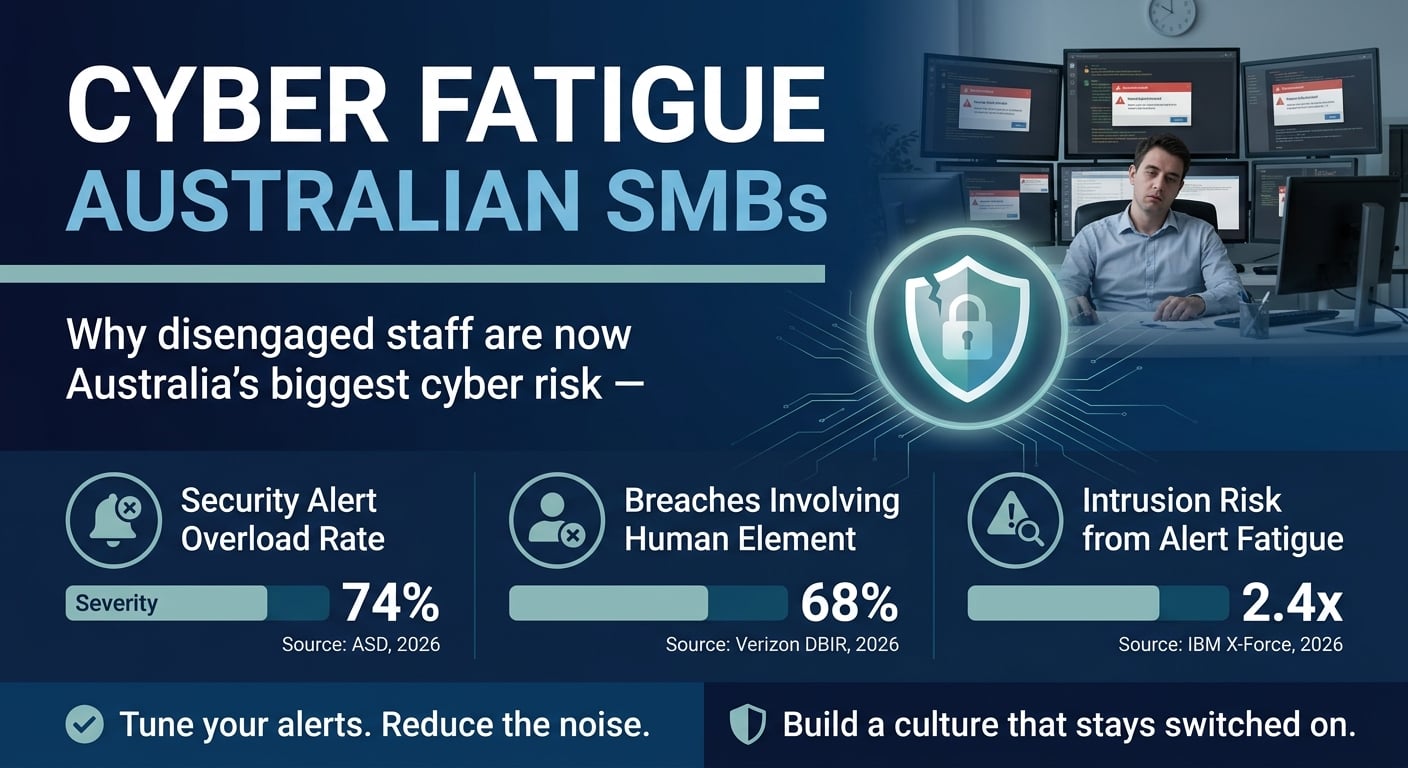
Australian SMBs are particularly exposed for several reasons. They typically lack the internal security operations resources of larger enterprises. Employees wear multiple hats, and security responsibilities are often layered on top of already demanding workloads. The ASD Annual Cyber Threat Report 2026 found that 74% of Australian organisations reported that security alert volumes had increased over the past 12 months, with staff frequently ignoring or delaying action on low-priority warnings. That pattern of avoidance is precisely how critical threats slip through.
Understanding the specific warning signs is the first step. Below are seven of the most common indicators that cyber fatigue has taken hold inside your business, along with practical guidance on how to address each one.
Warning Sign 1: Staff Are Clicking Through Security Prompts Without Reading Them
When employees encounter the same type of security prompt dozens of times a week, the brain learns to treat it as background noise. Browser certificate warnings, MFA push notifications, software update confirmations, and antivirus alerts all compete for limited attention. Eventually, most of them get dismissed with a single click. This is one of the clearest alert fatigue symptoms in any workplace.
The fix here is not more prompts. It is smarter prompting. Work with your managed IT provider to tune your security tooling so that only genuinely actionable alerts reach end users. Automated triage and contextual alerting reduce noise significantly without reducing protection. Pair that with brief, targeted communication that explains why a specific prompt matters, and compliance rates improve measurably.
Warning Sign 2: Your Helpdesk Is Logging Fewer Security Incidents, Not Fewer Threats
A drop in reported security incidents can look like progress. In many cases, it signals the opposite. When staff are fatigued, they stop reporting suspicious emails, unusual account behaviour, or unexpected access requests because the effort of raising a ticket feels disproportionate to what they expect will happen. The result is a silent backlog of unaddressed threats.
The Verizon Data Breach Investigations Report 2026 found that 68% of breaches involved a human element, with security-fatigued employees cited as a key contributing factor to errors and ignored warnings. If your helpdesk reporting volumes are declining while your business grows or threat levels rise, treat that gap as a red flag. Encourage a no-blame reporting culture and reduce the friction of lodging a security concern.
Warning Sign 3: Password Hygiene and MFA Compliance Are Quietly Slipping
Password reuse, weak credential choices, and MFA bypass requests are reliable indicators of a fatigued security culture. When staff find workarounds because the security process feels burdensome, it means the controls are not aligned with how people actually work. This is particularly common in SMBs across the Hunter Region where rapid growth has outpaced formal IT governance.
The solution is to make secure behaviour the path of least resistance. Deploy a business password manager, enforce phishing-resistant MFA using hardware keys or authenticator apps, and remove the need for employees to invent or remember complex passwords. If your team is bypassing security controls, the controls need redesigning, not the team. Our post on secure remote access mistakes outlines common credential vulnerabilities worth reviewing.
Warning Sign 4: Security Training Completion Rates Are Falling Year on Year
Annual security awareness training that takes the form of a 45-minute video module followed by a multiple-choice quiz was never especially effective. By 2026, it is actively counterproductive if it represents the entirety of your security culture programme. When completion rates drop, most businesses respond by sending more reminder emails. That approach compounds the fatigue rather than resolving it.
Research consistently supports short, frequent, role-relevant training delivered in context rather than in bulk. Simulated phishing exercises, micro-learning modules of three to five minutes, and scenario-based learning tied to real events keep engagement higher. For a detailed look at how Australian businesses commonly get this wrong, our guide on security awareness training mistakes is essential reading.
Warning Sign 5: Patch and Update Schedules Are Being Deferred Repeatedly
When patch management becomes a chore rather than a priority, deferred updates start stacking up. Employees hit “remind me later” on update prompts. IT teams deprioritise patching during busy periods. Before long, critical vulnerabilities sit unaddressed for weeks or months. This is a direct security posture decline with measurable consequences.
The IBM X-Force Threat Intelligence Report 2026 found that organisations with high alert-to-action ratios were 2.4 times more likely to experience a successful intrusion than those with tuned, low-noise security tooling. Automated patch management removes the human decision point entirely, which is exactly the right approach for fatigued teams. See our breakdown of common patch management mistakes Australian SMBs make for practical guidance.
Warning Sign 6: Security Policies Are Treated as Box-Ticking Exercises
When staff sign off on annual policy acknowledgements without reading them, or when managers approve compliance checklists because “we always do it this way,” your security policies have become theatre rather than practice. This is cybersecurity burnout at an organisational level. The policies exist on paper, but the behaviours they are meant to govern have drifted entirely.
Embedding security policy into everyday workflows rather than treating it as an annual documentation exercise is the sustainable fix. Regular policy reviews that involve staff in plain-language updates, combined with clear ownership and accountability structures, convert compliance from a chore into a shared standard. Businesses pursuing frameworks such as the ASD Essentials Framework will find this shift critical. Our post on the ASD Essentials Framework changes for SMBs provides context on the latest compliance requirements.
Warning Sign 7: Incident Response Plans Have Never Been Tested
Having an incident response plan stored in a shared drive is not the same as being prepared to execute it under pressure. If your plan has never been walked through, tabletop tested, or updated following a real incident or near-miss, it is effectively a document of intentions rather than a practical tool. Fatigued teams rarely find the time or motivation to run drills.
Scheduling a simple tabletop exercise once or twice a year does not require large resources. It does require leadership commitment. Engaging a managed IT provider to facilitate the exercise adds objectivity and surfaces gaps that internal teams often overlook. Consider also reviewing your backup and recovery posture. Our post on cloud backup compliance mistakes highlights related recovery gaps common across Australian SMBs.
How Cyber Fatigue Is Addressed by a Managed IT Provider in the Hunter Region
Reversing cyber fatigue requires structural change, not more reminders. A managed IT provider brings the external perspective and the technical capability to identify where your current security stack is generating unnecessary noise, where human processes are creating friction, and where automation can carry more of the load. This is the difference between telling your team to try harder and actually removing the barriers that make security feel impossible.
For businesses across Newcastle, the Central Coast, and Sydney, Adept IT Solutions provides managed security services that are specifically calibrated to SMB realities. That means alert tuning, automated patching, identity and access management, and ongoing security awareness programmes that do not overwhelm staff. The Australian Cyber Security Centre recommends a layered, risk-based approach to security, which aligns directly with how we structure managed security engagements. Our post on vulnerability management blind spots outlines how this plays out in practice.
It is also worth noting that zero-day threats continue to evolve in ways that exploit fatigued defenders. Our analysis of zero-day exploits affecting small businesses explains how disengaged teams create the exact entry points attackers look for. Addressing fatigue is not a soft issue. It is a hard security control.
“Security tools only work when the people using them are engaged. Fatigue is not a soft HR issue. It is a critical technical vulnerability that attackers actively exploit.”
Conclusion
Cyber fatigue is not a character flaw in your team. It is a predictable consequence of poorly designed security environments, excessive alert noise, and training programmes that do not respect how people actually work. The seven warning signs covered in this post range from dismissed prompts and declining training participation through to untested incident response plans and silently slipping MFA compliance. Each one is addressable with the right combination of automation, process redesign, and expert support.
For Australian SMBs operating in an increasingly hostile threat landscape, the cost of ignoring these signs is measured in breach costs, regulatory penalties, and reputational damage. The good news is that these are all preventable outcomes. If your business is ready to move from reactive security management to a proactive, sustainable posture, contact Adept IT Solutions today to arrange a no-obligation consultation with our managed IT team.
Frequently Asked Questions
Q: What are the most common alert fatigue symptoms in an SMB workplace?
A: The most common alert fatigue symptoms include employees dismissing security prompts without reading them, declining helpdesk incident reports despite a stable or growing threat environment, MFA bypass requests, deferred software updates, and disengaged participation in security training. These behaviours are early indicators that your security stack is generating more noise than your team can meaningfully process.
Q: How does cyber fatigue increase the risk of a data breach?
A: Cyber fatigue increases breach risk by causing employees to disengage from security controls. When staff stop reporting suspicious activity, approve prompts without reading them, or reuse passwords because a password manager feels like extra effort, they create exploitable gaps. The Verizon Data Breach Investigations Report 2026 identified the human element as a factor in 68% of breaches, with fatigue directly contributing to errors and ignored warnings.
Q: Can a managed IT provider in the Hunter Region help reduce cybersecurity burnout?
A: Yes. A managed IT provider reduces cybersecurity burnout by tuning security tooling to minimise unnecessary alerts, automating routine security tasks such as patching and backups, and delivering focused security awareness training that respects staff time. For businesses in Newcastle, the Hunter Region, the Central Coast, and Sydney, Adept IT Solutions provides managed security services specifically designed around SMB resource constraints.
Q: How often should Australian SMBs review their security posture for signs of staff cyber fatigue?
A: Australian SMBs should review their security posture and staff cyber awareness at least quarterly, with a full review annually. Tracking metrics such as training completion rates, MFA compliance, incident reporting volumes, and patch deferral rates provides ongoing visibility into whether fatigue is building. If any metric trends in the wrong direction for two consecutive quarters, that is a signal to engage external support before a breach occurs.
Get in touch with our team of IT experts today! You can contact us via phone at 1300 423 378 or email us at info@adept-it.com.au.

