
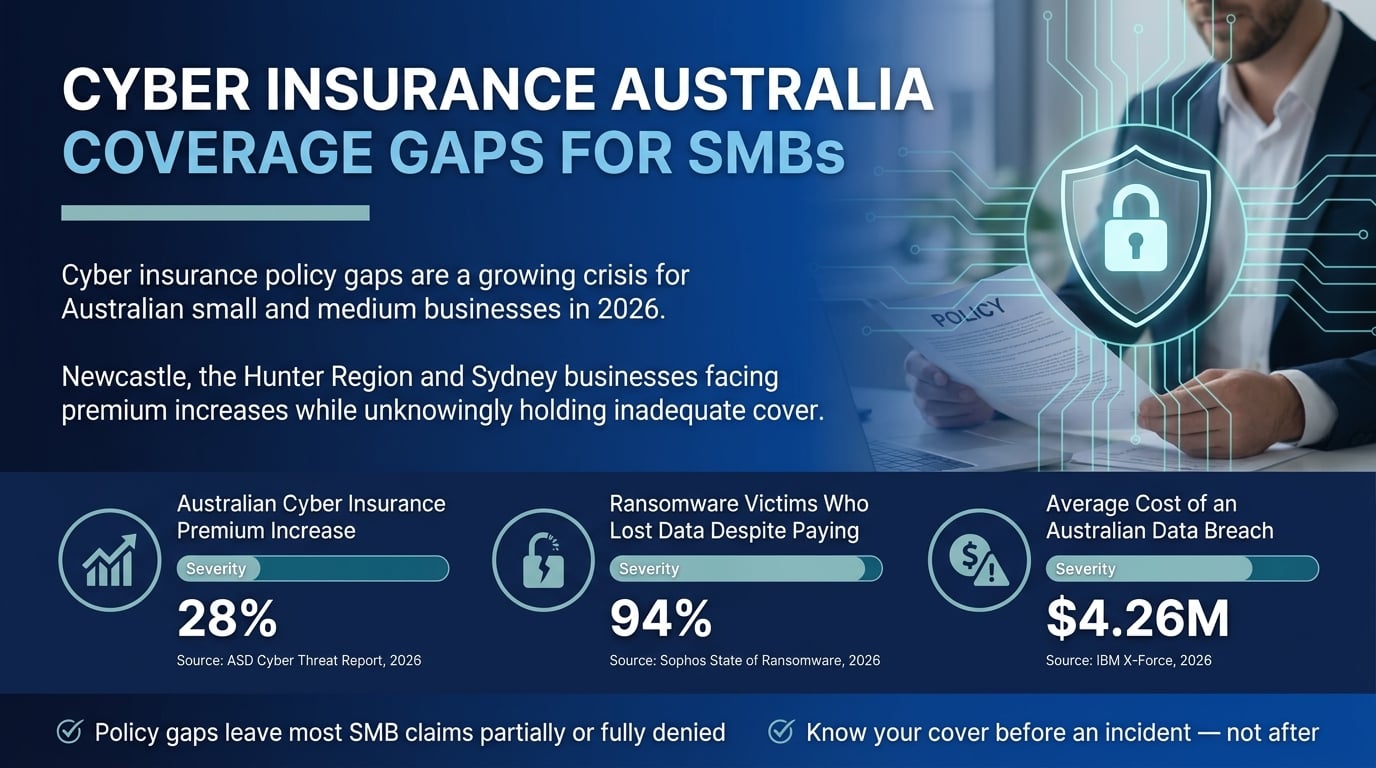
Cyber insurance Australia businesses rely on is failing them in ways most small and medium-sized businesses (SMBs) simply do not see coming. Policies that looked comprehensive at signing are riddled with exclusions, sub-limits, and warranty conditions that quietly eliminate coverage at the worst possible moment. With Australian cyber insurance premiums increasing by an average of 28% in the 2025-26 period as insurers tightened underwriting criteria following a surge in claims, according to the ASD Australian Cyber Threat Report, 2026, businesses across Newcastle, the Hunter Region, and the Central Coast are paying more and receiving less effective protection than they realise.
This post examines five of the most critical coverage gaps appearing in Australian cyber liability policies heading into 2026. Understanding these gaps is the first step toward closing them before a breach forces you to discover them the hard way.

What Is Cyber Insurance and Why Are Australian SMBs Getting It Wrong?
A cyber liability policy is designed to cover financial losses arising from data breaches, ransomware attacks, network disruptions, and related cyber incidents. In theory, it functions as a financial safety net when security controls fail. In practice, many Australian SMBs purchase a policy based on price or a broker’s summary and never read the policy wording closely enough to understand what is actually excluded.
The consequences of this approach are becoming increasingly costly. The average total cost of a data breach in Australia reached $4.26 million in 2026, with businesses holding inadequate cyber cover absorbing the majority of uninsured losses, according to the IBM X-Force Threat Intelligence Index, 2026. For an SMB in Sydney or Newcastle, absorbing even a fraction of that figure without adequate insurance support can be existential.
Business cyber risk management does not end with purchasing a policy. It requires actively auditing that policy against your current threat exposure, your security control posture, and your regulatory obligations. The five gaps below are the areas where Australian SMBs are most consistently falling short in 2026.
Coverage Gap 1: Social Engineering and Business Email Compromise Exclusions
Business Email Compromise (BEC) and social engineering fraud are among the most financially damaging cyber threats facing Australian SMBs today. Attackers impersonate executives or suppliers to trick employees into transferring funds or handing over credentials. The financial losses can be immediate and severe.
Despite this, many standard cyber liability policies explicitly exclude losses arising from social engineering unless a specific endorsement is purchased. Insurers argue that these events involve a voluntary act by an employee rather than a technical breach. From the insurer’s perspective, the employee was deceived into authorising the transaction, which places it outside the core cyber incident definition.
For SMBs that have not reviewed their policy wording recently, this exclusion can be a brutal surprise. Our guide on Business Email Compromise warning signs outlines the tactics attackers use. Understanding those tactics helps businesses demonstrate to insurers that reasonable controls were in place, which is often a condition of BEC endorsement eligibility.
Coverage Gap 2: Insufficient Sub-Limits for Ransomware Extortion Payments
Ransomware remains the most disruptive cyber threat category for Australian businesses in 2026. Many SMBs assume their cyber liability policy covers a ransomware extortion payment up to the policy’s total limit. The reality is almost always different. Most policies impose specific sub-limits on extortion payments that are significantly lower than the overall coverage amount.
A policy with a $1 million aggregate limit may carry a $100,000 sub-limit for extortion payments. When a ransomware group demands $500,000, the gap is borne entirely by the business. This is compounded by a sobering data point: 94% of ransomware victims who paid a ransom in 2025 still failed to recover all of their encrypted data, according to the Sophos State of Ransomware, 2026. Paying a ransom, even when partially covered, frequently does not resolve the incident.
This makes a robust backup and recovery posture just as important as insurance coverage. Our resource on Ransomware Recovery for Australian SMBs covers the seven critical steps that reduce both the likelihood of payment and the total recovery cost. SMBs should review extortion sub-limits carefully and negotiate upward where possible during renewal.
Coverage Gap 3: Third-Party and Supply Chain Incident Exclusions
A significant and growing source of cyber incidents for Australian businesses is third-party and supply chain compromise. An attacker breaches a software vendor, a cloud provider, or a managed service partner, and that access cascades into your environment. The origin of the incident sits entirely outside your network, yet your business suffers the consequences.
Many cyber liability policies contain language that excludes or limits coverage for incidents originating from a third party. The policy may cover losses only where the breach originated within the insured’s own systems. For businesses across the Hunter Region and Central Coast that depend on cloud platforms, Software as a Service (SaaS) tools, and external IT providers, this exclusion represents enormous uninsured exposure.
Reviewing how your policy defines “system failure” and whether third-party-originated incidents are explicitly included or excluded is essential. Our post on Supply Chain Cyber Attacks in Australia details five ways to reduce this exposure. Additionally, our guide on Third-Party Vendor Security audit failures identifies the due diligence steps that insurers increasingly expect SMBs to have completed before they will honour claims involving vendor-originated incidents.
Coverage Gap 4: Failure to Meet Security Controls Warranties Voids Claims
This is arguably the most dangerous gap in cyber insurance Australia businesses face today. When an SMB applies for cyber cover, the application asks about the security controls the business has in place: multi-factor authentication (MFA), endpoint detection and response (EDR), patch management, backups, and similar measures. The insurer prices the policy based on those answers.
If a claim is lodged and the insurer’s forensic investigators find that a warranted control was not actually implemented, or had lapsed, the insurer can void the entire policy. This is not a hypothetical risk. Insurers are increasingly conducting post-breach technical reviews, and businesses that answered “yes” to controls they only partially deployed are finding claims denied entirely.
The Essential Eight framework, published by the Australian Signals Directorate (ASD), has become the de facto baseline that insurers reference when assessing whether an SMB had adequate controls in place. Achieving and maintaining Essential Eight compliance insurance alignment is no longer optional for businesses serious about their coverage remaining valid. Our article on Endpoint Security gaps for Australian SMBs outlines the control failures that most commonly trigger claim disputes with insurers.
Insurers also reference frameworks such as the NIST Cybersecurity Framework when evaluating whether a business maintained a defensible security posture prior to an incident. Aligning with both ASD and NIST expectations gives SMBs the strongest position when navigating a claim.
Coverage Gap 5: Regulatory Fines and OAIC Penalties Left Uncovered
Following a data breach, the financial pain does not end with remediation costs. Australian businesses face potential regulatory action from the Office of the Australian Information Commissioner (OAIC) under the Privacy Act 1988. Penalties for serious or repeated privacy breaches can reach into the tens of millions of dollars under the reforms that came into effect in 2026.
Many cyber liability policies explicitly exclude civil fines and penalties imposed by regulatory bodies. The rationale is that regulatory penalties are considered punitive rather than compensatory, and public policy in many jurisdictions prevents insurers from indemnifying businesses against the consequences of regulatory non-compliance.
Some policies offer partial coverage for regulatory defence costs, including legal representation during an OAIC investigation, even where the fine itself is excluded. Understanding precisely what your policy covers in a regulatory scenario is critical. Our post on Privacy Act Reforms for Australian SMBs outlines the seven compliance steps businesses must take to reduce their exposure to OAIC action in the first place.
The Office of the Australian Information Commissioner has signalled that enforcement activity will increase as the reformed Privacy Act provisions bed in. SMBs that cannot demonstrate proactive compliance are at the highest risk of penalties that their cyber insurance will not cover.
“Cyber insurance is not a substitute for strong security controls. It is a financial backstop that only functions when those controls are demonstrably in place. Businesses that treat a policy as a replacement for security investment will find their claims denied precisely when they need them most.”

How to Strengthen Your Approach to Cyber Insurance in Australia
Addressing these five gaps requires a combination of policy review, security uplift, and ongoing compliance monitoring. The starting point is a detailed policy audit conducted alongside your broker and, ideally, a qualified IT security partner who can verify that your technical controls match your policy declarations.
Businesses in Newcastle and across the Hunter Region should also monitor for dark web exposure, which can be an early warning sign of credential compromise that has not yet escalated into a breach claim. Our guide on Dark Web Monitoring for Australian SMBs identifies the seven warning signs that warrant immediate action.
Cyber insurance Australia businesses can rely on requires more than a signature on a policy document. It requires a sustained commitment to the security controls, compliance posture, and incident readiness that make coverage enforceable. Adept IT Solutions helps SMBs across the Hunter Region, Central Coast, Sydney, and beyond build exactly that foundation. To discuss your organisation’s specific exposure, contact the Adept IT Solutions team today for a no-obligation assessment.
Frequently Asked Questions
Q: What does cyber insurance in Australia typically not cover?
A: Most Australian cyber liability policies exclude or limit coverage for social engineering fraud, ransomware extortion payments above specific sub-limits, third-party supply chain incidents, regulatory fines imposed by the OAIC, and claims where warranted security controls were not actually in place. SMBs should review their policy wording carefully and confirm exclusions with their broker before a breach occurs.
Q: Does Essential Eight compliance affect my cyber insurance coverage?
A: Yes. Essential Eight compliance insurance alignment has become a significant factor in how Australian insurers assess risk and validate claims. Insurers are increasingly using the ASD Essential Eight as a baseline when investigating whether an insured business had adequate security controls in place at the time of an incident. Businesses that cannot demonstrate compliance risk having claims disputed or denied.
Q: Can cyber insurance cover OAIC fines after a data breach?
A: Generally, no. Most cyber liability policies exclude civil penalties and regulatory fines as these are considered punitive rather than compensatory. Some policies do cover the legal defence costs incurred during an OAIC investigation, even if the fine itself is excluded. SMBs should confirm exactly what regulatory coverage their policy includes, particularly given the increased penalty thresholds introduced under Australia’s Privacy Act reforms in 2026.
Q: How can an SMB in Newcastle or the Hunter Region improve its cyber insurance position?
A: The most effective steps are: conducting a full policy audit to identify exclusions and sub-limits; implementing and documenting the security controls warranted in your application, including MFA, EDR, and patching; aligning with the ASD Essential Eight; and working with a local managed IT provider to ensure your declared security posture is accurate and defensible. Cyber insurance Australia SMBs can rely on is built on a foundation of strong, verifiable controls, not just a signed policy.
Get in touch with our team of IT experts today! You can contact us via phone at 1300 423 378 or email us at info@adept-it.com.au.

