
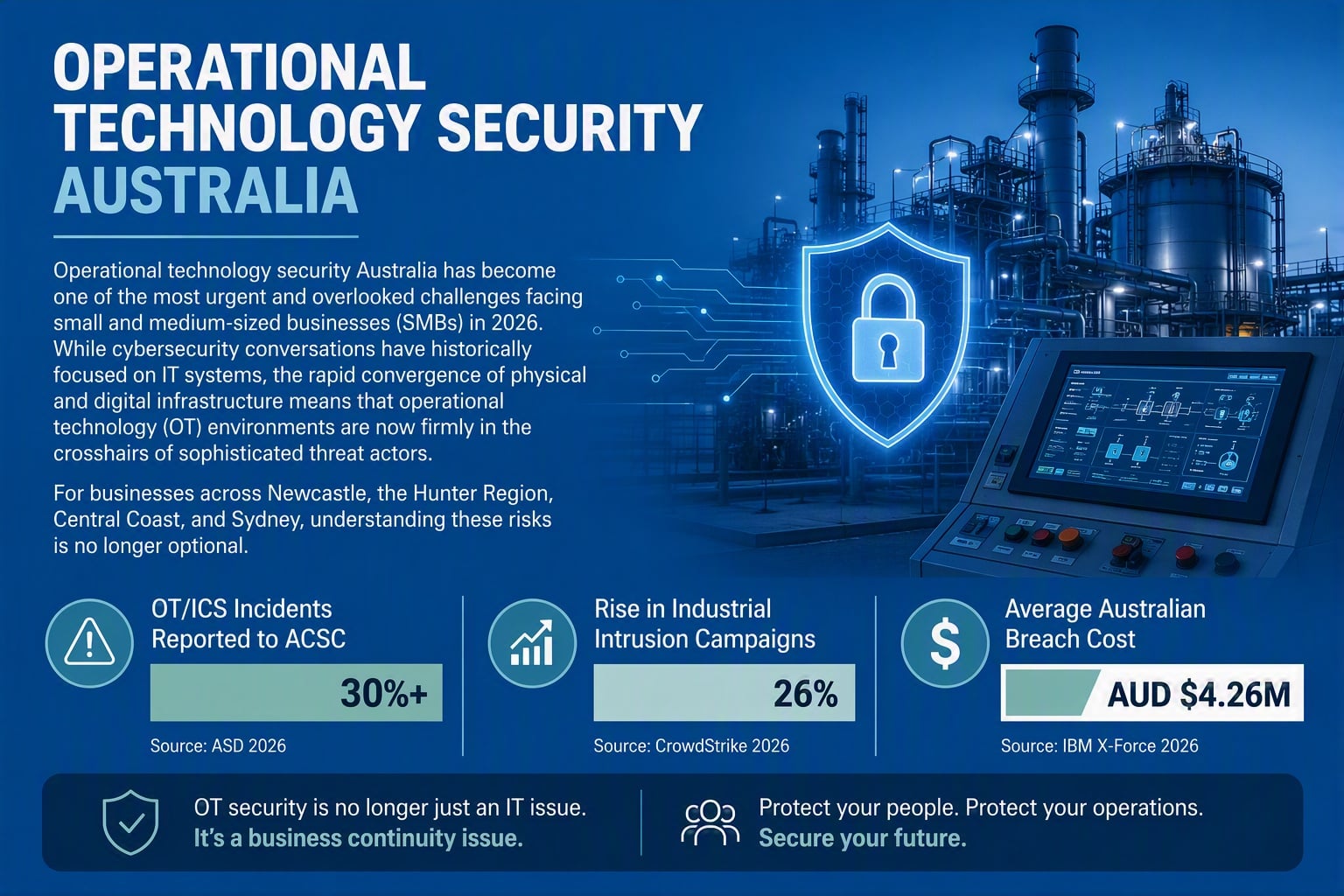
Operational technology security Australia has become one of the most urgent and overlooked challenges facing small and medium-sized businesses (SMBs) in 2026. While cybersecurity conversations have historically focused on IT systems, the rapid convergence of physical and digital infrastructure means that operational technology (OT) environments are now firmly in the crosshairs of sophisticated threat actors. For businesses across Newcastle, the Hunter Region, Central Coast, and Sydney, understanding these risks is no longer optional.

What Is Operational Technology Security and Why Does It Matter for Australian SMBs?
Operational technology refers to hardware and software that monitors and controls physical devices, processes, and infrastructure. This includes industrial control systems (ICS), supervisory control and data acquisition (SCADA) systems, programmable logic controllers (PLCs), and building management systems. For SMBs, OT is often found in manufacturing, food production, utilities, logistics, and commercial facilities.
According to the Australian Signals Directorate, 2026, over 30% of cyber incidents reported to the Australian Cyber Security Centre (ACSC) in 2025-26 involved OT or industrial control systems. This reflects a sharp rise in attacks targeting physical infrastructure. The numbers are impossible to ignore.
Many SMB owners assume OT security is exclusively a concern for large utilities or government-owned infrastructure. This is a dangerous misconception. Any business operating connected machinery, environmental sensors, or automated production lines carries real exposure. The threat landscape has expanded well beyond enterprise-scale targets.
Risk 1: Unpatched Legacy OT Systems Creating Exploitable Backdoors
Legacy OT systems were designed for reliability and longevity, not cybersecurity. Many PLCs and SCADA components installed a decade or more ago were never intended to be connected to the internet. Yet today, connectivity has been added incrementally, often without corresponding security controls or patching disciplines.
Vendors frequently discontinue firmware support for older OT devices, leaving known vulnerabilities permanently unpatched. Attackers specifically search for these weaknesses using publicly available exploit databases. A single unpatched industrial sensor on a production floor can serve as an entry point into your broader network environment.
For Hunter Region manufacturers and Central Coast food producers, this is particularly relevant. Many operations rely on equipment that is five to fifteen years old. Establishing a structured asset inventory and vulnerability assessment programme is the first step toward addressing industrial control system vulnerabilities before they are exploited.
Risk 2: IT and OT Network Convergence Expanding Your Attack Surface
The integration of IT and OT environments has delivered genuine business benefits, including real-time monitoring, predictive maintenance, and remote management. However, IT/OT convergence risks are substantial. When OT networks are connected to enterprise IT systems, a compromise on the IT side can cascade directly into physical operations.
The CrowdStrike, 2026 Global Threat Report found that adversary intrusion campaigns targeting industrial and operational environments increased by 26% year-on-year. Manufacturing and utilities ranked among the most targeted sectors globally. Australian SMBs operating in these industries face a heightened and measurable threat.
Effective segmentation is critical. Organisations that treat OT networks as an extension of their standard corporate network are creating avoidable exposure. Network architecture must include clearly defined demilitarised zones, strict access controls between IT and OT segments, and continuous monitoring of traffic crossing those boundaries. Learn more about how zero-trust cybersecurity principles apply to network segmentation strategies.
Risk 3: Insufficient Visibility Across Connected Industrial Devices
You cannot protect what you cannot see. Many SMBs operating OT environments have an incomplete picture of the devices connected to their networks. Sensors, actuators, human-machine interfaces (HMIs), and industrial routers are frequently added without formal change management or documentation processes.
This lack of visibility creates significant blind spots. Threat actors can establish persistence within an OT environment for extended periods before detection. The IBM X-Force, 2026 Threat Intelligence Index confirmed that the average cost of a data breach in Australia reached AUD $4.26 million in 2025-26. Breaches involving OT environments trended significantly higher due to extended operational downtime.
Passive network discovery tools designed specifically for OT environments can build comprehensive asset inventories without disrupting sensitive industrial processes. This visibility capability is foundational to any effective OT security programme. Without it, risk assessment and incident response are severely compromised.
Risk 4: Third-Party Remote Access to OT Environments Without Controls
Equipment vendors and maintenance contractors frequently require remote access to OT systems for diagnostics and software updates. In practice, many SMBs grant this access through generic shared credentials or persistent virtual private network (VPN) connections that are never properly reviewed or revoked.
This represents a substantial supply chain risk. A compromised vendor environment can provide attackers with a direct pathway into your OT network. Our detailed guide on supply chain cyber attacks Australia outlines how these attack vectors are exploited and how to mitigate them effectively.
Controls for third-party OT access should include just-in-time access provisioning, multi-factor authentication (MFA), session recording, and automated expiry of credentials after each maintenance window. These are not complex controls to implement, but they are consistently absent in SMB OT environments. Read our complementary post on third-party vendor security Australia for a deeper look at audit failures.
Risk 5: Inadequate Backup and Recovery Planning for OT Environments
Disaster recovery planning for IT systems has matured significantly among Australian SMBs. However, OT environments are frequently excluded from formal backup and recovery frameworks. PLC configurations, HMI programming, and SCADA historian data are often not captured in structured backup routines.
When a ransomware attack or hardware failure strikes an OT environment without adequate recovery provisions, the consequences extend far beyond data loss. Production lines stop. Facilities lose environmental controls. Revenue is lost by the hour. Recovery from a poorly documented OT environment can take weeks rather than days.
Our team has helped Newcastle and Hunter Region businesses integrate OT into their broader disaster recovery planning frameworks. Documented recovery procedures, offline configuration backups, and tested restoration plans are not luxuries. They are operational essentials for any business with critical OT dependencies.
Risk 6: Non-Compliance With Critical Infrastructure Security Standards
Critical infrastructure compliance Australia is growing increasingly complex. The Security of Critical Infrastructure (SOCI) Act 2018, as significantly amended in 2022, imposes specific obligations on entities across 22 critical infrastructure sectors. Many SMBs operating in supply chains connected to these sectors carry compliance obligations they are not aware of.
Beyond SOCI, the Australian Government’s Essential Eight framework provides a baseline of OT-relevant controls including application control, patching of operating systems, and restricting administrative privileges. The ACSC Essential Eight Framework is a strong starting reference point for SMBs building their OT security baseline.
Non-compliance carries regulatory risk, but more immediately, it signals to attackers that fundamental controls are absent. Businesses that have not assessed their obligations under these frameworks should treat this as an urgent priority, particularly as regulators increase enforcement activity through 2026.
Risk 7: Weak Identity Controls Across OT User Accounts
Identity management in OT environments lags significantly behind IT security practices. Shared operator accounts, default vendor credentials, and administrative accounts without MFA remain commonplace in SMB OT deployments across Australia. These weaknesses are actively exploited by both opportunistic and targeted threat actors.
The Verizon Data Breach Investigations Report consistently identifies credential abuse as a primary attack vector across operational environments. Compromised credentials provide attackers with legitimate-appearing access that is difficult to detect without robust identity monitoring and behavioural analytics in place.
Addressing OT identity security requires a dedicated programme. This includes auditing all existing accounts, eliminating shared credentials, enforcing role-based access control (RBAC), and applying MFA wherever the OT platform supports it. Our guide on identity security SMB gaps covers this in greater depth.
How Adept IT Solutions Helps Hunter Region Businesses Secure OT Environments
Addressing operational technology security Australia-wide requires expertise that bridges both IT and OT disciplines. Adept IT Solutions works with businesses across Newcastle, Lake Macquarie, the Hunter Region, Central Coast, and Sydney to assess, design, and manage OT security programmes that are proportionate to each organisation’s risk profile and operational context.
Our OT security services include asset discovery and inventory, network segmentation design, third-party access management, compliance gap analysis against the Essential Eight and relevant industry standards, and integration of OT environments into broader cybersecurity monitoring. These are delivered as part of our managed cybersecurity offering, providing continuous protection without requiring businesses to build in-house OT expertise.
For businesses concerned about AI-enhanced threats targeting OT environments, our post on AI cyber attacks targeting SMBs provides important context on the evolving threat landscape. OT security Newcastle businesses can rely on local expertise combined with the technical depth of a nationally capable team.
“The convergence of IT and OT environments has fundamentally changed the cyber risk profile for Australian SMBs. Legacy assumptions about OT isolation no longer hold. Businesses that do not actively assess and manage these risks are operating with significant blind spots in their security posture.”

Conclusion
The seven risks outlined in this post represent the most critical and commonly observed vulnerabilities in SMB OT environments across Australia today. Unpatched legacy systems, poor network segmentation, insufficient visibility, uncontrolled third-party access, inadequate backup provisions, compliance gaps, and weak identity controls are each exploitable individually. In combination, they create a threat profile that no business can afford to ignore.
Operational technology security Australia is not a problem that resolves itself with time. As connectivity increases and adversary capabilities grow, the window for proactive action narrows. Businesses that act now, rather than responding to an incident, are in a considerably stronger position. Understanding the threat is the starting point. Building a structured, managed response is what converts that understanding into resilience. To take the first step, contact Adept IT Solutions today for a no-obligation OT security consultation.
Frequently Asked Questions
Q: What does operational technology security Australia cover for a typical SMB?
A: For an Australian SMB, operational technology security covers the protection of physical systems and devices that run business operations. This includes manufacturing equipment, SCADA systems, PLCs, building automation systems, and any other networked industrial devices. It encompasses asset visibility, network segmentation, access controls, patching, compliance, and incident response planning specific to OT environments.
Q: Are small businesses in the Hunter Region actually targeted for OT cyber attacks?
A: Yes. Attackers increasingly target SMBs because they typically have weaker security controls than large enterprises while still operating valuable and disruptive industrial systems. Hunter Region businesses in manufacturing, food production, logistics, and commercial facilities are all relevant targets. Supply chain relationships with larger organisations can also make SMBs an attractive stepping stone for adversaries.
Q: How does the Essential Eight framework apply to industrial control system vulnerabilities?
A: The ACSC Essential Eight was originally designed with IT systems in mind, but several controls apply directly to OT environments. Application control, patching of operating systems, restricting administrative privileges, and multi-factor authentication are all applicable to OT assets where the platform permits it. Businesses should conduct a gap analysis to identify which controls can be applied to their specific industrial control system vulnerabilities.
Q: What is the first step an SMB should take to improve its OT cybersecurity managed services posture?
A: The most important first step is conducting a comprehensive OT asset inventory. Businesses frequently do not have an accurate picture of every device connected to their operational network. Once assets are identified and documented, a risk assessment can prioritise vulnerabilities, and a remediation roadmap can be developed. Engaging a managed security provider experienced in OT environments, such as Adept IT Solutions, ensures this process is conducted thoroughly and without disrupting critical operations.
Get in touch with our team of IT experts today! You can contact us via phone at 1300 423 378 or email us at info@adept-it.com.au.

