
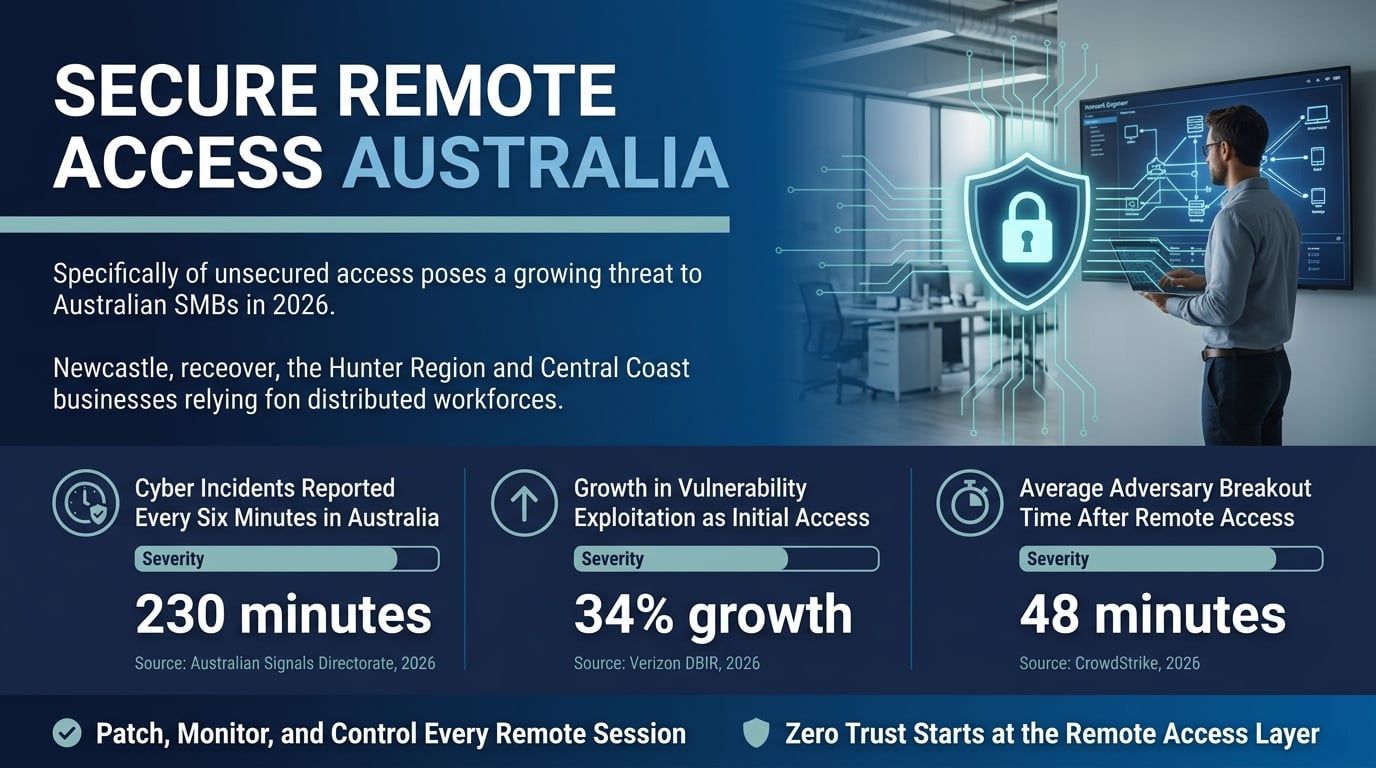
Secure remote access Australia businesses rely on has become one of the most actively exploited attack surfaces in 2026, and small to medium-sized businesses (SMBs) are paying the price. The Australian Signals Directorate, 2026 recorded a cybercrime report every six minutes in 2025-26, with remote access vulnerabilities ranking among the top three initial access vectors exploited against Australian businesses. For SMBs across Newcastle, the Hunter Region, the Central Coast, and Sydney, the consequences of getting this wrong extend well beyond a single incident. They include regulatory exposure, reputational damage, and operational disruption that many businesses do not recover from quickly.
The five mistakes outlined below are not theoretical. They reflect the patterns Adept IT Solutions encounters when assessing SMB environments across New South Wales and beyond. Understanding these gaps is the first step toward closing them.

Why Unpatched VPNs Remain the Number One SMB Entry Point in 2026
The Verizon, 2026 Data Breach Investigations Report (DBIR) found that exploitation of vulnerabilities as an initial access method grew by 34% year-on-year, with Virtual Private Network (VPN) and Remote Desktop Protocol (RDP) flaws the most frequently targeted entry points. For Australian SMBs, this is not a distant problem. Unpatched VPN appliances are frequently the first door threat actors try, and far too often, that door is open.
Many SMBs deployed VPN infrastructure rapidly during pandemic-era remote working arrangements and have not revisited those configurations since. Firmware updates have been missed, end-of-life hardware persists, and security policies written in 2021 have not been reviewed against today’s threat landscape. This combination creates exactly the kind of persistent, low-effort entry point that adversaries actively scan for at scale. Addressing VPN patch management is foundational to any credible remote access security posture in 2026.
Mistake 1: Relying on Legacy VPN Without Multi-Factor Authentication
Multi-Factor Authentication (MFA) is listed as the first control under the Australian Cyber Security Centre (ACSC) Essential Eight framework, yet a significant proportion of SMBs across regional New South Wales still operate VPN connections protected only by a username and password. A single phishing email or credential-stuffing attack is all it takes to hand an adversary authenticated access to the internal network.
Legacy VPN products compound this problem. Many older appliances do not natively support modern MFA methods or integrate poorly with cloud-based identity providers such as Microsoft Entra ID. Rather than working around these limitations, businesses often simply disable MFA requirements or leave them unconfigured. If your VPN gateway is more than five years old and was not purpose-built for zero trust remote access architectures, its security model is almost certainly inadequate for the current threat environment. Migrating to a supported platform with enforced MFA is a non-negotiable starting point, not an optional upgrade.
For guidance on broader identity security gaps, the post on identity security SMB gaps provides useful complementary context.
Mistake 2: Using Shared or Overly Broad Remote Access Credentials
Shared credentials are among the most common and most damaging configurations Adept IT Solutions identifies during SMB assessments. A single VPN account shared across an entire team, or a generic “remote” username used by multiple staff members, makes it impossible to attribute activity to an individual user. When an incident occurs, forensic investigation is severely hampered and accountability disappears entirely.
The CrowdStrike, 2026 Global Threat Report confirmed that adversaries leveraged valid remote access credentials or compromised remote services in the majority of hands-on-keyboard intrusions, with breakout time falling to an average of just 48 minutes. When shared credentials are involved, that window becomes even more dangerous because there is no baseline behaviour against which anomalies can be detected.
Every remote access user should have a unique, individually assigned credential tied to their corporate identity. Permissions should reflect the minimum access required to perform their role, not blanket access to the entire environment. Our post on privileged access management risks explores this further for businesses managing elevated accounts.
Mistake 3: Failing to Monitor and Log Remote Sessions in Real Time
Many SMBs have no visibility into what is happening during remote access sessions. VPN connections are established, traffic flows, and sessions close, all without any meaningful logging or monitoring in place. This is not simply a missed best practice. It is a compliance failure under frameworks including the Essential Eight and relevant obligations under the Privacy Act 1988.
Real-time session monitoring allows security teams to detect anomalous behaviour as it occurs, rather than discovering a breach weeks after the fact. Indicators such as off-hours logins, access to unusual file shares, lateral movement attempts, or large data transfers should trigger automated alerts. Without logging, these signals go undetected entirely. Security Information and Event Management (SIEM) platforms, paired with endpoint detection tools, provide the visibility layer that remote access environments require.
Businesses that have experienced ransomware events often discover during post-incident analysis that the attacker’s remote access sessions were never logged at all. For context on recovery obligations once an incident occurs, the article on ransomware recovery for SMBs outlines the critical steps involved.
Mistake 4: No Least-Privilege Policy for Third-Party Remote Access
Third-party vendors, managed service partners, and software suppliers frequently require remote access to SMB environments to perform maintenance, support, or integration tasks. The mistake most businesses make is granting those vendors persistent, broad remote access that remains active long after the original task is complete. This creates a shadow attack surface that sits largely outside the business’s direct control.
A least-privilege approach to third-party access means granting the minimum permissions necessary, for the minimum duration required, to specific resources only. Time-limited credentials that expire automatically, just-in-time access provisioning, and vendor-specific access pathways that are isolated from the broader network should form the baseline standard. The NIST Zero Trust Architecture publication provides a practical framework for structuring these controls around identity verification and segmentation principles.
The risks associated with uncontrolled third-party access extend beyond direct compromise. Supply chain attacks targeting vendor access pathways are a growing concern across Australian industry sectors. Our post on supply chain cyber attacks for SMBs outlines five practical protective measures. For businesses that want deeper coverage of vendor risk, the post on third-party vendor security audit failures is also highly relevant.
Mistake 5: Treating Remote Access as IT Infrastructure, Not a Security Control
The most fundamental mistake SMBs make is conceptual. Remote access is commonly treated as a productivity tool, something the IT team configures once and leaves running. It is not reviewed in security governance meetings, it does not appear in risk registers, and it is rarely included in incident response planning. This mindset is precisely what adversaries rely on.
Secure remote access must be governed as a security control with defined ownership, regular review cycles, and explicit inclusion in compliance assessments. Under the Essential Eight Maturity Model, businesses at Maturity Level 2 and above are expected to enforce MFA, restrict remote access, and maintain audit logs as interconnected, policy-driven controls. Remote access that is treated as infrastructure will always lag behind the threat environment because infrastructure maintenance is reactive, while security governance should be proactive.
The ACSC Essential Eight Maturity Model provides a publicly available baseline that any Australian SMB can use to benchmark its current remote access and broader security posture. Businesses that have not yet conducted a formal review against these controls should treat doing so as an immediate priority in 2026. If your business is also assessing its broader network posture, the post on network segmentation SMB mistakes covers complementary controls that reduce lateral movement risk once a remote session is compromised.
“Adversaries leveraged valid remote access credentials or compromised remote services in the majority of hands-on-keyboard intrusions in 2026, with an average breakout time of just 48 minutes.” — CrowdStrike Global Threat Report, 2026

Strengthening Secure Remote Access Across Australian SMBs: The Next Step
Addressing secure remote access Australia businesses depend on is not a one-time project. It is an ongoing security discipline that requires policy, technology, monitoring, and review working together. Each of the five mistakes outlined above is independently dangerous. In combination, they create environments where a motivated adversary can gain access, move laterally, exfiltrate data, or deploy ransomware within the hour.
SMBs that have already experienced incidents should also consider whether their current cyber insurance coverage adequately reflects their remote access risk profile. The post on cyber insurance coverage gaps for SMBs identifies five areas where policies commonly fall short. Combining robust remote access controls with appropriate coverage and a tested incident response plan represents the minimum standard for operating responsibly in the current threat environment.
Adept IT Solutions helps businesses across the Hunter Region, Newcastle, the Central Coast, and Sydney implement remote access security solutions that align with Essential Eight compliance requirements and reflect real-world threat intelligence. If any of the mistakes described in this post are present in your environment, the time to act is now. Contact Adept IT Solutions to arrange a security assessment and take control of your remote access exposure today.
Frequently Asked Questions
Q: What is the biggest risk with secure remote access for Australian SMBs in 2026?
A: The biggest risk is unpatched VPN infrastructure combined with a lack of Multi-Factor Authentication. When these two gaps exist together, adversaries can gain authenticated network access with minimal effort. Secure remote access Australia organisations implement must include current firmware, enforced MFA, and real-time session monitoring to meet the baseline security standard expected in 2026.
Q: Does the Essential Eight framework cover remote access security for SMBs?
A: Yes. The ACSC Essential Eight Maturity Model addresses remote access directly through its MFA, patching, and access restriction controls. At Maturity Level 2, businesses are expected to enforce MFA for all remote access, restrict privileged access, and maintain audit logs of remote sessions. SMBs pursuing Essential Eight compliance should treat remote access governance as a core component of their program, not a separate IT function.
Q: What is zero trust remote access, and do SMBs need it?
A: Zero trust remote access is a security model that requires continuous verification of every user and device attempting to connect, regardless of whether they are inside or outside the network perimeter. Rather than assuming that a user with valid credentials can be trusted, zero trust enforces least-privilege access, device compliance checks, and behavioural monitoring at every session. For SMBs relying on managed IT Newcastle and similar regional providers, adopting zero trust principles is increasingly practical and strongly recommended given current threat volumes.
Q: How should SMBs manage third-party vendor remote access securely?
A: Third-party vendor remote access should be governed by a formal policy that enforces time-limited credentials, just-in-time provisioning, and network segmentation to restrict vendor access to only the systems they require. Persistent, broad-access credentials should be removed immediately after each engagement. All vendor sessions should be logged and reviewed. Businesses with VPN vulnerabilities SMB assessments commonly identify should treat third-party access pathways as a priority audit item, as these are frequently the least-governed entry points in the environment.
Get in touch with our team of IT experts today! You can contact us via phone at 1300 423 378 or email us at info@adept-it.com.au.

