
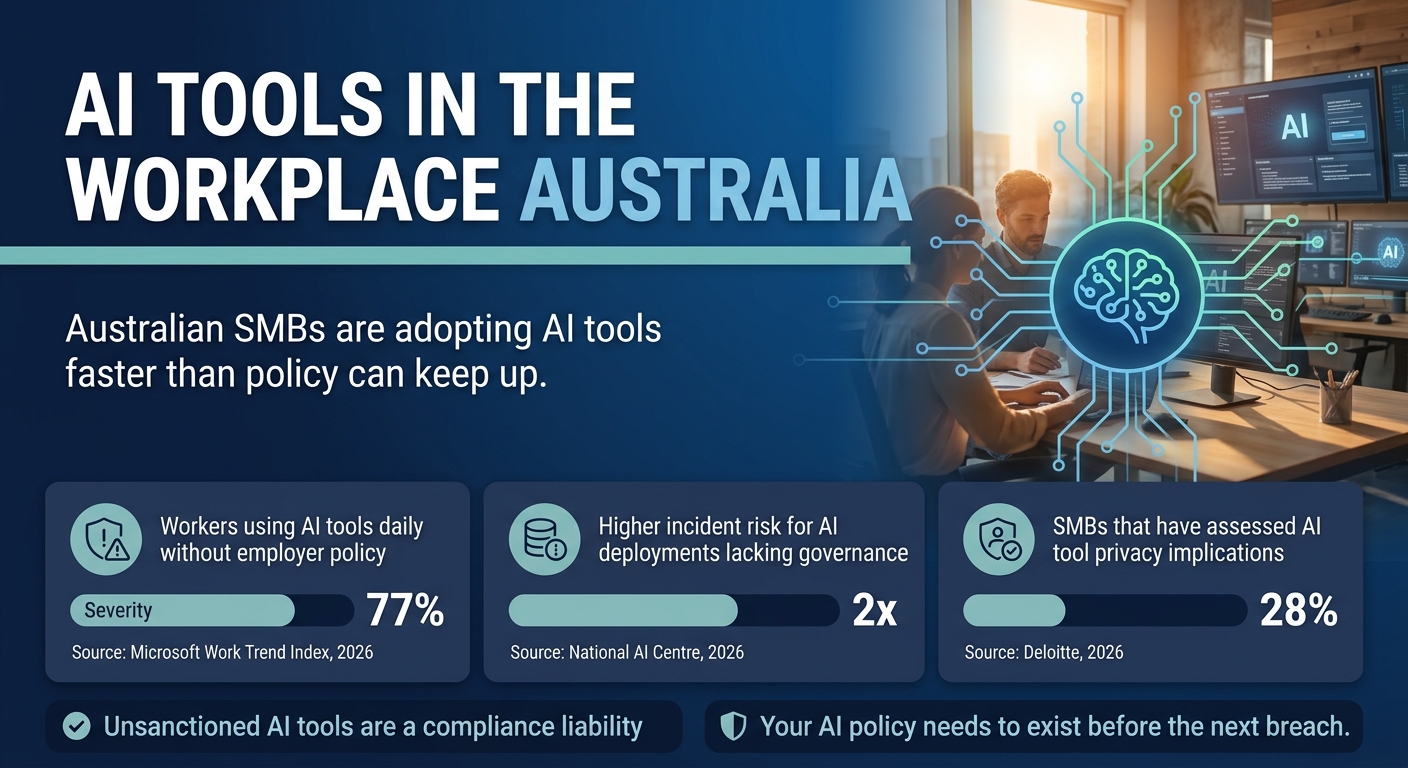
AI tools in the workplace are now a fixture of daily business life across Australia, yet most small and medium businesses (SMBs) have adopted them without the governance structures needed to manage the risks that come with them. According to the Microsoft Work Trend Index 2026, 77% of Australian workers report using AI tools in their daily work, yet fewer than one in three employers have a formal AI use policy in place. That gap between adoption and governance is where risk lives. For businesses in Newcastle, the Hunter Region, Central Coast, and Sydney, the consequences of getting this wrong range from data breaches to regulatory penalties.

1. Why Unsanctioned AI Tools Are Your Biggest Compliance Blind Spot
Shadow AI is the term used to describe AI productivity tools that employees adopt independently, without IT or management approval. It is the 2026 equivalent of shadow IT, and it is far more dangerous. When a staff member pastes a client contract into a consumer-grade AI summarisation tool, that data may be retained, processed offshore, or used to train future models. The business owner rarely knows it happened.
The unsanctioned AI risk is compounded by the fact that most employees genuinely believe they are being helpful. They are not acting maliciously; they are simply solving problems with the tools at hand. Without a clear policy, there is no way to distinguish responsible use from a compliance event in progress. This is the compliance blind spot that catches Australian SMBs off guard more than any other.
2. How AI Tools in the Workplace Silently Expose Customer and Business Data
Data exposure through AI tools does not usually look like a breach. It looks like efficiency. A finance officer summarises a supplier agreement. A receptionist drafts a client email using an AI assistant. A project manager uses a free AI note-taker during a confidential strategy meeting. Each action feels routine, but each one may be transmitting sensitive business or personal data to external servers governed by foreign privacy laws.
The Office of the Australian Information Commissioner has made clear that organisations remain responsible for personal information even when it is processed by a third-party service provider, including AI platforms. This means that if an AI tool your staff use without authorisation processes personal data unlawfully, the liability rests with your business, not the tool’s vendor. Understanding this exposure is the starting point for any serious AI governance conversation.
3. The Essential Eight and AI Tool Procurement Australia: What SMBs Get Wrong
The Australian Signals Directorate’s Essential Eight framework sets the baseline for cyber resilience across Australian organisations. Most SMBs that have heard of it associate it with patching and backups. What they miss is how AI tool procurement Australia introduces new gaps across multiple Essential Eight controls, particularly application control, user application hardening, and restricting administrative privileges.
When employees install or access AI tools outside of the approved software procurement process, they effectively bypass the application control controls your IT team has worked to implement. Browser-based AI tools are especially problematic because they do not require installation and therefore evade many endpoint controls entirely. For more on how vulnerability management for Australian SMBs intersects with unsanctioned software, the risks are well documented.
4. When AI Productivity Gains Create a Bigger Security Debt
Productivity is the primary reason employees adopt AI tools independently. The gains are real: faster drafting, quicker research, automated scheduling. But productivity gains achieved without oversight accumulate what security professionals call security debt. Every unreviewed tool, unvetted integration, and unmonitored data flow adds to a balance that eventually comes due, usually at the worst possible moment.
According to the Australia’s National AI Centre (NAIC), Australian organisations adopting AI without governance frameworks are twice as likely to experience a data-related incident within 12 months of deployment. For SMBs without dedicated security teams, that incident can be catastrophic. The security debt created by unmanaged AI tools is rarely visible until it materialises as a breach, a regulatory notice, or a client complaint.
If your business has already experienced gaps in endpoint protection, our guide on endpoint security gaps for Australian SMBs covers the overlapping risks in detail.
5. Privacy Act Exposure Most SMBs Have Not Assessed
Only 28% of SMBs globally have assessed the privacy implications of the AI tools their employees are already using, according to the Deloitte State of Generative AI 2026. For Australian businesses, this is particularly concerning given the strengthened obligations under the Privacy Act 1988 (Cth). The reforms introduced in recent years have expanded the definition of personal information and increased penalty exposure for mishandling it.
If your staff are using AI tools that process client names, contact details, health information, or financial data, and you have not completed a Privacy Impact Assessment, your organisation may already be in breach. Our overview of Privacy Act reforms for Australian SMBs outlines the practical steps businesses need to take in 2026.
6. AI-Generated Misinformation and Decision-Making Risk
Large language models can produce confident, well-structured, and entirely incorrect outputs. When employees use these outputs to inform business decisions, client advice, or operational processes without verification, the organisation assumes the risk of acting on misinformation. This is not a theoretical concern. In 2026, it is a documented pattern across professional services, healthcare administration, and legal support functions.
Australia’s voluntary AI ethics principles, published by the Department of Industry, Science and Resources, specifically identify reliability and human oversight as foundational requirements for responsible AI use. SMBs that allow AI outputs to flow directly into client-facing work without human review are not just taking a quality risk; they are potentially breaching professional obligations and duty-of-care requirements.
7. Third-Party and Supply Chain Risk from AI Integrations
Many AI tools connect to other business systems via application programming interfaces (APIs). When an employee connects an AI writing assistant to your customer relationship management (CRM) platform, or links an AI scheduling tool to your calendar and email, they create an integration that your security team may not know exists. Each integration point is a potential entry vector for a threat actor.
Supply chain attacks via third-party software integrations are a growing vector in 2026. If an AI tool your business uses is compromised upstream, that compromise can propagate directly into your systems. This is especially relevant for Hunter Region businesses with operational technology environments or multi-site networks. Our article on multi-site network security risks explores related exposure areas.
8. How to Build a Practical AI Tool Policy Without Slowing Your Team Down
The instinct of many business owners when confronted with AI risk is to ban the tools outright. This rarely works. Staff will continue to use them via personal devices or browser extensions, and the business loses both visibility and influence. A more effective approach is a structured AI acceptable use policy that defines approved tools, data handling obligations, and human review requirements.
A practical policy does not need to be lengthy. It should address: which AI tools are approved for use, what data categories may not be entered into any AI tool, and who is responsible for reviewing AI-generated outputs before they are acted upon. For SMBs that want a framework to build from, our post on AI governance for small business covers the critical gaps most organisations overlook.
9. What to Do Right Now If Your Staff Are Already Using AI at Work
The reality for most Australian SMBs is that AI tools in the workplace are already in active use, whether or not the business knows it. The first practical step is an AI tool audit: a structured review of which tools staff are using, what data is being entered, and whether those tools appear on an approved list. This does not require expensive software; it requires a structured conversation with your team and a review of your network traffic logs.
The second step is staff education. Security awareness training that specifically addresses AI risks is now a baseline expectation, not an optional extra. Our guide on security awareness training mistakes for Australian SMBs outlines the gaps in most existing training programmes. The third step is engaging a managed IT partner who can help you build the policy, deploy the monitoring, and maintain ongoing oversight as the AI landscape continues to evolve.
“The organisations that manage AI risk effectively in 2026 are not those that banned the technology. They are the ones that built governance before the incident, not after it.”

Managing AI Tools in the Workplace Starts with the Right Partner
AI tools in the workplace will only become more prevalent as 2026 progresses. The nine risks outlined above are not hypothetical; they are active exposure areas for SMBs across Australia right now. From shadow AI and Privacy Act obligations to Essential Eight compliance gaps and third-party integration risks, the governance challenge is real and growing. The good news is that with the right frameworks, most of these risks are manageable.
Adept IT Solutions helps SMBs across Newcastle, the Hunter Region, Central Coast, and Sydney build practical, proportionate AI governance programmes that align with Australian compliance obligations. If your business is ready to take AI risk seriously, contact Adept IT Solutions to speak with a specialist today.
Frequently Asked Questions
Q: What are the biggest risks of using AI tools in the workplace for an Australian SMB?
A: The biggest risks include unsanctioned AI tool use (shadow AI), exposure of personal and business data to offshore servers, non-compliance with the Privacy Act 1988 (Cth), gaps in Essential Eight controls, and reliance on AI-generated outputs without human verification. Most of these risks arise not from deliberate misuse but from the absence of a formal AI acceptable use policy. Australian SMBs should conduct an AI tool audit and implement a governance framework as a priority in 2026.
Q: Do Australian SMBs need a formal policy for AI tool procurement?
A: Yes. A formal AI tool procurement process is essential for maintaining application control, data sovereignty, and compliance with Australian privacy obligations. Without a structured approval process, employees will adopt tools independently, creating unsanctioned AI risk that bypasses existing IT controls. A policy does not need to be complex; it needs to clearly define which tools are approved, what data may be used with them, and how outputs should be reviewed before use.
Q: How does the Essential Eight relate to AI tool governance for SMBs?
A: The Essential Eight framework developed by the Australian Signals Directorate includes application control, user application hardening, and patch management controls that are directly relevant to AI tool governance. When employees access AI tools outside of approved procurement channels, particularly browser-based tools, they can circumvent these controls entirely. SMBs targeting Maturity Level 1 or above should include AI tool assessment as part of their Essential Eight compliance review.
Q: How can a managed IT provider help my business govern AI tools in the workplace?
A: A managed IT provider like Adept IT Solutions can conduct an AI tool audit to identify what tools your staff are currently using, assess the data exposure and compliance risks associated with each tool, develop a tailored AI acceptable use policy aligned with Australian regulations, and deploy monitoring solutions to detect future unsanctioned AI adoption. Managed IT support also ensures your AI governance framework evolves as new tools emerge and as Australian regulatory requirements continue to develop through 2026 and beyond.
Get in touch with our team of IT experts today! You can contact us via phone at 1300 423 378 or email us at info@adept-it.com.au.

