
IoT device security is now one of the most pressing concerns for Australian small and medium-sized businesses (SMBs), yet it remains one of the most consistently overlooked areas of a modern cyber defence strategy. The Internet of Things (IoT) has transformed how businesses in Newcastle, the Hunter Region, Central Coast, and Sydney operate, connecting everything from smart printers and IP cameras to building management systems and industrial sensors. But every connected device is a potential entry point for adversaries, and most SMBs have far more of them than they realise.
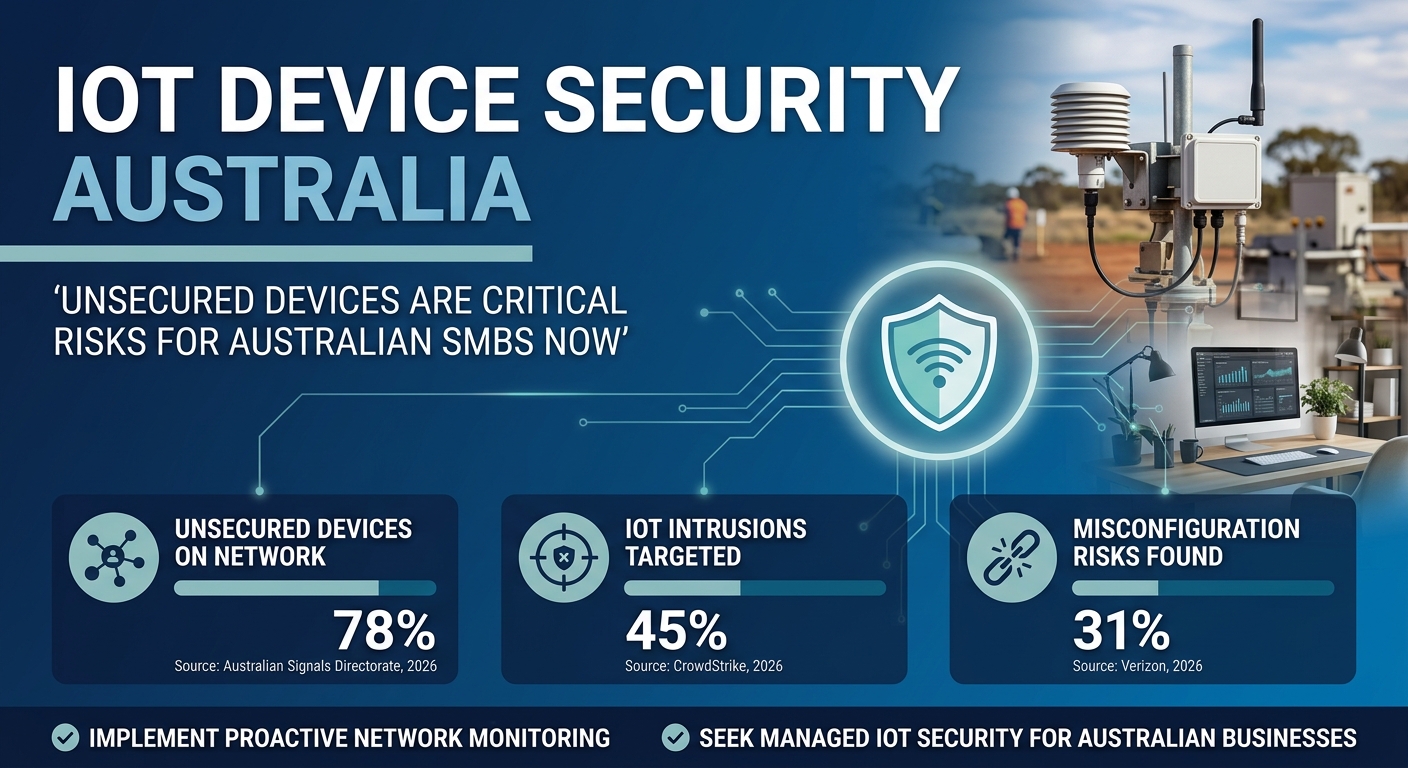
According to the Australian Signals Directorate, 2026, adversaries are exploiting internet-exposed devices at scale, with network and edge device intrusions representing one of the fastest-growing initial access vectors observed across the 2025-26 threat period. For SMBs without dedicated security teams, the consequences of a single compromised device can cascade across an entire network.

Why IoT Device Security Is Your Network’s Biggest Blind Spot
Most SMBs invest in endpoint protection for laptops and servers but give far less attention to the dozens of connected devices sitting quietly on the same network. Smart TVs in meeting rooms, environmental sensors, VoIP handsets, Wi-Fi access points, and even coffee machines with network connectivity can all serve as footholds for attackers. These devices often run stripped-down operating systems that are difficult to monitor with standard endpoint detection tools.
The challenge is compounded by shadow IT. Employees and operational teams frequently connect devices without notifying IT departments, meaning organisations often have no accurate inventory of what is on their network. Without visibility, there can be no protection. This problem is especially acute in industries common across the Hunter Region, including manufacturing, healthcare, and logistics, where operational technology blends with corporate IT environments. Poor network segmentation practices make the risk significantly worse.
How Threat Actors Are Targeting Unsecured Connected Devices in 2026
The threat landscape around unsecured connected devices has intensified considerably in 2026. In 2026, exploitation of public-facing applications and internet-exposed devices ranked among the top three initial access techniques observed globally across incident response engagements, according to the CrowdStrike, 2026 Global Threat Report. Threat actors are automating reconnaissance against internet-facing IoT assets, scanning for known vulnerabilities within hours of a Common Vulnerabilities and Exposures (CVE) being published.
Once inside a network via a compromised IoT device, attackers move laterally to higher-value targets including file servers, cloud credentials, and financial systems. Ransomware operators in particular have refined this playbook. The Verizon, 2026 Data Breach Investigations Report (DBIR) identifies system intrusion as the leading pattern in breaches, with misconfigured and unpatched network-connected devices consistently flagged as key contributing factors. Australian SMBs are not exempt from this global pattern.
Botnets built from compromised IoT devices are also being leveraged for distributed denial-of-service (DDoS) attacks and credential-stuffing campaigns. Many business owners are unaware that their CCTV system or smart thermostat may already be participating in an attack against another organisation. For more on how AI is accelerating these threats, read our post on AI cyber attacks targeting SMBs.
The 10 Critical IoT Security Risks Australian SMBs Face Right Now
Risk 1: Default Credentials Left Unchanged
Factory-set usernames and passwords such as “admin/admin” remain one of the most exploited vulnerabilities in IoT environments. Attackers use publicly available default credential databases to gain access within seconds. Many SMBs deploy devices and never update these settings, leaving an open door on their network perimeter.
Risk 2: Firmware That Is Never Updated
Unlike standard operating systems, IoT firmware rarely updates automatically. Manufacturers release patches for critical vulnerabilities, but if no one is monitoring for these updates, devices remain exposed indefinitely. Effective patch management practices must extend beyond servers and laptops to include every networked device in the environment.
Risk 3: No Network Segmentation
Placing IoT devices on the same flat network as business-critical systems is a configuration error with serious consequences. When a threat actor compromises a smart TV or access control panel, a flat network gives them direct routing to financial databases, email servers, and cloud applications. Proper segmentation isolates IoT traffic and contains any breach.
Risk 4: Lack of Asset Visibility
You cannot protect what you cannot see. Many SMBs have no complete, current inventory of their connected devices. Devices are added by staff, contractors, or vendors without formal approval processes. Without an accurate asset register, vulnerability management becomes guesswork rather than a structured security function.
Risk 5: Insecure Remote Access to Devices
Many IoT devices are configured to allow remote management over the open internet, often without multi-factor authentication (MFA) or encrypted connections. This gives attackers a straightforward route to administrative control. Businesses should review remote access configurations for every connected device and apply the same standards they use for staff remote access. See our guidance on secure remote access for SMBs.
Risk 6: Weak or Absent Encryption
Some IoT devices transmit data in plain text, including sensor readings, video streams, and configuration commands. Attackers performing man-in-the-middle attacks on a local network can intercept and manipulate this data. Where devices support encryption protocols, these must be enabled and verified during deployment.
Risk 7: Supply Chain Vulnerabilities in Device Hardware
Low-cost connected devices sourced from unverified suppliers can contain pre-installed malicious firmware or hardcoded backdoors. This is a recognised supply chain risk. Businesses should only procure IoT hardware from reputable vendors with documented security practices and review supplier security posture regularly. Our post on supply chain cyber attacks in Australia covers this risk in detail.
Risk 8: End-of-Life Devices Still in Operation
Manufacturers discontinue support for IoT hardware on defined timelines. When a device reaches end-of-life (EOL), security patches stop. Yet many SMBs continue operating EOL cameras, routers, and access controllers for years beyond their supported lifespan. These devices are permanently vulnerable and should be decommissioned or replaced on a scheduled asset lifecycle plan.
Risk 9: Privacy Act and Data Exposure Risks
IoT devices such as biometric access systems, IP cameras, and health monitoring equipment frequently collect personal information. Under Australia’s Privacy Act 1988 and the Australian Privacy Principles (APPs), businesses have specific obligations around how this data is stored, transmitted, and protected. A breach involving IoT-collected personal data can trigger mandatory notification obligations under the Notifiable Data Breaches (NDB) scheme. Our post on Privacy Act reforms for Australian SMBs outlines current obligations.
Risk 10: No Incident Response Plan for IoT Breaches
Even businesses with a general incident response plan often have no specific procedures for IoT-related incidents. Isolating a compromised smart device, preserving evidence, and restoring operations requires device-specific knowledge that generic playbooks do not cover. Without a tested plan, response times extend dramatically and damage compounds. Pair this with a robust disaster recovery planning process to ensure business continuity is maintained.
Default Credentials, Flat Networks and Firmware: Where SMBs Go Wrong
The three most common IoT device security failures in SMB environments are consistently the same: unchanged default credentials, a flat network architecture that provides no containment, and firmware that has not been updated since installation. These three weaknesses often appear together, and when they do, a single compromised device can grant an attacker effective control of the entire network.
Addressing these failures does not require enterprise-level investment. It requires structured process. Every new device should go through a security hardening checklist before it connects to the network. This includes changing default credentials, disabling unused services, enabling available encryption, and assigning the device to an appropriate network segment. The NIST Cybersecurity Framework provides a widely adopted model for structuring these controls across the identify, protect, detect, respond, and recover functions.
How to Build a Practical IoT Security Framework for Your Business
Building a practical IoT network protection strategy starts with visibility. Conduct a full asset discovery exercise to enumerate every connected device across all office locations, whether that is a single Newcastle site or multiple locations across the Hunter Region and Central Coast. Document manufacturer, model, firmware version, and support status for each device.
Next, segment IoT devices into dedicated virtual local area networks (VLANs) with firewall rules that prevent lateral movement into production systems. Apply the principle of least privilege: IoT devices should only communicate with the specific services they require. Disable all unnecessary protocols and ports. Establish a firmware update schedule and assign ownership to a specific team member or your managed service provider.
The Essential Eight framework, published by the Australian Signals Directorate (ASD), provides a baseline of mitigation strategies directly applicable to IoT environments, particularly around patching applications, restricting administrative privileges, and application control. Closing the Essential Eight IoT gap should be a priority for any SMB seeking to align with Australian government security guidance. Complement this with strong security awareness training so staff understand why unauthorised device connections are a security risk.
For SMBs handling sensitive client data, consider working toward alignment with ISO 27001, the international standard for information security management. The ISO 27001 Standard requires organisations to assess and address risks associated with all information assets, which explicitly includes networked devices. This provides a documented, auditable approach to IoT risk management that supports client and regulatory confidence.
How Adept IT Solutions Helps Hunter Region Businesses Secure Every Device
Adept IT Solutions works with businesses across Newcastle, Lake Macquarie, the Hunter Region, Central Coast, and Sydney to deliver managed IoT security Australia-wide. Our approach begins with a comprehensive network discovery and asset audit, giving your business the visibility it needs to make informed security decisions. We identify unknown and unmanaged devices, assess their risk profile, and recommend remediation in priority order.
We design and implement network segmentation architectures that contain IoT traffic and prevent lateral movement. Our team manages firmware update schedules, device hardening procedures, and ongoing monitoring through our managed security operations function. We also assist businesses with compliance alignment, including the Essential Eight, ISO 27001, and Privacy Act obligations relevant to IoT-collected data.
IoT security Newcastle businesses need is not a one-time project. It is an ongoing discipline that requires continuous monitoring, regular reviews, and a trusted partner who understands the local threat environment and the operational realities of Australian SMBs.
“Every connected device that lacks proper IoT device security controls is not just a risk to itself. It is a risk to every system, every dataset, and every customer record on the same network. The cost of securing these devices is a fraction of the cost of recovering from the breach they enable.”

Conclusion
The ten risks outlined in this post represent the most critical IoT device security exposures facing Australian SMBs in 2026. From default credentials and firmware vulnerabilities to flat network architectures and Privacy Act obligations, the attack surface created by connected devices is broad, growing, and actively being exploited. Businesses across the Hunter Region, Central Coast, and Sydney that address these risks proactively will be significantly better positioned than those that wait for an incident to prompt action. To discuss how Adept IT Solutions can help your organisation take control of its connected device environment, contact our team today.
Frequently Asked Questions
Q: What is IoT device security and why does it matter for Australian SMBs?
A: IoT device security refers to the policies, controls, and technical measures used to protect internet-connected devices such as IP cameras, smart sensors, routers, and building management systems from unauthorised access and exploitation. For Australian SMBs, it matters because these devices are increasingly being targeted as entry points into business networks, and a single compromised device can expose sensitive data, enable ransomware deployment, or trigger Privacy Act notification obligations.
Q: How does the Essential Eight framework address IoT risks for Australian businesses?
A: The Essential Eight, published by the Australian Signals Directorate, includes mitigation strategies that directly apply to unsecured connected devices. Key controls such as patching applications and operating systems, restricting administrative privileges, and application control help close the Essential Eight IoT gap that leaves many SMBs exposed. While the framework was designed for general IT environments, its principles translate effectively to IoT asset management when applied consistently.
Q: How often should SMBs audit their IoT devices and network configurations?
A: At a minimum, SMBs should conduct a full IoT asset discovery and configuration audit every six months. In higher-risk environments such as healthcare, manufacturing, or professional services, quarterly reviews are advisable. Any time a new device is connected, a vendor relationship changes, or a staff member brings in new hardware, a targeted review should be triggered. Continuous network monitoring tools can complement scheduled audits by detecting new or anomalous devices in real time.
Q: Can a managed IT provider help with managed IoT security for my business in Newcastle or the Hunter Region?
A: Yes. A qualified managed service provider can conduct device discovery, implement network segmentation, manage firmware update schedules, and provide ongoing monitoring of IoT traffic patterns. For businesses in Newcastle, Lake Macquarie, and across the Hunter Region, working with a local provider that understands both the technical requirements and the operational environment of Australian SMBs delivers the most effective managed IoT security outcomes. Adept IT Solutions offers these services as part of a comprehensive managed security engagement.
Get in touch with our team of IT experts today! You can contact us via phone at 1300 423 378 or email us at info@adept-it.com.au.

