
The encrypted messaging apps security risks facing Australian small and medium-sized businesses (SMBs) are more serious and more varied than most owners appreciate. From WhatsApp groups used to share client files, to Signal threads where staff discuss sensitive projects, consumer-grade messaging tools have quietly embedded themselves into the daily operations of businesses across Newcastle, the Hunter Region, the Central Coast, and Sydney. They feel secure because of the word “encrypted” on the label. In practice, encryption in transit is only one layer of a much more complex security picture, and for many SMBs, the remaining layers are completely unmanaged.

1. Why Consumer Messaging Apps Create a Hidden Attack Surface
Consumer messaging applications were designed for personal use. Their developers optimised for ease of adoption, not enterprise security controls. When businesses in the Hunter Region begin relying on these platforms for internal communication, they inherit a set of structural weaknesses that no amount of end-to-end encryption can fully address.
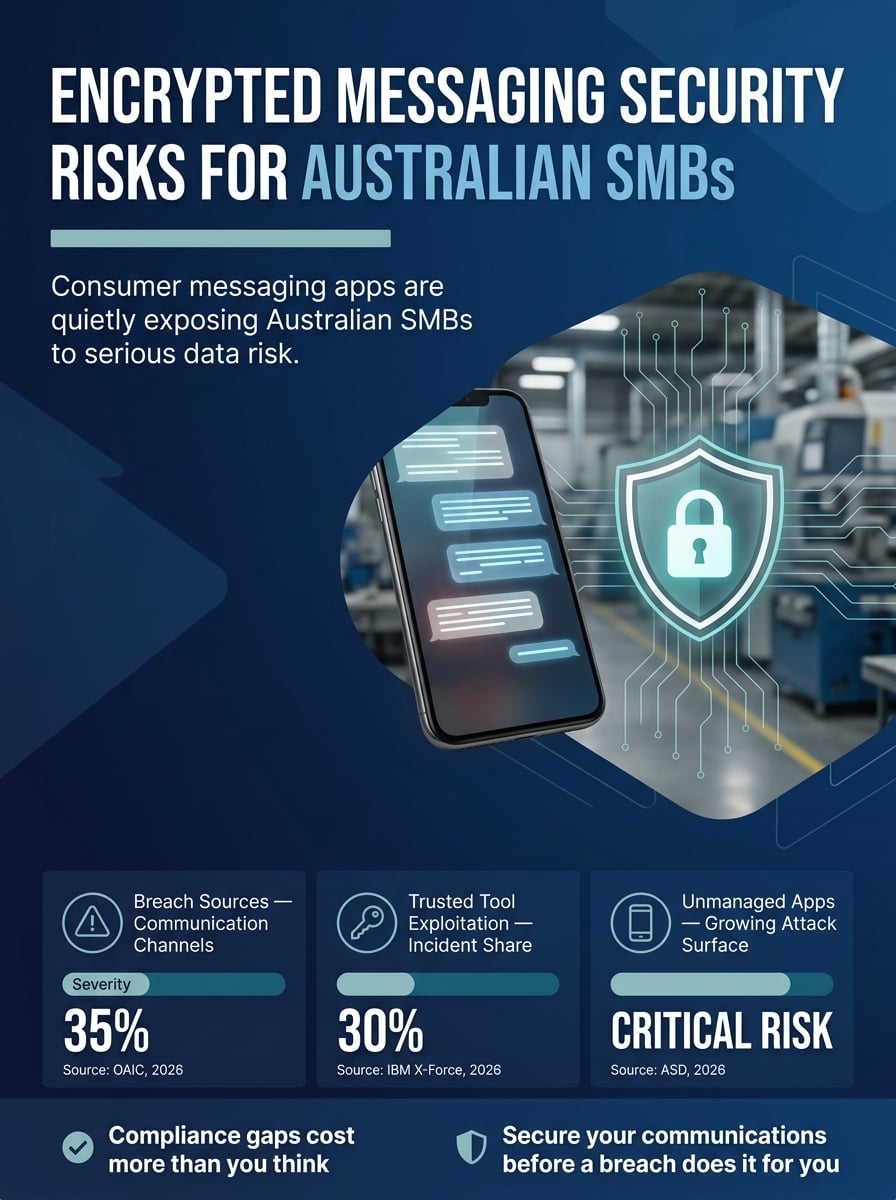
The Australian Signals Directorate, ASD Cyber Threat Report 2025-26 identified unmanaged and consumer-grade communication applications as a growing attack surface for adversaries targeting Australian organisations. This is not a theoretical risk. It is an observable trend in active threat campaigns targeting SMBs across Australia.
The core problem is visibility. Your IT team cannot monitor, audit, or enforce policies on a platform they do not control. Attachments shared via consumer apps bypass your endpoint security, your data loss prevention tools, and your logging infrastructure. From an attacker’s perspective, this invisibility is an invitation. For related risks around unmanaged endpoints, see our post on endpoint security SMB gaps.
2. Data Residency and Sovereignty Risks You Cannot Ignore
When an employee sends a message through a consumer platform, the data often travels through and is stored on servers located outside Australia. For businesses handling personal information, financial records, or health data, this creates an immediate data residency problem under Australian law.
Many popular messaging applications route traffic through infrastructure in the United States or Europe. The terms of service for these platforms rarely align with Australian privacy obligations. Most businesses using them for work communication have never reviewed where their data actually lives or who can access it under local legal frameworks in those jurisdictions.
This issue connects directly to cloud compliance obligations. Businesses that have invested in Australian-region Microsoft Azure or Microsoft 365 deployments can unknowingly undermine that sovereignty position the moment a staff member shares a sensitive document via an overseas-hosted consumer app. Our blog on cloud backup compliance mistakes covers related sovereignty pitfalls in detail.
3. How Unmanaged Messaging Channels Undermine Privacy Act Compliance
Australia’s Privacy Act 1988 requires organisations to take reasonable steps to protect personal information from misuse, interference, loss, and unauthorised access. Using unmanaged consumer messaging platforms for business communication is increasingly difficult to reconcile with that obligation.
The Office of the Australian Information Commissioner, Notifiable Data Breaches Report found that over 35% of data breaches reported in the first half of 2025-26 involved unauthorised disclosure through communication channels, including messaging platforms. That figure should prompt every SMB to reassess how personal information flows through their organisation.
Secure messaging compliance is not only about choosing the right tool. It requires documented policies, staff training, and technical controls that enforce those policies. Without all three elements, a business cannot demonstrate the “reasonable steps” standard that the Office of the Australian Information Commissioner (OAIC) expects. For a broader look at your Privacy Act obligations, read our guide on Privacy Act reforms for SMBs.
4. Shadow Messaging: When Employees Choose Convenience Over Security
Shadow messaging refers to the use of personal or unsanctioned communication tools for business purposes, outside the visibility of IT and management. It is one of the most pervasive unsecured communication threats facing SMBs in 2026, and it typically begins with a simple act of convenience.
A sales representative on the Central Coast adds a client to their personal WhatsApp. A project manager in Sydney creates an informal group chat to coordinate a deadline. These decisions feel harmless in the moment. Over time, they create sprawling, unmonitored communication networks carrying business-sensitive information completely outside your governance framework.
Shadow messaging is a form of shadow IT, and the risks compound when staff leave the organisation. There is no centralised offboarding process to revoke access to a personal chat group. Former employees may retain access to months of sensitive conversations, client details, or internal strategy discussions long after their employment has ended. For context on the broader insider risk dimension, see our post on insider threats warning signs.
5. Understanding the Encrypted Messaging Apps Security Risks Around Account Takeover
Account takeover is one of the most directly damaging encrypted messaging apps security risks for business users. When an attacker gains access to a messaging account, they inherit the trust that account has established with every contact in it. From there, social engineering, fraud, and data exfiltration become straightforward.
The IBM X-Force Threat Intelligence Index 2026 found that credential abuse and exploitation of trusted communication tools featured in 30% of all incidents tracked. Consumer messaging accounts are particularly vulnerable because they are typically secured by a phone number alone, with multi-factor authentication (MFA) either disabled or reliant on SMS, which is susceptible to SIM-swapping attacks.
Session hijacking presents a parallel threat. An attacker who gains access to an active session on a shared or unmanaged device can read historical conversations, send messages impersonating the legitimate user, and extract attached files. Business messaging security in Newcastle and across regional Australia depends on addressing these authentication weaknesses at the platform level. Our post on deepfake fraud detection for SMBs covers how attackers escalate from account access to more sophisticated impersonation.
6. Malware Delivery Through Messaging Platforms
Consumer messaging apps have become a preferred delivery channel for malware, precisely because recipients trust messages from known contacts. A compromised account in your supplier network can send a malicious file or link that bypasses your email security gateway entirely, landing directly in the hands of your staff.
Attachments received through consumer platforms are rarely scanned by enterprise security tools. Unlike email, where most SMBs have implemented at least basic filtering, files received via personal messaging apps typically go straight to a device’s local storage. From there, a single click can initiate a ransomware infection or establish a persistent backdoor. For context on managing these vectors, our guide on ransomware recovery for Australian SMBs is essential reading.
7. Lack of Audit Trails and Forensic Evidence
When a security incident or a legal dispute arises, businesses need to produce documented evidence of their communications. Consumer messaging platforms make this extremely difficult. Many default to automatic message deletion after a set period. Others store data on personal devices with no centralised backup accessible to the organisation.
Regulated industries face particular exposure here. A financial services firm in Newcastle or a healthcare provider on the Central Coast may face regulatory requirements to retain communications records for several years. Using consumer apps for those communications creates an automatic compliance breach, regardless of the content of the messages themselves.
8. Addressing Encrypted Messaging Apps Security Risks in Your Supply Chain
Supply chain communication is a growing vector for encrypted messaging apps security risks. When Australian SMBs communicate with suppliers, contractors, or partners through unmanaged consumer apps, they extend their attack surface beyond their own organisation and into third-party environments they cannot control or audit.
An attacker who compromises a supplier’s messaging account can use that trusted channel to initiate fraudulent payment requests, exfiltrate commercially sensitive information, or deploy malware. The target business has no technical control over the supplier’s messaging security posture. This is a direct manifestation of supply chain risk that extends well beyond traditional network boundaries. For more on supply chain cyber exposure, see our blog on supply chain cyber attacks in Australia.
9. Weak Device Controls Amplify Every Other Risk
Consumer messaging apps are most commonly installed on personal smartphones, which sit entirely outside an SMB’s mobile device management (MDM) controls. If that device is lost, stolen, or sold without a proper wipe, every business conversation on it becomes accessible to whoever holds the phone. Encrypted communication tools at the network layer cannot protect data that is stored unencrypted in a local app on an unmanaged device.
The risk is compounded on personal devices running outdated operating systems. Many employees delay software updates on personal phones, leaving known vulnerabilities unpatched for months. Our guide on patch management mistakes for SMBs explores how unpatched devices directly enable the exploitation of communication platforms.
How Adept IT Solutions Helps Secure Your Business Communications
Addressing these risks requires a structured, policy-driven approach that replaces consumer tools with enterprise-grade alternatives. Adept IT Solutions helps SMBs across Newcastle, the Hunter Region, the Central Coast, and Sydney deploy secure communication platforms including Microsoft Teams, which provides end-to-end encryption, compliance recording, data residency controls, and MFA enforcement within a managed environment.
Beyond platform selection, Adept IT delivers security awareness training to reduce shadow messaging behaviours, and governance frameworks that align communication policies with Privacy Act data handling requirements. Businesses seeking to meet the Australian Signals Directorate’s (ASD’s) Essential Eight framework will find that communication channel governance is an essential component of that alignment. The ISACA Journal on cybersecurity governance consistently reinforces that policy and technology must work together for effective risk reduction. Our post on security awareness training mistakes is a useful companion resource for teams beginning this journey.
“Encryption protects data in transit. It does not protect data on an unmanaged device, in an unmonitored app, operated by staff who have never received guidance on secure communication practices. For Australian SMBs, the gap between perceived security and actual security has never been wider.”

Conclusion
The encrypted messaging apps security risks outlined in this post are not edge cases. They represent the everyday reality of business communication in 2026, where convenience has consistently outpaced governance. Every one of the nine risks above is addressable with the right combination of technology, policy, and training. The question is whether your business has taken deliberate action to address them, or whether you are relying on the word “encrypted” to do all the security work that only a managed solution can actually deliver.
Australian SMBs across the Hunter Region, Central Coast, Newcastle, and Sydney face a threat environment that is evolving rapidly. The ASD’s guidance, combined with OAIC breach data, makes it clear that communication platforms are now a frontline concern. If your business is ready to move from consumer-grade tools to a secure, compliant, and fully managed communications environment, the team at Adept IT Solutions is ready to help you get there.
Frequently Asked Questions
Q: What are the most serious encrypted messaging apps security risks for Australian SMBs in 2026?
A: The most serious risks include account takeover through weak authentication, data residency breaches where messages are stored offshore, shadow messaging that bypasses governance controls, malware delivery through trusted contacts, and the absence of audit trails required for Privacy Act compliance. Each of these risks is amplified when consumer apps are used on personal, unmanaged devices without MDM oversight.
Q: Does end-to-end encryption make consumer messaging apps safe enough for business use?
A: No. End-to-end encryption protects data in transit between sender and recipient, but it does not address the risks of unmanaged devices, weak account authentication, offshore data storage, or the lack of compliance recording. Secure messaging compliance for business requires enterprise-grade platforms with centralised administration, policy enforcement, and documented controls that consumer apps simply do not offer.
Q: How does shadow messaging expose a business to Privacy Act liability?
A: When employees use personal messaging apps to share personal information about clients or colleagues, that data moves outside the organisation’s controlled environment. If a breach occurs through those channels, the business may be unable to demonstrate “reasonable steps” to protect the data, which is a core requirement under the Privacy Act 1988. The OAIC can investigate and, in serious cases, impose significant penalties. Implementing a sanctioned, managed messaging platform with clear Privacy Act data handling policies is essential.
Q: What encrypted communication tools should Australian SMBs use instead of consumer apps?
A: The most suitable options for SMBs seeking secure business messaging in Newcastle and across Australia are enterprise platforms such as Microsoft Teams, which provides end-to-end encryption, MFA enforcement, compliance recording, eDiscovery support, and Australian data residency options through Microsoft 365. These platforms can be configured and managed by an MSP to align with your specific compliance obligations, including the Essential Eight and Privacy Act requirements.
Get in touch with our team of IT experts today! You can contact us via phone at 1300 423 378 or email us at info@adept-it.com.au.

