
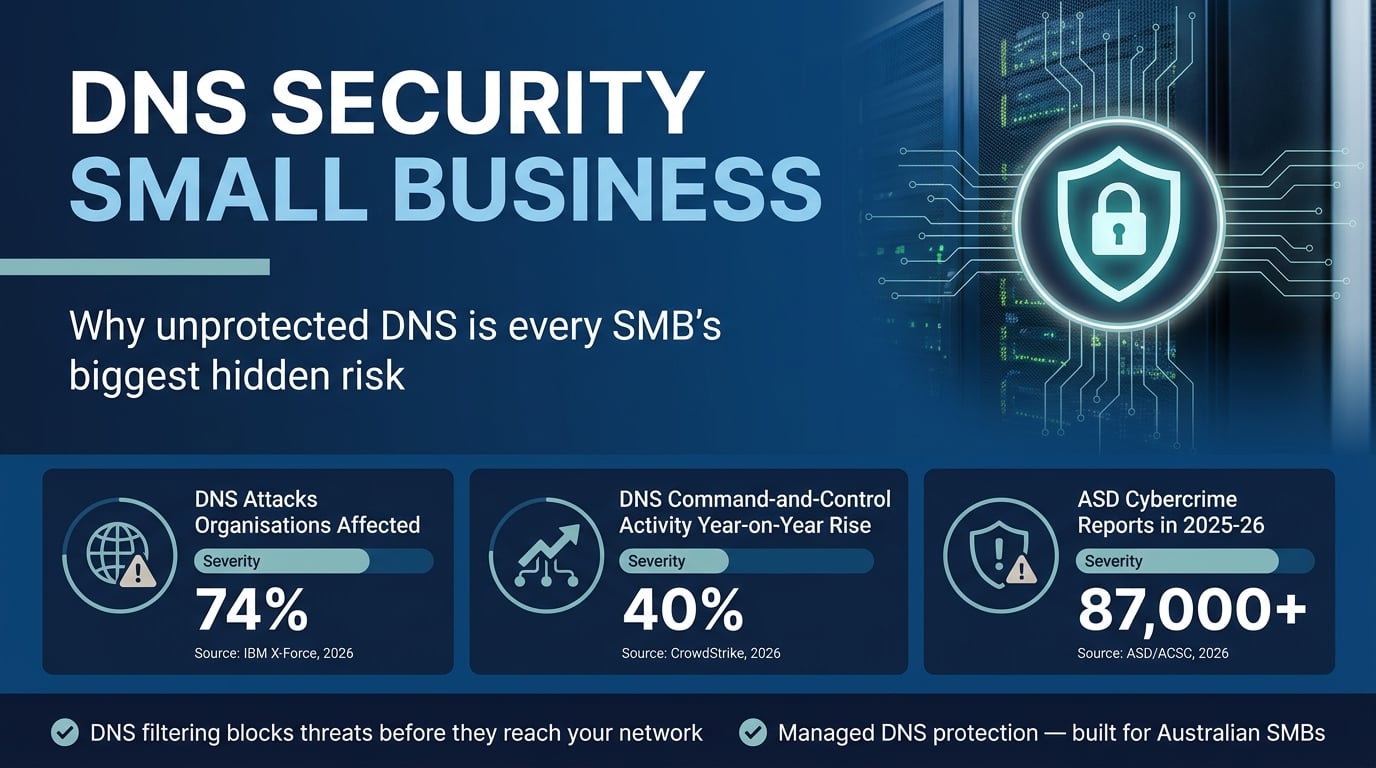
DNS security for small business is no longer a concern that can be deferred to larger organisations or treated as a secondary consideration. The Domain Name System (DNS) underpins every single internet connection your business makes, yet it remains one of the most underprotected layers in Australian small and medium business (SMB) networks. According to the IBM X-Force Threat Intelligence, 74% of organisations globally experienced a DNS attack in the past year, with average remediation costs exceeding AUD $1.1 million per incident. For businesses across Newcastle, the Hunter Region, the Central Coast, and Sydney, that figure should serve as an immediate wake-up call.

What Is DNS and Why Does It Make Such an Attractive Target?
DNS is the internet’s address book. When a staff member types a website address into their browser, DNS translates that human-readable name into a machine-readable IP address. This lookup happens in milliseconds, silently, and for every single connection your business makes, whether to cloud applications, email servers, or supplier portals.
Because DNS traffic is so routine and voluminous, threat actors have discovered it is an ideal channel for attacks that can go undetected for weeks or months. Many SMBs rely on default DNS settings provided by their internet service provider, with no filtering, logging, or anomaly detection in place. That default configuration is precisely what attackers are counting on.
The ASD/ACSC Annual Cyber Threat Report recorded over 87,000 cybercrime reports in 2025-26, with network-layer attacks including DNS exploitation among the fastest-growing categories. Australian SMBs are firmly in scope.
Threat 1: DNS Hijacking, When Your Traffic Is Silently Redirected
DNS hijacking occurs when an attacker modifies DNS records at the registrar, hosting provider, or router level to redirect legitimate traffic to a malicious destination. Your staff believe they are visiting your banking portal or cloud platform, but they are actually connecting to a convincing fake site controlled by the attacker.
This attack is particularly dangerous because it operates at infrastructure level. Standard endpoint antivirus tools offer no protection against a DNS hijacking attack, because the threat intercepts the connection before the browser renders any content. Credentials harvested this way are then used for account takeover, financial fraud, or ransomware deployment.
SMBs with unmonitored domain registrar accounts and default router configurations are especially vulnerable. Attackers require only basic credentials to alter DNS records, and many small businesses have not enabled multi-factor authentication (MFA) on their registrar accounts. You can explore related authentication risks in our post on privileged access management risks.
Threat 2: DNS Tunnelling, The Hidden Data Exfiltration Channel SMBs Miss
DNS tunnelling exploits the fact that DNS traffic is rarely blocked at the firewall. Attackers encode data inside DNS query and response packets to create a covert communication channel between a compromised internal machine and an external command-and-control server. This channel can be used to exfiltrate sensitive data or receive attacker instructions, all while appearing as routine DNS traffic.
The CrowdStrike Global Threat Report found that DNS-based command-and-control activity rose 40% year-on-year in the 2025-26 threat period. For SMBs without DNS query logging or behavioural analytics, this activity is virtually invisible. A compromised workstation can quietly transmit customer records, financial data, or intellectual property for weeks before any alarm is raised.
DNS tunnelling is also a technique used by malware that has already breached endpoint defences. If your organisation has gaps in endpoint protection, the risk compounds significantly. Our overview of endpoint security gaps for Australian SMBs covers complementary controls worth reviewing alongside DNS defences.
Threat 3: DNS Cache Poisoning, How It Sends Your Staff to Fake Sites
DNS cache poisoning (also known as DNS spoofing) involves injecting fraudulent DNS records into the cache of a resolver. Once poisoned, the resolver serves the attacker’s fabricated IP address to every device that queries it. Staff are redirected to malicious sites without any indication that something is wrong. The browser address bar may show the correct URL, adding to the deception.
This attack does not require attackers to compromise individual devices. By targeting a shared resolver, a single successful poisoning event can affect an entire office network simultaneously. Businesses in the Hunter Region and Central Coast that rely on shared ISP resolvers without DNS Security Extensions (DNSSEC) validation are particularly exposed to this class of threat.
Cache poisoning is frequently used as a precursor to phishing campaigns or credential theft at scale. When your team believes they are on a legitimate banking or payroll platform, they will enter credentials without hesitation. The downstream consequences for Privacy Act compliance obligations can be severe if customer data is subsequently accessed.
Threat 4: DNS-Based DDoS Attacks on Small Business Networks
Distributed Denial-of-Service (DDoS) attacks leveraging DNS amplification are a growing problem for smaller networks. In a DNS amplification attack, attackers send small queries with a spoofed source IP address (your network’s address) to open DNS resolvers. The resolvers respond with much larger packets directed at your IP, overwhelming your internet connection and rendering services unavailable.
Amplification factors of 50x or more are achievable using certain DNS record types. A small business with a modest internet connection can be completely knocked offline with relatively little attacker effort or cost. For customer-facing businesses, even a short outage translates directly to lost revenue and reputational damage.
DDoS-related DNS threats also intersect with broader network infrastructure vulnerabilities. If your organisation operates across multiple locations, the risk profile is amplified further. Our analysis of multi-site network security risks for Australian SMBs addresses the related infrastructure considerations in detail.
Threat 5: DNS-Based Phishing and Lookalike Domain Attacks
Attackers register domain names that closely resemble legitimate brands, suppliers, or government agencies. These lookalike domains exploit minor typographical differences (such as substituting a numeral for a letter) and are often underpinned by valid SSL certificates, giving them an appearance of legitimacy. Without a DNS filtering solution, your staff have no automated protection against connecting to these sites.
The Australian Cyber Security Centre has consistently highlighted lookalike domain abuse as a primary enabler of business email compromise and invoice fraud. The attack does not require any technical exploit. It succeeds purely through social engineering, and DNS-layer filtering is one of the few controls capable of blocking the connection before a browser even loads the page.
These campaigns are increasingly personalised and targeted. Businesses with suppliers in the Newcastle or Sydney metropolitan area have reported receiving fraudulent invoice emails that originate from near-perfect lookalike domains. Complementary awareness training is also essential. Our post on security awareness training mistakes outlines how to build a human layer of defence alongside technical controls.
Threat 6: DNS Reconnaissance, The Attacker’s First Step Before a Breach
DNS reconnaissance is the intelligence-gathering phase that precedes most sophisticated attacks. By querying publicly available DNS records, attackers can map your mail servers, identify subdomains, enumerate services, and pinpoint potential entry points into your network. This reconnaissance is largely passive, legal in itself, and leaves no trace on your systems.
The information gathered during DNS reconnaissance directly informs subsequent attack stages, including spear phishing, credential stuffing, and targeted exploitation of exposed services. The NIST Cybersecurity Framework specifically identifies asset discovery and exposure management as foundational controls that reduce an organisation’s attackable surface at the DNS layer.
SMBs that have not audited their DNS zone configurations or removed legacy DNS records are unintentionally advertising their internal architecture to anyone who queries it. Addressing this alongside broader vulnerability management is critical. Our post covering vulnerability management blind spots for SMBs provides a useful starting framework.
Why DNS Security for Small Business Requires a Managed Filtering Solution
Addressing these six threats individually through manual configuration is impractical for most SMBs. A purpose-built DNS filtering solution automates protection at the network layer, blocking malicious domains before a connection is ever established. It also provides logging, reporting, and anomaly detection that give your IT provider visibility into threats that would otherwise be completely silent.
An effective managed DNS security provider will deliver DNSSEC validation to prevent cache poisoning, category-based filtering to block known malicious and suspicious domains, query logging for forensic investigation, and real-time threat intelligence feeds that keep protection current as the threat landscape evolves. These capabilities are typically included within a managed security service rather than requiring separate procurement.
DNS filtering also aligns with the Australian Signals Directorate’s (ASD) Essential Eight maturity framework, particularly the controls around restricting internet access and protecting against malicious macros and scripts that phone home via DNS. Achieving Essential Eight Maturity Level 2 and above specifically benefits from DNS-layer enforcement as a complementary control.
For businesses that have recently adopted cloud platforms or expanded remote work capabilities, DNS protection extends across both on-premise and remote endpoints. Our guidance on secure remote access mistakes explains how DNS filtering integrates with remote workforce security architecture.
“DNS security is not a luxury add-on. It is the foundational network control that every Australian SMB should have in place before evaluating any other security investment. You cannot protect what you cannot see, and without DNS visibility, you are effectively operating blind at the network layer.”

Strengthen Your DNS Security with ACSC Threat Protection Principles
DNS security for small business is most effective when it is embedded within a broader, layered security posture rather than deployed as a standalone tool. Effective protection combines DNS filtering with patch management, endpoint security, and user awareness training to create overlapping defences that compensate for the gaps in any single control.
Businesses in Newcastle, the Hunter Region, the Central Coast, and Sydney that engage a managed security provider gain access to continuous DNS monitoring, threat intelligence integration, and expert incident response. These capabilities close the operational gap between what SMBs can realistically maintain in-house and the level of protection that the current threat environment demands.
If your organisation has experienced unusual network behaviour, unexplained redirections, or staff receiving credential prompts from unfamiliar pages, DNS-layer compromise is a strong candidate cause. Prompt investigation and DNS filtering deployment can contain the damage significantly. Reviewing your ransomware recovery preparedness in parallel is also advisable, given how frequently DNS threats precede ransomware deployment.
To learn more about how Adept IT Solutions can implement and manage DNS security filtering for your business, contact our team today for a no-obligation assessment tailored to your environment.
Frequently Asked Questions
Q: What does a DNS filtering solution actually block?
A: A DNS filtering solution intercepts and evaluates every DNS query made by devices on your network before a connection is established. It blocks requests to known malicious domains, lookalike phishing sites, command-and-control infrastructure, and categories of content defined by your organisation’s policy. This means staff cannot inadvertently connect to harmful sites, even if they click a convincing phishing link, because the connection is stopped at the DNS layer before the browser loads anything.
Q: Is DNS security for small business necessary if we already have antivirus and a firewall?
A: Yes, absolutely. Antivirus and firewalls operate at different layers and leave DNS traffic largely unexamined. Many DNS attacks, including tunnelling, hijacking, and cache poisoning, bypass both controls entirely because they exploit the DNS protocol itself rather than files or network ports. DNS security adds a critical layer that these tools simply do not cover, and the Australian Cyber Security Centre recommends DNS filtering as a complementary control within a layered defence strategy.
Q: How quickly can a managed DNS security provider deploy protection for our business?
A: In most cases, a managed DNS security provider can deploy foundational DNS filtering within hours, not weeks. For cloud-delivered DNS filtering solutions, the change involves redirecting your resolver configuration to the provider’s protected service. Policy refinement, reporting setup, and integration with your existing security stack typically follow over subsequent days. For Newcastle, Hunter Region, Central Coast, and Sydney businesses, Adept IT Solutions can assess your current DNS configuration and have protection active rapidly as part of a managed security engagement.
Q: Does DNS security for small business help with ACSC threat protection and Essential Eight compliance?
A: Yes. DNS filtering directly supports several Essential Eight controls, particularly those relating to restricting access to malicious content, preventing malware execution, and limiting the ability of compromised systems to communicate with attacker infrastructure. ACSC threat protection guidance specifically references DNS-layer controls as part of a mature security posture. Implementing DNS filtering contributes to Essential Eight Maturity Level 2 compliance and supports the broader network security controls assessed during ISO 27001 audits.
Get in touch with our team of IT experts today! You can contact us via phone at 1300 423 378 or email us at info@adept-it.com.au.

